The world is changing tremendously. Every day there is some technology, application and device introduced for users to explore. In such a situation, businesses are under constant pressure to build applications quickly, reduce costs and stay competitive. Also, it makes choosing the right kind of development more important than ever. Whether you’re a startup launching a new product or an enterprise modernizing your systems, choosing between low-code development or traditional development may seem like a task. This is because both Low-Code and Traditional Development have their own strengths and limitations. But worry not! Here, we’ve simplified the key differences to help you make a confident and informed decision. So, without any further ado, let’s get started…
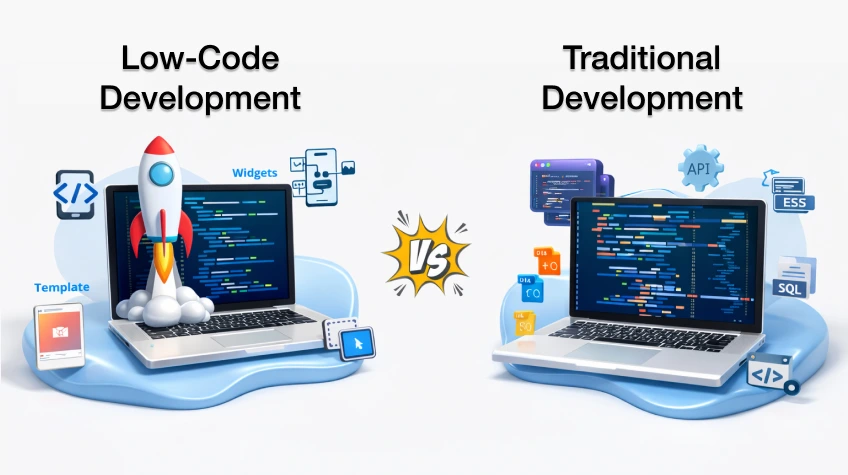
Low-code development refers to an advanced approach in which applications are built using visual tools, drag-and-drop interfaces and pre-built components. It eliminates writing long lines of code and in turn saves a lot of time for developers. The best thing about low-code development is that even people with limited coding knowledge can create functional apps quickly. Developers are still involved, but most of the work is handled by ready-made modules. In a nutshell, low-code development allows developers to build applications faster and with minimal manual effort.
What is Traditional Development?
Image Source Manetor
Traditional development, also known as custom or high-code development, refers to building software from scratch using programming languages. Developers need to have knowledge of programming languages such as Java, Python, C++ and so on. Traditional development allows developers to have full control over the development process, from design to functionality. But the thing is these are time-consuming processes and require both expertise and significant resources for great results. Overall, it is the classic way of building software and is still widely used for complex and large-scale systems.
Low-Code vs. Traditional Development: Key Differences
Here are the key differences between Low-Code and Traditional Development; take a look….
Speed: Low-code helps in faster software development as they come with pre-built components. Whereas, traditional development takes more time because it involves writing lengthy codes.
Customization: Low-code development offers very limited customization options as most of the components are pre-built. Traditional development, on the contrary, offers full flexibility and complete freedom to developers to customize the app according to client’s needs.
Skill Requirement: Low-code development needs minimal coding knowledge, whereas, traditional development requires skilled developers to create a customized product.
Control: Low-code development is done within platform constraints. This means that developers have less control over different aspects of the development. But that’s not the case with traditional development, it provides developers with complete control over each aspect, from design to functionality.
Cost: Low-code development is more cost-effective than traditional development. This is because traditional development requires higher investment depending on the customization.
Benefits of Low-Code Development
Image Source tipsonsbrokingcom
Low-code platforms have gained immense popularity in the past few years, because:
1. They Offer Faster Development: Low-code significantly reduces development time as it uses ready-made components and automation.
2. Help Release Apps Quickly: With low-code development businesses can launch applications much faster compared to traditional coding.
3. They Are Cost-Effective: Low-code helps reduce overall development costs because it requires fewer developers and less time.
4. They Are Easy to Use: Low-code platforms are very easy to use. Even non-developers can create basic apps using intuitive interfaces.
5. They Help with Faster Updates and Maintenance: More often than not, low-code platforms are efficient enough to handle updates and maintenance automatically. This saves a lot of time and effort for developers.
Limitations of Low-Code Development
Despite its advantages, low-code offers some limitations as well, which include:
1. Limited Customization: You cannot have full control over each aspect of the development because of the platform’s capabilities.
2. Does Not Support Complex Feature: Low-code platforms do not always support complex features.
3. Performance Concerns:Low-code apps may not perform as efficiently as fully custom-built applications.
4. Vendor Lock-In: Switching platforms is not easy with low-code development.
5. Integration Challenges:Connecting with complex or legacy systems may become difficult at times.
Best Use Cases for Low-Code Development
Low-code development is considered ideal for simple applications, such as:
Basic Applications
Internal Business Tools
Dashboards
Reporting Systems
Basic Websites
Workflow Automation
Benefits of Traditional Development
Here are some of the best benefits of traditional development; take a look…
1. Full Control: Traditional development allows developers to have full control over each aspect of the development. This includes everything, from designing to functionality and updates.
2. Greater Flexibility:Traditional development allows developers to have complete flexibility. Developers can build exactly what they want without any limitation. This makes this approach ideal for complex systems.
3. Improved Performance: Tools created using traditional development methods perform better in every scenario. This is because these applications are optimized for specific needs, which ultimately leads to improved performance.
4. High Scalability: Software made using traditional development is highly scalable. They are designed to grow and adapt as your business expands.
5. Strong Security and Compliance: Customized applications are designed to be secure. They meet strict security and regulatory requirements.
Limitations of Traditional Development
Of course, traditional development offers numerous advantages, but it does have some challenges, such as:
1. Time-Consuming:Building software from scratch takes a lot of time and effort, which affects the launch of the final product.
2. Higher Costs:Traditional development depends highly on skillsets of developers and resources, which make it an expensive endeavour.
3. Heavy Dependency on Experts: Developing a customized tool requires experienced developers with strong technical skills.
4. Difficulty Finding the Right Expert:As you know custom development requires highly skilled developers. Finding the right expert is not an easy task for organizations.
5. Slower Updates and Maintenance:Updating features or fixing bugs can take a lot of time due to complex code structures. This makes it harder for developers to respond quickly to market needs.
Best Use Cases for Traditional Development
Here are some of the best use cases for traditional software development; take a look…
Low-Code Vs. Traditional Development: Which One Should You Choose?
Image Source outsourcing software dey
Choose low-code development if you want to:
Launch the product quickly
Design a simple or moderately complex application
Create a tool with limited technical resources
Automate internal processes
Have quick prototypes or MVPs
Choose traditional development if you want to:
Develop a complex or large-scale application
Have full customization
Incorporate critical performance and scalability
Implement strict security or compliance requirements
Have complete ownership of your code
Top 5 Steps to Choose the Right Development for Your Business
Choosing the right approach very much depends on your business goals, resources and long-term vision. Still, here are some considerations to take into account. Take a look…
1. Consider complexity of your project
If the project is simple, then opt for low-code development, while if it is complex, then traditional development is the best choice.
2. Consider your budget
If the budget is limited, then low-code development is the best bet. While, in the case of a flexible budget, traditional development is the best option.
3. Consider the timing
Again, time matters! If you wish to launch the app quickly, then low-code platforms make the best choice. In the case of a flexible timeline, traditional development is the best option.
4. Consider the customization level
For basic customization needs, a low-code approach is best, and advanced customization chooses only traditional development.
5. Consider your long-term goals
If you are looking for a short-term solution, then opt for low-code development. However, if you want a scalable product, then traditional development is the best bet.
Time for the most important question – Can Both the Approaches Be Used Together?
Yes, you can use both low-code and traditional development together. When these two are used together, it becomes a ‘Hybrid Model.’ Many businesses today prefer using hybrid models to ensure quick launch. They use low-code platforms for quick solutions and internal tools and write code for core systems and advanced features. Using low-code cut time spent on repetitive tasks, which developers can use to create outstanding user experience. Also, together they speed up the process and ensure quick launch.
The Bottom Line
So, this is all about low-code vs. traditional development. Hopefully, this article has been informative for you and helped you choose the best approach. Know that choosing the right approach very much depends on your long-term goals, budget, availability of resources and complexity of the product. Both the approaches come with their own pluses and minuses. Low-code is popular for speed, simplicity and cost savings, while traditional development is good when you want more flexibility, control and scalability. Choose the one that fits your goals and needs perfectly. Ultimately, the right choice is the one that aligns with your business goals, resources, and vision for the future.