With generative AI rapidly progressing from the experimental stage to integral parts of the business infrastructure, one of the most important architectural and engineering questions facing company leadership is how to leverage the immense power of Large Language Models (LLMs) to access your proprietary business data?
Foundation models like GPT-4, Claude, or Llama are impressively eloquent, yet ignorant of your documents, customer histories, inventory data, and peculiarities of your domain. There are two primary ways how you can address this limitation: Retrieval-Augmented Generation (RAG) and Fine-Tuning.
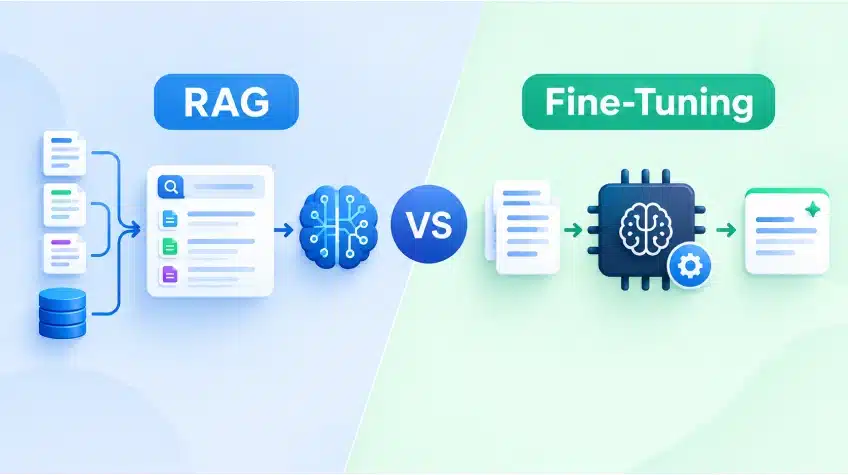
Both methods improve the LLMs’ capabilities in respect of business-relevant tasks, however, they have completely different mechanisms of doing so. RAG gives the model an “open-book” way to access your data while fine-tuning gives it “memorized” knowledge and behavioral patterns by re-training its internal weights.
Choosing the wrong method to integrate your business data with the language model may cost you an excessive spend on cloud services, obsolete results, breaches of the regulation, or fragile architecture. In this guide, we’ll explain how RAG and Fine-Tuning work, analyze their major differences, and help you choose the right approach for your case.
Why Enterprise AI Models Need More Than General-Purpose LLMs
General-purpose LLMs are trained on massive public datasets including internet text, books, coding, and encyclopedic information. Such extensive exposure makes them very good at general reasoning, language translation, and understanding diverse topics. Nevertheless, when used within an organization, off-the-shelf LLMs soon encounter three important limitations:
Limited Knowledge and Static Memory: The foundation model stops learning after training and doesn’t know about any events, policy changes, or other developments that happened after the end of its training process.
Absence of Proprietary Context: A foundation LLM doesn’t know anything about your company’s internal documentation, customer tickets, HR guidelines, or standard operating procedures (SOP).
Hallucination Risk: If asked to provide answers on some particular topic which wasn’t available during the training process, a general-purpose LLM is likely to come up with some made-up answer which will be quite reasonable but completely wrong.
To deliver enterprise value, AI apps need to combine LLM’s language capabilities with proprietary information. RAG and Fine-Tuning solve this problem, but using different approaches.
RAG vs Fine-Tuning: Key Differences
To select the right architecture, technical teams must understand how RAG and Fine-Tuning compare across foundational performance indicators.
➣ Knowledge Freshness & Updates
RAG: Works like an “open-book” test. After receiving input from the user, the system makes queries to external knowledge sources (vector databases or SQL storages), finds relevant snippets and adds them to the context window for further analysis by the model. Knowledge updates are carried out through adding, deleting, and changing records in your database. The update process occurs instantly, and there is no need for re-training.
Fine-Tuning: Works like a “closed-book” test where knowledge is memorized in the model. The knowledge is memorized through embedding knowledge into the weights of the neural network via supervised learning. Knowledge updates require re-training of the whole training pipeline with the new pairs of data, resulting in the latency in the Data Creation → Model Awareness Cycle.
➣ Domain-Specific Behavior
RAG: Excellent at providing the contextual information but poor at altering the tone and syntax of the LLM’s response. Uses system instructions and retrieved context to drive the output of the model.
Fine-Tuning: Excellent at changing the behavior of the model. In case your company needs answers to be in an obscure JSON format, medical lingo, legalese, or a unique brand voice, fine-tuning changes the basic generative behavior of the model to achieve just that.
➣ Cost & Infrastructure
RAG: Costs are front-loaded in the form of runtime infrastructure. This involves running vector databases, embedding pipeline, semantic chunking methods, and orchestrator (such as LangChain or LlamaIndex). Also, as retrieved documents add to prompt size (tokens), inference cost per query is also greater.
Fine-Tuning: Costs are front-loaded during training computation and dataset processing. Cleaning, formatting, and validation of thousands of good quality instruction-response pairs require a lot of engineering effort. However, once fine-tuned, inference cost may be lower since fewer context tokens will be needed in prompts.
➣ Accuracy & Reliability
RAG: Reduces hallucination because the model needs to anchor its response in relation to the snippets present in the context. Furthermore, it is easy for RAG models to trace back to their sources through the retrieved document ID.
Fine-Tuning: No formatting mistakes, but susceptible to factual hallucinations. This is because facts are softly encoded into parameter weights and not explicitly stated in the document, therefore, fine-tuned models cannot automatically give references to sources.
➣ Governance and Data Control
RAG: Easier data access control and compliance. Security of data can be implemented at the retrieval layer ensuring that the user has access to the document he/she retrieves (e.g., role-based access control or RBAC). If some data has to be deleted due to GDPR, then simply deleting the record from the index is enough.
Fine-Tuning: Harder data governance. The moment personal data becomes a part of model parameters, it is difficult to delete any data point other than deleting the entire model. Role-based access control cannot be easily implemented.
When RAG Is the Right Choice
Retrieval-Augmented Generation has become the default architecture for modern enterprise knowledge systems because of its flexibility, ease of implementation, and auditability.
➺ Frequently Changing Information
For any data that refreshes on a daily, hourly, or even live basis, then RAG is clearly the way to go. Some examples are as follows:
E-commerce product catalogues and price engines.
Financial news aggregators and live stock market analysis systems.
Internal wikis, customer support FAQs and manuals that need frequent policy revisions.
➺ Enterprise Knowledge Search
While designing an AI assistant that would help people search information across multiple corporate drives, Slack channels, Notion spaces, or even Jira boards, then RAG is the way to go. You can perform a semantic search across millions of documents without having to worry about retraining the model every time some member uploads a new PDF.
➺ Factual Question-Answering
In highly regulated industries such as healthcare, law, or banking, providing accurate responses backed up by references is compulsory. In those cases, RAG makes it possible to build architectures that demand strict grounding: “Answer the question using ONLY the text snippets below. If the answer is not contained in the text, say ‘I do not know.'”
When Fine-Tuning Is the Right Choice
While RAG provides context, fine-tuning instills skill, tone, and structural adherence. It adapts a foundation model to behave like a domain specialist.
➩ Specialized Outputs & Behavior
In case your downstream applications need outputs in structured and complicated formats where standard LLMs will not perform well, such as customized code, specific SQL language, and complicated JSON schemas, fine-tuning makes the model output these types without prompt engineering efforts.
➩ Consistent Task Performance
In case an AI task is required to perform with some specific style or language, then fine-tuning is your best choice. Examples where fine tuning can come in handy are listed below:
Changing a customer service agent’s style to suit company needs (e.g., empathic, to the point, or very formal).
Summarizing medical records using structured clinical language.
Transforming a complicated input to classification tags.
➩ Domain-Specific Workflows
Certain industries use languages and terminology so specialized that off-the-shelf models struggle to parse them effectively. Fine-tuning on domain-specific corpora (e.g., genomic research papers, niche engineering specifications, or localized legal frameworks) helps the model internalize specialized vocabulary and nuanced relationships.
When to Combine RAG and Fine-Tuning
Fine-Tuning and RAG are not mutually exclusive. Rather, sophisticated enterprise architectures often employ both methods in a hybrid approach to get the best out of their models.
In the hybrid approach:
Fine-Tuning trains the model to think, develop a certain style, learn custom language or format.
RAG provides the model with accurate factual information at runtime.
⇨ Example Scenario: Financial Risk Analysis
Suppose that an enterprise builds an automated platform for financial risk analysis:
The Fine-Tuned Model: A smaller, open-weights model (such as Llama 3 8B) is fine-tuned on thousands of historical risk reports authored by senior financial analysts. This enables the model to learn risk report structure, risk rating language used by the company and outputting structured tables.
The RAG pipeline: At runtime, the platform uses RAG to retrieve today’s quarterly earnings statements, market news feeds and live stock filings from the vector database.
By marrying the two, the system leverages fine-tuning for style, format, and reasoning efficiency, and RAG for factual accuracy, freshness, and citation tracing.
How to Choose Between RAG and Fine-Tuning
To simplify your decision-making process, evaluate your project against this quick matrix:
Consideration
Choose RAG If…
Choose Fine-Tuning If…
Primary Goal
You need to provide accurate, up-to-date facts and documents.
You need to customize tone, style, output format, or syntax.
Data Dynamics
Data updates continuously (daily, hourly, or live).
Data and operational style remain relatively static over time.
Traceability
You must cite sources and provide verifiable document links.
Source attribution is not required for the end user.
Hallucination Risk
Zero-tolerance for invented facts; strict grounding required.
Format adherence matters more than factual retrieval accuracy.
Data Privacy / Access
You need document-level permissioning (RBAC) and instant data deletion.
All model users have identical access rights to the training set.
Resource Budget
You have database/engineering infrastructure to maintain search pipelines.
You have labeled training data and compute budgets for fine-tuning runs.
⇨ Rule of Thumb Checklist:
First comes RAG: When it comes to Enterprise knowledge management and customer support use cases, RAG will offer faster time-to-market, reduced costs, and simpler maintenance 80 percent of the time.
Then there is fine-tuning: When your RAG flow has problems with formatting of the responses, needs a longer prompt for the system, or needs a smaller and faster model running on-edge, fine-tune it.
And lastly, you can combine the two: To develop enterprise-level AI solutions that will excel at processing data in specific industries, you will need to fine-tune a model first, and then use RAG.
Conclusion
Selecting either Retrieval Augmentation Generation (RAG) or Fine-Tuning does not involve deciding which approach is “better” among these two; rather, it is about aligning your tech stack with attributes of your company’s own data.
RAG allows you to provide your AI system with a flexible memory bank that can process ever-changing enterprise data safely and openly. With Fine-Tuning, you shape the abilities of your AI with specific domain knowledge, formatting practices, and the company’s unique voice.
Based on your needs for timely updates, accuracy, consistency, and sustainability of the results, you will be able to create your reliable AI strategy from your proprietary data.