Learn everything about the different types of e-commerce business models and how each of these have its own unique objectives. Find all the relevant details right here.
When you want to start a business that will last, the first thing you need to do is pick the right e-commerce venture. This is because the e-commerce model you choose will show you how customers and sellers work together, and how goods are handled. How money is made. For example, running a peer-to-peer marketplace is very different from operating a B2B platform or selling directly to customers through an online store.
Each of these structures will affect how you price products, market them, manage your stock, and plan for the term, so it is actually very important to learn about them. The global Business-to-business e-commerce market is expected to grow to $47.54 trillion by 2030, which is a massive increase from $19.34 trillion recorded in 2024, according to Research and Markets. This metric single-handedly shows how important it is to choose the correct model to scale your business in recent times.
This guide will help you decide which of the models is best for your company by explaining them with examples and revenue flows.
What Is an E-commerce Model?
Image Source dzeeapp
An e-commerce model is like a business plan for how a company decides to sell things. It shows who the customers and sellers are, how the transaction process works, and how the business makes money.
At its simplest, it answers these questions:
Who is selling and who is buying?
How do products or services move from seller to buyer?
How does the business earn revenue from these transactions?
This is an important idea because different e-commerce models require different strategies. Where a wholesale platform focuses on orders and long-term connections, a D2C business has short sales cycles and depends on brand involvement.
Why business model selection matters
E-commerce business models are necessary for both established businesses.
Here are some benefits of choosing the e-commerce model.
Guide Strategic Decisions: For all sorts of businesses, a clear operational model is essential for making decisions and using resources wisely.
Drive Growth and Adaptation: For companies, the business model helps them to succeed by giving them a way to understand customer needs and find new opportunities at the same time.
Align and Motivate Teams: A defined model helps employees understand what they are working towards and gives them a sense of purpose while reducing fatigue and uncertainty.
Attract Investment: It helps attract investors by showing them a path to growth and profitability.
Ensure Long-term Competitiveness: To stay relevant, businesses must be willing to update their model and adapt to market shifts which allows them to seize opportunities.
With this in mind, we can now look at the types of e-commerce models and what they are designed to achieve.
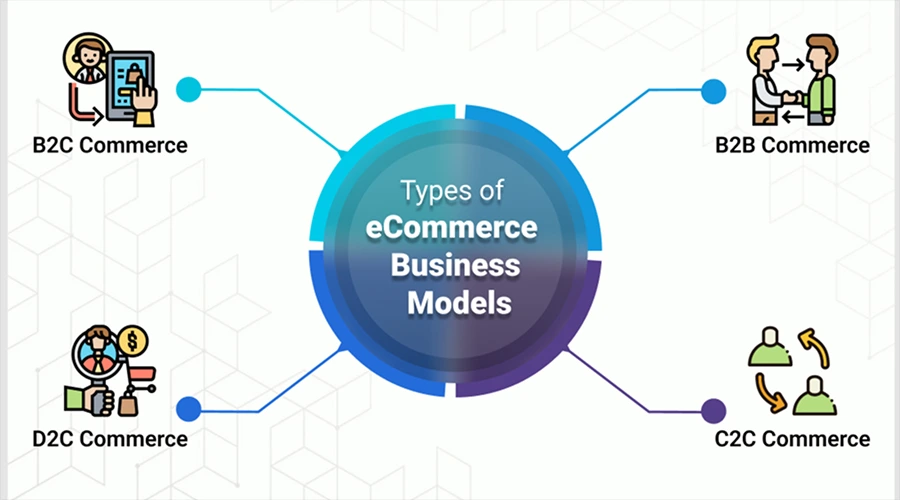
Types Of E-commerce Business Models
Image Source Envision e Commerce
Almost all businesses across any sector can be put into four groups when it comes to e-commerce, and every kind of e-commerce model is unique. By learning and understanding these various e-commerce models, you can pick the right business model that’s the best fit for your product, the people you want to sell to, and the resources you have.
➢ Business to Consumer (B2C)
This is the model when businesses sell things directly to customers online. They usually take care of everything from making the products to delivering them. For example, a store like H&M sells clothes to customers on its website and inside physical stores. On the other hand, Amazon sells things like gadgets and books directly to people who buy them.
➢ Business-To-Business (B2B)
Business-To-Business e-commerce models are when companies sell their products or services to other businesses, not to individual customers. These sales usually take longer to complete and involve orders. For instance, Grainger supplies equipment and products to companies. Business-To-Business sales often have features, like special prices for different company clients or options for big orders.
➢ Consumer-to-Consumer (C2C)
Consumer-to-Consumer e-commerce models are when customers sell to each other through platforms like marketplaces or resale apps. The platform takes care of payments, reviews, and resolving problems. As a seller, you rely on the platform to get your products seen. It is a way to start selling. You have less control over the whole experience of buying something.
➢ Consumer-to-Business (C2B)
Consumer-to-Business e-commerce models are the opposite. As an individual, you provide value to businesses by selling insights, doing influencer marketing, or freelancing. You have influence in this e-commerce model. It requires strategic placement on platforms where businesses are looking for services.
How to Choose The Right E-commerce Model for Your Business
Image Source Envent Digital Technologies
To choose the model for your business, focus on three main things.
1. Market Analysis
Who are you trying to reach?
How crowded is the market for your Consumer-to-Consumer e-commerce model or your Consumer-to-Business e-commerce model? Where can you stand out from the rest?
Are customers looking for products, long-term contracts, or speed and variety in your B2C e-commerce model
2. Capital
Do you have money set aside for marketing, storage, and inventory?
If you have money, you might have to use e-commerce models like dropshipping or marketplace selling for your C-to-C e-commerce model or your Consumer-to-Business e-commerce model.
If you have money, you have the freedom to build your own platform and brand for your e-commerce model.
3. Logistics Needs
Do your customers need additional fulfillment, or can you handle high-volume consumer deliveries?
Do you have automated systems in place to keep track of inventory, shipping, and returns across all channels and reduce human error?
Next Steps
Choosing the e-commerce model is not just about following the current trends; it is also about matching your market, budget, and logistics to your goals and resources. Whether you choose B2C, B2B, C2C, or C2B is crucial for your growth and sustenance.
Decide if you should start using marketplaces or invest in your own platform based on your budget.
Figure out which e-commerce models your business can actually support by studying your logistics capabilities.
Consider different strategies if you want to reach audiences across several sectors or diversify your income streams.
With the correct foundation and tools, you will be able to choose the best e-commerce model for now and be ready to adapt to new opportunities in the future.
Frequently Asked Questions
1. What is an e-commerce business model?
An e-commerce businessmodel defines how online transactions happen, such as how revenue is generated for companies, and who the buyer and seller are.
2. What are the main types of e-commerce models?
B2C (Business-to-Consumer)
B2B (Business-to-Business)
C2C (Consumer-to-Consumer)
C2B (Consumer-to-Business)
3. How do I choose the e-commerce model for my business?
You should focus on three things:
Your target market
Capital
Logistic capacity
These can help you decide which model is the best fit for your business.
4. What is the difference between e-business models and e-commerce models?
An e-business model includes all activities within a business, while an e-commerce model only includes online buying and selling, or, in other words, transactions.
5. Can a company use more than one e-commerce model?
Yes, hybrid models are very common. For example, a D2C brand might sell both on its website and through a marketplace.
6. Which e-commerce model is most profitable in 2026?
Your profitability will depend on your specialization. B2b and hybrid models often produce larger margins and stability.