Hiring a professional product development company helps businesses turn ideas into market-ready products through structured processes, like analysis, conceptualization, prototyping and evaluation. Professional product developers have multidisciplinary teams, proven workflows and industry expertise. Businesses can reduce risk, accelerate project timelines and maintain high product quality.
Most companies that make products will eventually need to decide whether to work with a product development companyor seek other forms of outside help. Some projects need expertise that the company doesn’t have. Others need people during busy times. Sometimes a company just needs someone who hasn’t been stuck on the problem for months.
There are two options: full-service design firms and freelance industrial designers. They work in ways that cost different amounts and fit different situations. Understanding the difference between them helps when deciding which one to choose.
The Work Itself
Image Source Punchlist
Product development follows a pattern no matter who is doing it. First, a company needs to figure out what problem it is actually trying to solve. This means talking to users, looking at what else is out there and being realistic about what can be built and how much it might cost. Skipping this step can lead to products.
Then, a company generates ideas. Lots of them. Some will be practical, some will be weird. Some will seem completely impossible. That is okay. At this stage, a company is just exploring possibilities, not making decisions.
Next, a company starts to narrow down its ideas. Ideas get measured against budget, timeline and manufacturing constraints. The ideas that survive become prototypes. Sketches become models, models become something a company can hold and each version teaches a company something about what works and what does not.
Finally, a company tests its product. Real people use the product. Engineers measure its performance. Problems get. Fixed. This loop continues until the design is ready for production.
Design Firms
Product design firms employ teams of specialists who work together every day. Industrial designers work near engineers, while UI/UX design specialists collaborate with researchers to refine the user experience. When questions come up, answers come from down the hall rather than emails that take days to arrive.
This setup has benefits. Communication is clearer because everyone looks at the files and attends the same meetings. Decisions happen faster because approvals do not require layers. Problems get spotted earlier because different specialties examine the work from their perspectives.
Firms also have equipment that most companies cannot justify owning. Rapid prototyping machines, testing rigs and advanced simulation software are some examples. These tools let firms move fast and catch issues before production starts.
Experience might be the advantage that firms have. Established firms have done this before. They know where projects typically get stuck. They have relationships with manufacturers. They understand requirements across different industries. That experience translates into timelines that hold up and budgets that do not blow out at the end.
Freelance Designers
Independent designers work alone or in groups. Many specialize in various kinds of work. Some focus on concepts. Others are good at CAD or prototyping. A few have knowledge in specific areas like medical devices or consumer electronics.
Because freelancers move between clients and industries, they accumulate combinations of knowledge. A designer who worked on kitchen appliances year and medical equipment the year before might see connections that someone with a narrower focus would miss. That cross-pollination can produce solutions.
Flexibility is another advantage that freelancers have. If a company needs someone for six weeks of concept work but cannot justify a full-time hire, a freelancer fits that gap. If a company wants to supplement its team with specialized skills for a particular phase, a freelancer can slide in and out cleanly.
The cost structure of freelancers is different, too. Freelancers have overhead, so their rates are often lower than what firms charge. For companies with internal project management, bringing in freelancers for specific tasks can be more economical than hiring a full-service firm.
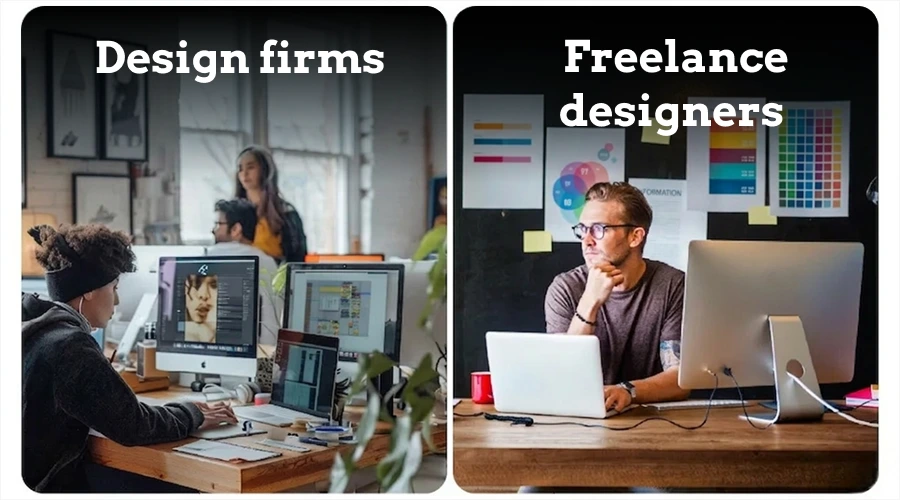
Design firms vs Freelance designers
Image Source Digital Marketing Agency
➢ Speed
Time pressure affects every product development effort. Both design firms and freelancers have something to offer when it comes to speed.
Firms move fast because they have systems in place. Project managers keep things on schedule. Dedicated teams maintain momentum. When someone hits a wall, someone else steps in. The operation keeps running.
Freelancers move fast because they are agile. They have no meetings, no approval layers. When something needs to change, the person making the decision is the person doing the work. For stages where directions shift frequently, this means getting answers in days rather than weeks.
➢ Quality
Both design firms and freelancers deliver quality. They do it in different ways.
Firms rely on process. Multiple people review every deliverable. Designs pass through established checkpoints. Testing follows protocols developed over the years. The result is reliable work.
Freelancers rely on their reputation. Their next job depends entirely on how they do on the current one. So they invest deeply in each project’s success. They give their work attention because they cannot hide behind a brand name if something goes wrong.
➢ Innovation
Where do new ideas come from? Both design firms and freelancers generate them in various ways.
Firms create environments where different disciplines intersect. Engineers talk to designers. UX researchers talk to materials scientists. These conversations spark ideas that would not emerge from any specialty alone.
Freelancers draw on their breadth of experience. Having worked across industries, they have seen many ways of solving problems. They can borrow approaches from one category. Apply them to another in ways that feel fresh.
➢ Risk
Product development carries uncertainty. Technical challenges emerge late. Markets shift. Costs escalate. Both design firms and freelancers help manage these risks.
Firms use structure to manage risk. They conduct feasibility studies, maintain risk registers and have stage reviews. They identify problems early when fixes are still cheap. Their experience lets them anticipate issues that seasoned teams might miss.
Freelancers use speed to manage risk. They iterate quickly, testing ideas before much investment has been made. If something is not working, they pivot. This agility keeps projects from going far down dead ends.
Making It Work
For companies, the question is not whether to use a design firm or a freelancer but how to combine them. A freelancer might handle concept work, bringing fresh eyes and quick iteration. A firm might take over for development and production liaison, providing structure and manufacturing expertise. The internal team might manage the thing, coordinating between outside partners and maintaining strategic direction.
What matters is matching the approach to the work. Early exploratory phases benefit from agility and fresh perspectives. Later execution-heavy phases benefit from structure and experience. Companies that understand this distinction can assemble teams that fit each stage, rather than forcing one model to handle everything.
What to Watch For
When evaluating partners, a few things matter more than others. Look at experience, not just years in business. Ask about projects of yours, not just impressive work in other categories. Talk to clients. Understand how they handle problems when things go wrong because things will go wrong.
Also, pay attention to chemistry. A company will work closely with these people for months. If communication feels difficult during the sales process, it will not get easier later.
The Bottom Line
Product design partners exist to fill gaps. Sometimes the gap is in expertise that a company does not have internally. Sometimes it is capacity during a period. Sometimes it is a perspective when a company is too close to the problem.
Both design firms and freelancers offer value. Firms bring structure, resources and experience managing complex projects. Freelancers bring specialization, agility and fresh thinking. Used thoughtfully, both can help get products to market faster and with less risk than going alone.
The key is knowing what a company needs at each stage and finding partners who fit those needs. Companies that approach outside help strategically tend to get better results than those that simply hire whoever seems easiest. A little time spent understanding the options pays off throughout the development process.
Let us handle the stress
At Wee Tech, we specialize in offering customized software solutions that meet the needs of your business. From cost estimation to scalable implementation, let our experienced personnel help you with every stage of the software development process.
Businesses can more effectively handle the challenges of product development by working with a seasoned organization, which will lead to better goods and greater market success rates.