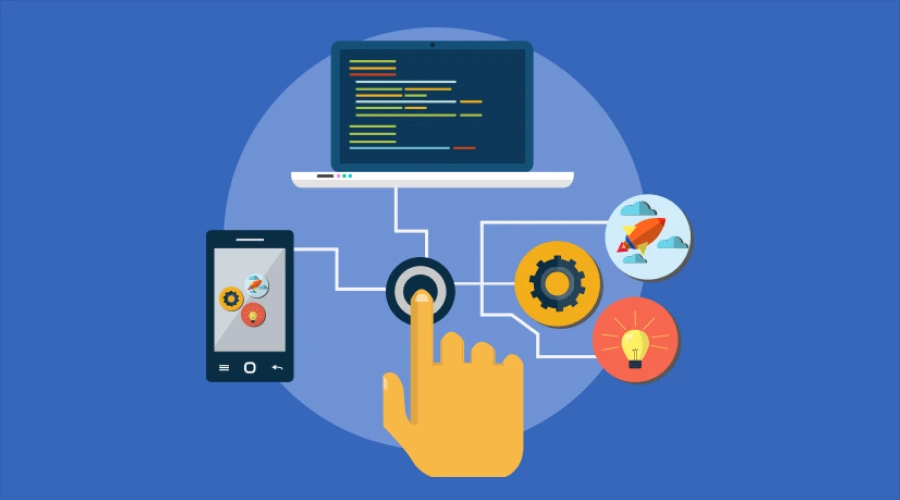
Low code platforms are allowing users to build entire mobile applications without any manual coding. Learn how to leverage these benefits yourself and more about this new technology that seemingly everyone is using.
Businesses must quickly adjust to shifting consumer demands and technical breakthroughs in today’s fast-paced digital world. And they are doing so. You have to agree, despite its strength in other areas, traditional mobile app development is frequently expensive and dependent on highly qualified developers. Here comes low-code mobile app development as a genuine alternate option, a revolutionary method that enables users to create mobile apps fast and effectively with little to no manual coding.
For startups and even big businesses looking to speed up digital transformation, low-code development platforms are currently a game-changer. Low-code platforms provide quicker time-to-market and reduced costs without sacrificing functionality by simplifying the challenges of traditional app development.
What is a Low-Code Platform?
Image Source Big Data Analytics News
For low-codemobile app development, low-code platforms work well as visual, quick application development tools that don’t require a lot of hand-coding. With the use of templates and a drag-and-drop interface, non-developers may create both apps independently.
If you run an app development company, you know how important mobile application development has become in today’s corporate world. It can assist companies in improving their work, communicating with customers, and thus staying updated. Custom mobile apps are becoming more and more necessary for organizations in order to fulfill their industry goals and functions.
Why Low-Code Development is Gaining Popularity
Faster, more agile development techniques are required due to the increasing demand for mobile applications across industries. In contrast to fewer than 25% in 2020, Gartner predicts that by 2025, 70% of new applications created by businesses will use low code or no code technology.
To satisfy the growing need for mobile solutions, particularly in areas like workforce productivity and operational efficiency, businesses are turning to low-code development. Low-code platforms are favored for digital transformation projects due to their rapid prototyping and real-time deployment capabilities.
Key Features of Low-Code Mobile App Platforms
Low-code platforms provide a range of capabilities that make developing apps easier while preserving scalability and reliability. We have listed a few for you to read:
Visual Development Interface: The app creation process is streamlined by graphical modeling tools and drag-and-drop builders.
Reusable Components: Efficiency is increased by pre-built modules such as payment gateways and navigation menus.
Cross-Platform Compatibility: The majority of low-code platforms enable simultaneous deployment on both iOS and Android.
Third-Party interfaces: Simple API interfaces with ERP and CRM systems.
Scalability and Security: Enterprise-grade platforms can grow with your organization and have built-in security measures so you have one less thing to worry about.
Benefits of Low-Code Mobile App Development
➢Faster Time to Market
Image Source ScienceSoft
Perhaps the most attractive benefit of low-code development is speed. Compared to other standard coding processes, using minimal code platforms can significantly shorten the time required to develop apps.
➢Cost Efficiency
Because they use fewer coding resources and provide a quicker time to market for custom mobile applications, minimal code app development platforms reduce overall development costs.
➢Enhanced Collaboration
Low code platforms for mobile application development enable the use of cloud-based development environments, which improve team member communication.
➢Integration with existing systems
It will be feasible for new business apps to successfully integrate with current business systems if features that facilitate integration allow new applications to be integrated into the current ones.
➢Reduced Maintenance Overhead
Image Source Freepik
The majority of components are pre-tested and standardized, lowering the likelihood of errors and performance problems. Over time, the costs associated with application maintenance are further reduced by clear code layouts and built-in maintenance features.
➢Accessibility for non-technical users
Low code platforms allow non-technical people, also known as citizen developers, to design and launch an entire application with minimal to no coding.
➢Drag-and-drop interfaces
Effective interfaces allow the user to create or customize the layout as well as the functionality of an application, even if they do not know how to program.
➢Visual development tools
Graphics facilitate complex processes, which enable the development of apps even for persons who are not programming gurus.
➢Enhanced productivity
Because low code platforms reduce the amount of time spent on coding routines, they have a positive effect on the overall efficiency of mobile application development.
➢Real-time collaboration features
Image Source Level Up Coding
This feature allows different team members to work at the same time on different parts of the application, thus increasing efficiency by a lot.
➢Reduced need for manual coding
The use of pre-built components and templates means that there is less hand coding to be done, and the process of development is made faster.
Industries Benefiting Most from Low-Code Platforms
Healthcare: Creation of patient management and telemedicine applications.
Retail: Development of loyalty apps and mobile shopping systems.
Finance: Creating fintech and mobile banking solutions.
Education: Apps for virtual classrooms, student administration, and online education.
Logistics: Applications for inventory management and real-time tracking.
Challenges of Low-Code Development
There have to be some challenges when something promises to be this smooth and attractive. Low-code development also has a few, but not as many as you might think.
Limited Customization: Highly complicated applications could still need custom development.
Vendor Lock-In: Once an app is developed, some platforms make it challenging to switch to a different system.
Scalability Concerns: Large-scale operations and heavy traffic are not handled similarly by all low-code systems.
Remember, it’s critical to select the appropriate platform and collaborate with a knowledgeable service provider. These setbacks can be avoided if proper plans are devised for each section.
Popular Low Code Mobile App Development Platforms
➢OutSystems
One of the top low-code platforms is OutSystems, which offers a comprehensive, integrated platform for developing online and mobile applications for businesses. Additionally, it contains tools to enable integration features for application development, support for AI code creation, and multimedia development tools.
➢Mendix
Mendix is a low-code tool that enables the creation of multi-experience apps by both professional and citizen developers. It offers the ability to create enterprise mobile applications using artificial intelligence, a shared workspace, and SD components.
➢AppGyver
AppGyver is a visual editor-based no-code environment for developing original mobile applications. In fact, its functions include intricate logical and data models, offering a well-considered, effective, and relatively user-friendly environment for the creation of multiplatform applications.
➢Appian
Appian is a low-code development platform with features for intelligent automation. By offering a drag-and-drop interface builder and improved integration options for enterprise-grade apps, it facilitates the rapid design of mobile applications.
➢Adalo
Adalo wants to offer a no-code platform for creating captivating online and mobile applications. It offers a range of component options with databases and integration features that can be previewed and changed to quickly create effective apps.
➢Power Apps
Microsoft Power Apps are low-code platform-based applications and connectors that facilitate rapid application development. Because it enables users to design apps that link to data and function on the Web and Mobile, it is beneficial for business application development.
Low code platforms are a phenomenon that is changing mobile application development for the better because of speed and simplicity. As an app development company, you should fully acknowledge the value of these tools in building unique mobile apps.
The advantages associated with the use of low code platforms, such as prototyping, shortened development time, and an increase in collaborative working, can easily be leveraged by anyone, making imagination the only limitation.