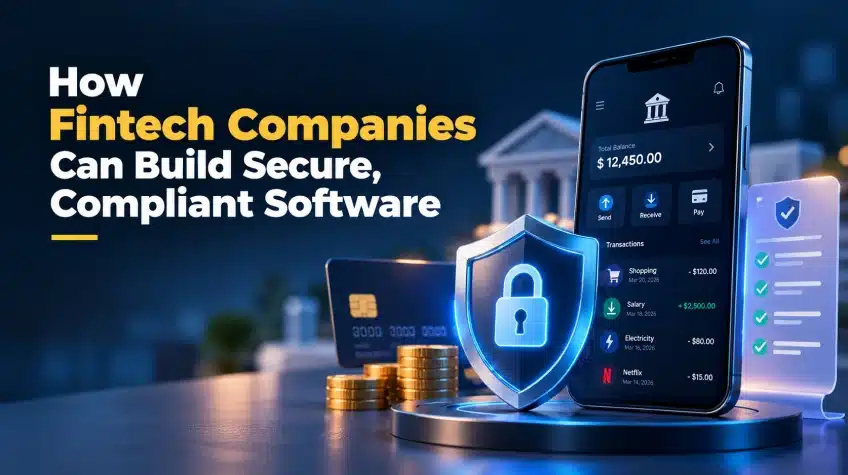
Fintech has made managing money easier through digital payments, mobile banking, online lending and investment apps. But these services handle sensitive financial and personal data of customers. This makes it crucial for Fintech companies to build secure, compliant software. Even a small security breach can cause huge financial losses, legal issues and loss of customer trust. More and more Fintech companies in 2026 are building secure, reliable software that protects user data and meets relevant regulations from the start. So, if you want to know how to build secure, compliant software, then read this post. Here, we have explained how you can keep financial services secure while making them easy to use. Let’s dive in…
Why Security Matters So Much for Fintech Software
Financial software is the most common target for cybercriminals because it involves both money and personal data. More often than not, Fintech platforms store names, addresses, ID documents, payment details, account information, transaction records and login details. Even a small breach can cause serious problems. Common threats include:
A security breach can affect many customers, not just those directly targeted. Therefore, it is essential for Fintech companies to build secure platforms because even a small security breach can harm customers, cause financial losses, and damage business operations and reputation.
Tips to Follow When Building Secure Software for Fintech Companies
Here are the tips that every Fintech company should follow when building a secure platform. Take a look…
TIP NO. 1: Understanding the Rules & Regulations that Apply to the Product
The process of building a secure software begins with understanding of regulations. Rules and regulations vary by financial service, country, customers, payment methods and data handled. Payment apps, lending platforms and investment apps may have different requirements. Companies operating in multiple countries must also follow local laws. Therefore, they should plan for compliance from the beginning instead of adding it later.
Ask:
What customer data will the software collect?
Where will the data be stored?
Who can access it?
How long should it be retained?
What financial transactions will the platform handle?
What security controls are required?
What records need to be maintained?
What should happen if there is a security incident?
Which third-party services will have access to customer data? And so on.
Having answers to these questions will make it easier to add the right security controls into the product.
TIP NO. 2: Following a Secure Software Development Process
Security should not be treated as the last step; it should be the part of every stage of development. Developers should begin security checks when the product requirements and design are being created. They should follow a secure development process, which often includes:
Planning: Identifying security and compliance requirements before development starts.
Design: Taking possible security risks into account and deciding how sensitive information will be protected.
Development: Following secure coding practices and review important code.
Testing:Testing the software for security weaknesses before it is released to the general public.
Deployment: Secure configurations and restricted access must be mandatory.
Monitoring: Keeping track of unusual activity, vulnerabilities and other security problems after launch.
Following a secure software development process can help companies find problems earlier and fix them in timely manner without any trouble.
TIP NO. 3: Protecting Customer Data
Protecting customer data should be one of the highest priorities for Fintech companies. Fintech companies should collect only the customer data they need and make sure the data is completely protected during storage and transfer. In addition, access should be limited to authorised people who need the information for their work purposes only. They should also have clear rules for storing and deleting data to reduce security risks.
TIP NO. 4: Using Strong Authentication
Only having a username and password cannot provide enough protection for financial applications. Fintech companies should use stronger login security, especially for sensitive actions, such as logging in from a new device, changing account details, adding a payment method or making large payments. They must use multi-factor authentication, biometrics or security keys for extra protection. However, security should remain easy for customers. Companies should have reliable methods for extra checks to monitor risky activities but they should keep routine logins from trusted devices simpler.
TIP NO. 5: Securing APIs and Third-Party Connections
Modern fintech applications often connect with banks, payment gateways, credit agencies, identity verification services, accounting platforms, cloud services and other external systems. These connections are commonly made through APIs. Since APIs allow different systems to communicate, they can also become an entry point for attackers if they are poorly protected.
Fintech companies should ensure that APIs:
Require proper authentication
Check user permissions
Validate incoming data
Limit excessive requests
Protect sensitive information
Record important activities
Reject unauthorized requests
Are regularly tested for security weaknesses
Also, third-party services should be reviewed before they are integrated into the product. Even if a fintech company has strong security, a poorly protected third-party service can still create risks.
TIP NO. 6: Building Fraud Detection into the Product
Security should not just be limited to stopping hackers from entering a system. Fintech companies should also have proper systems to identify suspicious financial activity. Fraud detection comes in handy here. It helps identify unusual patterns, such as:
Sudden changes in account information
Repeated failed authentication attempts
A sudden high-value transaction
Multiple transactions in a short period
Login attempts from unusual devices
Transactions that do not match normal customer behaviour
Automated systems can detect suspicious activity, but false alerts may affect genuine customers. Human review remains important for high-risk decisions.
TIP NO. 7: Regularly Testing the Software
Only creating software is not just enough; Fintech companies must test them on a regular basis. This is to eliminate any vulnerability that software may contain. Security testing can include code reviews, vulnerability assessments, penetration testing, API testing, configuration checks and other security assessments. Penetration testing helps find security weaknesses by simulating real attacks. Companies should make sure that all the apps, APIs, databases, cloud systems and third-party services retested after fixing any issues.
TIP NO. 8: Keeping Software and Dependencies Updated
Fintech software often depends on open-source libraries, frameworks, cloud services, operating systems and other components. These dependencies can also have security weaknesses. Even if the company’s code is secure, outdated components can create risks. Companies should track these components, check for security updates, and apply patches on time. Updates
TIP NO. 9: Securing the Cloud Environment
Many fintech companies use cloud platforms because they are flexible and easy to scale. However, cloud services are not automatically secure. Companies must configure them properly and control access to protect their data by focusing on Access permissions, Database security, Encryption, Network controls, Backup protection, Logging and monitoring, Secure storage and Configuration management. In addition, companies should review cloud security regularly as applications, users and infrastructure change over time.
TIP NO. 10: Preparing for Security Incidents
Even strong security cannot ensure complete prevention from cybercriminals. Fintech companies should also prepare for security incidents. They should have a clear plan for handling security issues. The plan should include details about who will respond, how affected systems will be secured, when customers and authorities should be informed and how services will be restored. In addition, company employees should also know how to report suspicious activity. A clear plan can help Fintech companies act instantly and reduce damage significantly.
TIP NO. 11: Investing in Employee Training
Security should be everyone’s concern in an organization. Employees are an important part of fintech security. Therefore, it is crucial for every Fintech company to train its employees as well. Even strong security can fail because of simple mistakes, such as clicking harmful links, sharing passwords or sending sensitive data to the wrong person. Regular training helps employees identify these risks.
Your training module should include real-life examples and explain what to do when something seems suspicious. Developers should know secure coding, while employees handling customer data should understand privacy and data protection.
TIP NO. 12: Making Compliance an Ongoing Process
Compliance is not a one-time job; it should be an ongoing process for every Fintech company. Rules, software, and business needs do change over time. Hence, fintech companies should review compliance regularly. Also, they should keep records of security measures and conduct regular checks to find gaps early. Automated tools come in handy here. They help monitor user access, system changes and security events.
Putting it all together…
So, there you have it: the best tips to build secure, compliant software for a Fintech company. Building secure fintech software in 2026 does not solely rely on security tools and audits. Fintech companies must also focus on protecting customer data, testing systems regularly, keeping software updated and following relevant rules. Security and compliance should be ongoing priorities, not one-time tasks. By focusing on security, privacy, and ease of use from the beginning, fintech companies can protect customer trust and build safer, more reliable financial services. Also, Fintech companies must balance security with ease of use. Too many security steps can frustrate customers. Companies must implement risk-based authentication, clear alerts and simple account recovery to keep financial services secure and convenient. Security should be everyone’s responsibility, instead of just IT guys taking care of it. From developers to managers and support staff, everyone in a Fintech business should be trained to make decisions to protect customer information.