There are drawbacks to classical computing. Megawatts are used in data centers. Every few months, the size of AI models doubles. Another route is provided by quantum computing. Not faster in terms of clock speed, but faster in terms of problem-solving.
Combining quantum physics with machine learning makes it difficult for conventional computers to do tasks like molecular simulations, encrypted traffic analysis, and large optimization spaces. This is not science fiction. Prototype hardware from Google, IBM, and IonQ is currently being used for this.
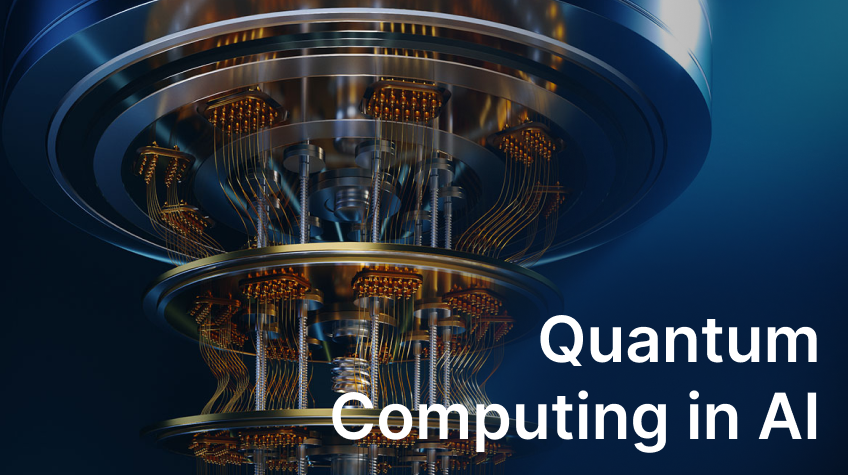
Understanding Quantum Computing
Image Source AZoQuantum
Computers use bits 0 and 1. Quantum computers use qubits. A qubit is in superposition, or both states at once, until it is measured. Two classical bits can store one of four possible values. Two entangled qubits hold all four at the same time. That scaling gap increases a lot at 50 or 100 qubits.
Superposition can be collapsed by heat, vibration, or stray radiation. A small number of qubits with high error rates define the NISQ (Noisy Intermediate-Scale Quantum) era of modern processors. Practical fault-tolerant systems are still not functional, even though Google’s Willow chip just resolved a 30-year error-correction issue.
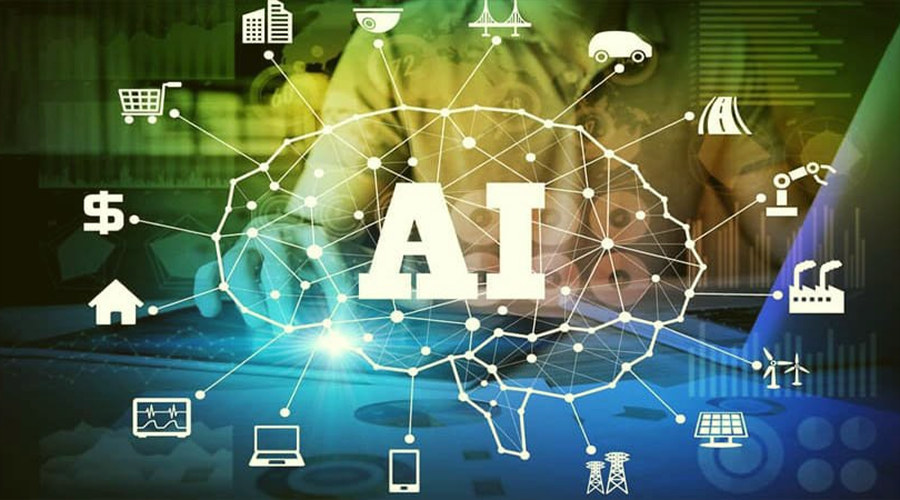
Overview of Artificial Intelligence
Deep learning models process terabytes of labeled data and modify millions of parameters to lower prediction error. GPT-4 was trained using an estimated fifty gigawatt-hours. Although these models perform well on classical computers, they are limited in their ability to handle combinatorial problems.
A 100-stop delivery route has more possible paths than atoms in the universe. Heuristics and approximations are used by classical optimizers. The whole region can be simultaneously investigated by quantum computers.
How Quantum Computing Enhances AI
Image Source Vocal Media
First, quantum neural networks (QNNs) achieve similar accuracy with significantly fewer trainable parameters by substituting qubit circuits for classical neurons. Second, quantum kernels find patterns that conventional approaches miss by converting data into a high-dimensional Hilbert space. Third, optimization tasks that grow exponentially on classical systems are handled by variational quantum algorithms like QAOA (Quantum Approximate Optimization Algorithm) and VQE (Variational Quantum Eigensolver).
Key Applications of Quantum AI
Image Source SIRT
➢Healthcare
Image Source Linkedin
Over the course of the ten to fifteen years that drug research takes, about $2 billion is spent on each authorized compound. That time is shortened with quantum AI. By merging quantum drug research with conventional AI refining, researchers at St. Jude Children’s Research Hospital developed one million candidate compounds that target the KRas protein, a notoriously difficult cancer target.
Two candidates who passed laboratory testing suppressed KRas activity in cells. Quantum algorithms also expedite protein folding simulations and multi-omic data integration for precision medicine. This makes it possible for medical practitioners to test treatments on virtual patients before implementing them, a process known as digital twin modeling.
➢Financial Modeling
Optimizing a portfolio is an NP-hard task. Even with 100 assets, classical solutions provide approximations. Quantum-inspired reinforcement learning fared better than traditional deep Q-networks in simulated turbulent markets in terms of cumulative returns, drawdowns, and Sharpe ratios.
➢Supply Chain Optimization
Image Source Data Science Blogs Hashnode
Classical optimizers cannot handle the combinatorial complexity of global supply chains. In order to lower costs, carbon emissions, and delivery times while preserving supplier workshare, researchers projected an Airbus logistics dilemma onto IonQ’s trapped-ion quantum technology. Pareto-optimal solutions were produced using hybrid quantum-classical solvers, reducing expenses and emissions for practical networks.
➢Climate Modeling
Weather prediction models are run on supercomputers for hours at a time. Quantum machine learning reduces that time. Quantum neural networks for cloud cover parameterization found important climate patterns using short, high-resolution simulations. Quantum-inspired models that require 10–50 times less computer resources than conventional systems are able to anticipate sub-seasonal weather. Better crop planning, early hurricane alerts, and reduced energy usage in simulation centers are other advantages.
➢Cybersecurity
Image Source Pantherun
Shor’s algorithm breaks both RSA and ECC encryption. A sufficiently enough quantum computer can decipher digital communications from the past and the future. Intelligence services already collect encrypted data for future decryption.
But quantum AI is also protective. Compared to conventional models, agentic AI was able to improve intrusion detection accuracy by up to 42% and decrease threat response latency by 55% when combined with quantum machine learning. Quantum key distribution and NIST post-quantum cryptography guidelines are meant to safeguard the transition.
➢Benefits
Quantum AI promises exponential processing capacity, whereas conventional systems face a combinatorial explosion. When quantum cores perform matrix computations, training large AI models uses less energy. When traditional models overfit, pattern identification on high-dimensional data becomes possible.
Additionally, because quantum neural networks require fewer parameters, overfitting and barren plateaus are less likely to occur. Quantum AI transforms cost structures and produces previously unattainable efficiencies for sectors like energy, banking, and logistics.
➢Challenges
Hardware continues to be the biggest challenge. Current quantum processors are characterized by low qubit counts, limited coherence periods, and gate noise. The barren plateau phenomenon, which causes gradients to vanish exponentially with circuit depth, makes training quantum neural networks difficult. Quantum data encoding remains unsuccessful. The need for preprocessing and postprocessing around the quantum core in traditional AI causes bottlenecks.
Error correction requires a large qubit overhead, with an estimated 1,000 physical qubits per logical qubit. Additionally, there isn’t much talent. Few computer scientists are familiar with quantum physics, and few physicists are familiar with modern machine learning pipelines.
➢Future Scope
According to the director of Google’s quantum AI unit, all sophisticated AIs will employ quantum resources well before AI reaches the century mark. He declares, “We will no longer distinguish between AI and quantum.” “There will only be one discipline, called quantum AI.” The NISQ gap is already filled by hybrid quantum-classical architectures. Error-corrected logical qubits will provide a true quantum edge in financial risk, materials research, and drug discovery within five years.
Conclusion Classical machine learning cannot be replaced by quantum AI. It is a specialized accelerator for issues that traditional systems are unable to effectively resolve. There are benefits for cybersecurity, logistics, healthcare, finance, and the climate. Whether quantum AI stays a lab curiosity or becomes as commonplace as GPUs are today will be determined during the next ten years. In either case, the convergence has begun.