Data protection is the process of protecting information and ensuring its availability.It employs numerous strategies to ensure data privacy and security while promising restoration of lost or corrupted information.
The process of safeguarding one’s sensitive information is known as Data protection. The goal of the process is to prevent data loss and corruption, and to ensure it is always available and compliant with any regulatory requirements.
One of the most effective strategies for protecting data is to replicate and restore it if it is lost or corrupted. Unfortunately, information online is prone to various predicaments, which include but are not limited to: Cyber-attacks, server shutdowns, human error, and even intentionally trying to harm someone. Ensuring availability is the core of Data protection. This means the user can access the information even when it is lost or corrupted, making sure the daily business operations are not hindered.
This is the reason most companies are adopting recovery strategies such as Business continuity and disaster recovery (BCDR), along with traditional data protection methods such as:
Solid-state drives or SSDs, servers and vast storage arrays.
Backups, around-the-clock data protection, and availability techniques.
Storage tiering information, which is routinely accessed or important.
Disaster recovery as a service (DRaaS)
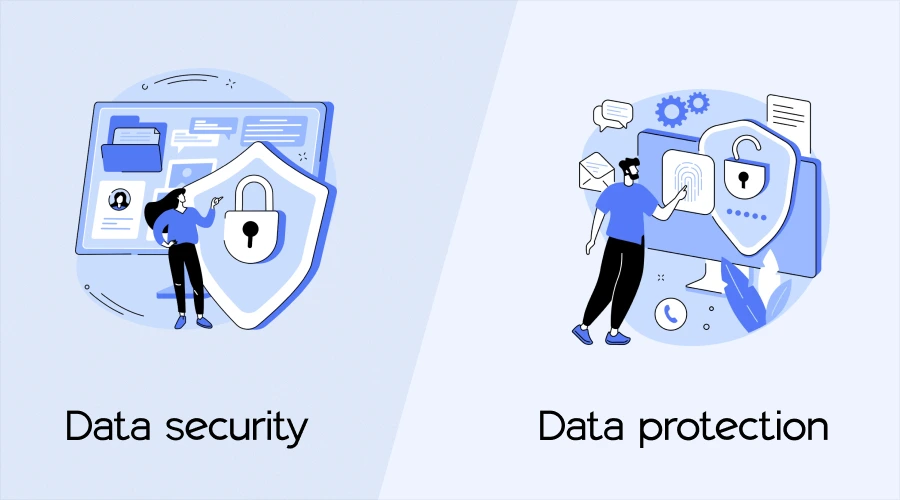
How is Data protection different from Data security?
Although the two terms are used interchangeably almost too often, these are two separate fields with significant differences.
Data security can be called a subset of Data protection. It mainly focuses on stopping unauthorized access to the information and reduces chances of theft and corruption. This includes physical security and various organizational guidelines.
Both Data security and protection involve the underlying concept of Data privacy. Which supports the idea that an individual has control over their personal information, sensitive or otherwise. This encompasses the potential capacity of organizations to collect, store and utilize the data.
We can concur that both data privacy and data security are part of the broader strategy that is Data protection.
There are multiple levels to ensuring Data protection, including data inventory, data backup and recovery, and an effective strategy to manage the information throughout its life cycle. All of which are required to retain and manage data in a suitable manner. We will go through a brief explanation of what each of the strategies entails:
Data inventory keeps track of the various types of data and their respective amounts across the whole organization. This is to make sure all of the data which is detected is properly included when setting up data protection strategies and life cycle management plans.
The most common way of losing data is hardware failure. Backup and recovery methods are used to safeguard against such threats. This is the most basic contingency plan against accidental loss of information or intentional wrongdoing.
Lifecycle management of data ensures the information is stored and protected under the enterprise’s data protection policies and privacy laws. Simply put, it is the process of overseeing the data until it is eventually destroyed.
Why is Data protection important?
The world creates almost 2.5 quintillion bytes of data every day. Every time someone makes a purchase, creates an online profile or opens a webpage, a trail of their personal data is being stored in the organization’s database. This is very crucial to the business and helps them maintain operations and make important decisions catering to their customers. In case of a breach, even if a very small amount of data is compromised, the business can lose its reputation and money along with it.
Mike Pedrick, vice president of cybersecurity consulting at Nuspire, states, “In industry circles, consumer data is often compared to plutonium powerful and valuable but terribly dangerous to the handler if abused.”
Not too long ago, IBM did a survey on the cost of a data breach in 2023 and reported the figure to be a whopping 4.45 million USD. In the same year, Meta, a California-based company, was fined 1.3 billion USD by Ireland’s data protection authorities. The company was charged with violating the guidelines of the General Data Protection Regulation (GDPR).
Safe to say, data protection teams of businesses today are facing numerous issues almost every day, some of which are as follows:
Streamlining the management, retention, and monetization of large data volumes.
Deciding when the data has reached the end of its life cycle and has become a liability.
Working to prevent new and more polished cybersecurity attacks.
Properly securing the massive amounts of data spread throughout vast cloud environments.
Introducing new technology in existing business environments and IT facilities.
Grasping the full potential of newgenerative AI capabilities and machine learning.
Maintaining compliance with international and organizational data privacy laws, which are always being updated.
Adapting to stricter regulatory provisions, which can severely penalize the company if disregarded.
In this age, data is the single most important resource for every major organization. Thus, it has become mandatory for businesses to learn how to collect, use, and protect the same.
What are the key principles of data protection?
The core of data protection consists of two things: warranting the availability of information under any and all circumstances, and protecting sensitive data from corruption, loss or malfeasance. Here are some of the key principles laid out by the European Union in the form of the General Data Protection Regulation or GDPR.
1. Lawfulness, fairness and transparency
“Personal data shall be processed lawfully, fairly and in a transparent manner in relation to the data subject [individual person].”
2. Purpose limitation
“Personal data shall be collected for specified, explicit and legitimate purposes and not further processed in a manner that is incompatible with those purposes; further processing for archiving purposes in the public interest, scientific or historical research purposes or statistical purposes shall, in accordance with Article 89(1), not be considered to be incompatible with the initial purposes.”
3. Data minimization
“Personal data shall be adequate, relevant and limited to what is necessary in relation to the purposes for which they are processed.”
4. Accuracy
“Personal data shall be accurate and, where necessary, kept up to date; every reasonable step must be taken to ensure that personal data that are inaccurate, having regard to the purposes for which they are processed, are erased or rectified without delay.”
5. Storage limitation
“Personal data shall be kept in a form which permits identification of data subjects for no longer than is necessary for the purposes for which the personal data are processed; personal data may be stored for longer periods insofar as the personal data will be processed solely for archiving purposes in the public interest, scientific or historical research purposes or statistical purposes in accordance with Article 89(1) subject to implementation of the appropriate technical and organizational measures required by this Regulation in order to safeguard the rights and freedoms of the data subject.”
6. Integrity and confidentiality
“Personal data shall be processed in a manner that ensures appropriate security of the personal data, including protection against unauthorized or unlawful processing and against accidental loss, destruction or damage, using appropriate technical or organizational measures.”
7. Accountability
“The controller [corporate officer in charge of data protection practices] shall be responsible for, and be able to demonstrate compliance with, [the first six principles].”
Data protection regulations and practices
Acknowledging the pressing need to protect data, various authorities have devised a few privacy regulations that organizations must follow to continue doing business with their customers.
Some of the most common regulations are as follows:
➢The General Data Protection Regulation (GDPR)
The General Data Protection Regulation (GDPR) is a data privacy framework devised by the European Union (EU). This is an attempt to safeguard the personal information of various users (also referred to as “data subjects”) on a platform.
This regulation mainly focuses on personally identifiable information or PII, and ensures businesses are compliant with the different requirements placed upon them. Enterprises are also mandated to adopt measures, such as appointing a data protection officer to handle data and being transparent about their data collection practices. GDPR also allows citizens of Europe much more control over their personal information, such as name, profile ID, biometric data, medical files and much more. Although it is important to note that, purely personal uses of information, national and law enforcement agencies are exempt from these regulations.
➢Health Insurance Portability and Accountability Act (HIPAA)
This act was passed in the United States of America in 1996. The Health Insurance Portability and Accountability Act is a set of guidelines for healthcare facilities and businesses which ensure proper handling of Patient Health Information (PHI) and maintain secrecy and security.
Under this act, all entities must operate under some data security and compliance regulations. These regulations are not limited to just healthcare facilities. rather all businesses that collect and process PHI. Some examples are firms which provide data transmission services, software companies, medical transcription services and even insurance companies. Any organization which collects and handles PHI must be compliant with HIPAA guidelines.
➢Payment Card Industry Data Security Standard (PCI-DSS)
These guidelines are primarily devised to protect credit card data. These guidelines are not issued by a government authority, but by an independent regulatory council known as the Payment Card Industry Security Standards Council (PCI SSC).
Any business that handles the data of a credit card user (Collecting, processing and transmitting) is required to follow these contractual commitments.
The international and state laws regarding data protection are changing very frequently, and businesses are expected to be knowledgeable about these guidelines and to follow them strictly. Especially considering the recent implications of AI, organizations are constantly seeking better guidance and understanding of these regulations.