

Every time you go online, your identity becomes exposed. Your IP address, your location, your behavior on the internet – everything becomes known to each server that gets your request. While that might be a privacy issue for a person, for business organizations it is a serious security threat.
A proxy server works as an intermediary between your device and the rest of the internet. It filters and regulates all connections that happen. Proxy servers are among the most useful tools used in cyber security.
In this article, we will discuss what a proxy server is, how it works, the types of proxy servers, and why it is so important in cyber security today.
What Is a Proxy Server?
A proxy server is an intermediate layer that receives requests from the client machine and forwards them to the server on the internet.
While making a request through the browser, the request is usually made directly by the device to the target server. In case of a proxy server, the request is first sent to the proxy server. The proxy server analyzes the request, implements its rules, and forwards the request on behalf of the client. The response returns back through the same path.
The request appears to come from the proxy server and not the client machine to the destination server. The real IP address of the client machine is hidden.
A proxy server performs the following three functions:
- It hides the identity of the original requesting device
- It implements rules for filtering the requests
- It can analyze the traffic of the network
In terms of cyber security, these three functions make proxy servers an essential layer of network defense.
How Does a Proxy Server Work?
The working mechanism of a proxy server follows a clear sequence for every request.
Step 1 – The client sends a request
The client sends a request to access a resource on the internet. This could be anything from a website to an API or a file stored on an external server.
Step 2 – The proxy intercepts the request
As opposed to the request being sent directly to the internet, it passes through the proxy server. At this point, the proxy checks the request according to the rules that have been set up by the administrator.
Step 3 – The proxy evaluates and applies rules
The proxy checks if the destination server has been allowed, whether the request matches any threat signatures, and also checks whether there are any content filtering rules that need to be applied. Requests that do not comply are blocked here.
Step 4 – The proxy forwards the approved request
For the requests that are allowed, the proxy forwards them to the destination server using the IP address of the proxy itself and not the client’s.
Step 5 – The response is received through the proxy
The destination server replies to the request through the proxy. Here too, the proxy inspects the response and filters the response before sending
This entire sequence happens in milliseconds and is invisible to the end user under normal circumstances.
Types of Proxy Servers in Cyber Security
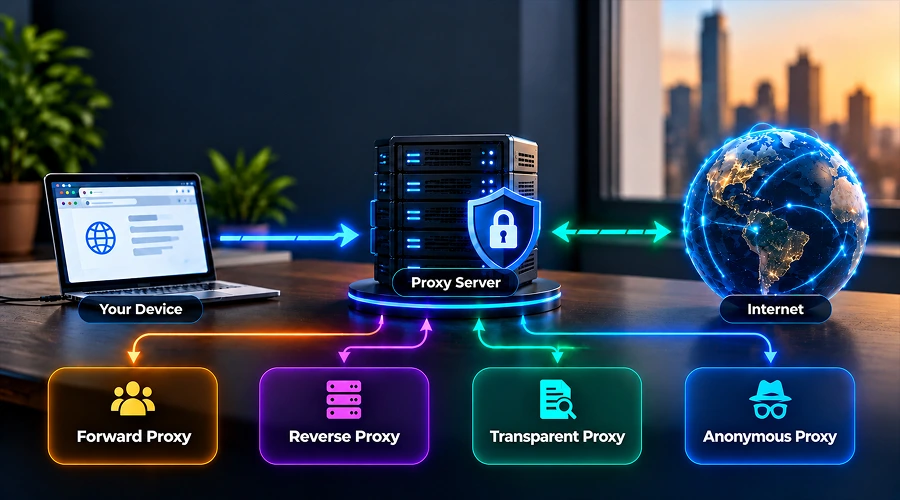
Not every proxy server works the same way or serves the same purpose. Understanding the different types helps organisations choose the right configuration for their security requirements.
➩ Forward Proxy
A forward proxy lies in between internal users and the external internet. It deals with outgoing requests from within the network on behalf of the users.
Applications include:
- Implementation of acceptable usage policies for employees
- Filtering access to harmful or undesirable websites
- Prevention of data leakage through outbound filtering of content
- Anonymization of network traffic originating from inside the network
Most corporate web content filters and gateways are forward proxies.
➩ Reverse Proxy
A reverse proxy lies in front of the internal servers and manages incoming requests from external users. Unlike a forward proxy that protects outgoing traffic, a reverse proxy protects the servers.
Applications include:
- Obfuscation of the actual IP addresses of internal web servers
- Load balancing of traffic among various backend servers
- SSL termination before traffic enters the internal network
- Protection of internal application servers from any direct attack
Reverse proxies are an integral part of web application security architecture and are commonly used along with web application firewalls.
➩ Transparent Proxy
A transparent proxy captures the network traffic without needing any configuration on the client side. Sometimes users do not even know that it exists.
Typical use cases:
- Content filtering at network level in academic and corporate settings
- Employee monitoring of internet use without client configuration
- Caching of commonly accessed content to save bandwidth
The fact that no client configuration is required makes transparent proxies simple to use on a larger scale, although they are less flexible.
➩ Anonymous Proxy
An anonymous proxy hides the client’s IP address from the destination server, although it does not disguise the fact that it is a proxy. The destination server detects that it receives traffic from a proxy, although it cannot understand whose it is.
Typical use cases:
- Protection of user privacy when conducting research or other activities
- Accessing different content depending on the regional availability
- Prevention of targeted tracking by ad companies
➩ High Anonymity Proxy (Elite Proxy)
A high anonymity proxy hides the identity of the client and the very fact that it is a proxy. The destination server receives the traffic as it comes directly from the client.
Common uses:
- Maximum privacy in sensitive operational environments
- Security testing and penetration testing workflows
- Protecting the identity of researchers working in threat intelligence
SSL or HTTPS Proxy
An SSL proxy can intercept and inspect encrypted HTTPS traffic by performing SSL in
An SSL proxy can intercept and inspect encrypted HTTPS traffic by performing SSL inspection, also known as SSL termination or man in the middle inspection.
Common uses:
- Inspecting encrypted traffic for malware and data leakage
- Enforcing data loss prevention policies on encrypted connections
- Detecting threats hidden within SSL encrypted sessions
SSL proxies are increasingly critical as a growing proportion of internet traffic moves to HTTPS by default.
The Role of Proxy Servers in Cyber Security
Proxy servers contribute to cyber security across several distinct layers of protection.
🢧 Access Control and Content Filtering
The most commonly used feature of proxy server security is to restrict access to external resources by internal users and systems.
- Blocking known malicious domains and IP addresses in the network
- Restricting access to categories of web sites tsecurity, and regulatory compliance. As cyber threats evolve in 2026, a well configured proxy architecture remains essential for protecting data and maintaining a secure network.hat can be risky for business or security
- Preventing access by users to file sharing sites where there is a risk of leaking information
- Implementing different access restrictions for different user groups or departments
This will narrow down the surface area for attacks that exploit user visitation of malicious web sites or downloads of dangerous content.
🢧 Anonymisation and Identity Protection
The ability to hide IP addresses of internal systems makes it much more difficult for outside attackers to discover the network structure of the organisation.
- Outside attackers cannot trace or target internal systems
- Threat intelligence work can be performed without revealing the origin
- Employees working on sensitive projects are shielded from targeted surveillance
🢧 Traffic Inspection and Threat Detection
Deep packet inspection performed by proxy servers can examine network traffic content in real time.
- Detect malware signatures in downloads before they make their way to endpoints
- Identify command and control traffic from potential compromised hosts
- Anomaly detection of data transfer patterns that can be the sign of breach
- Prevent malicious scripts included in web page contents from being executed
All this gives proxy servers the possibility to be used as complementary tool in security solutions that include endpoint technologies and detect threats at network periphery.
🢧 Data Loss Prevention
Outbound traffic inspection becomes a major element of data loss prevention technology.
- Detect patterns in the content of outbound traffic that match personally identifiable information
- Prevent unauthorised file upload to external services
- Large outbound data transfers outside usual traffic pattern detection
- Outbound connections logging for audit purposes
In case of compliance with data protection standards, this control is essential for organisations.
🢧 Logging and Forensic Capability
Every transaction routed through a proxy server is recorded. This creates a detailed, searchable log of all network activity.
- Provide evidence during security incident investigations
- Identify the timeline and scope of a breach after the fact
- Support compliance auditing and regulatory reporting
- Detect patterns of unusual behaviour that may indicate insider threats
Without proxy logging, significant network activity occurs with no record, leaving security teams with no visibility into what happened during an incident.
Proxy Servers vs Firewalls vs VPNs
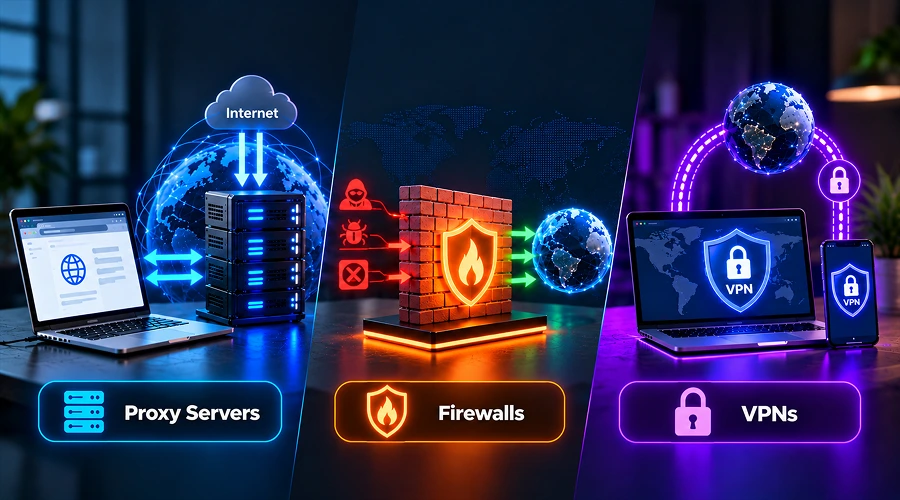
Proxy servers are often confused with firewalls and VPNs. They are related but serve distinct functions.
| Feature | Proxy Server | Firewall | VPN |
| Primary purpose | Traffic routing and inspection | Network access control | Encrypted tunnel for remote access |
| Traffic inspection | Deep content inspection | Packet filtering | Encryption, no content inspection |
| Identity masking | Yes, at application layer | No | Yes, full tunnel encryption |
| Content filtering | Yes | Limited | No |
| Logging | Detailed application logs | Connection logs | Minimal |
| Performance impact | Low to moderate | Low | Moderate to high |
In a well designed security architecture, these three tools work together rather than replacing one another.
Common Cyber Security Use Cases for Proxy Servers
Security of corporate networks All major corporations make sure that the internet traffic passes through the proxy servers in order to implement acceptable use policies, block harmful websites and keep audit logs of the employees’ network activities.
Security of remote workforces With increasing use of the distributed workforces, proxy servers provide equal content filtering and access control irrespective of the location from which the employee works.
Security of cloud computing and APIs Reverse proxies shield the cloud hosted APIs and web applications from the internet and thus minimize the risks of direct attacks on the application infrastructure.
Threat intelligence and penetration tests Security professionals use proxy servers for the purpose of conducting investigations and penetration tests without revealing their actual infrastructure and identities.
Compliance and regulations The industries such as financial services, healthcare and legal services use proxy servers as part of the compliance infrastructure in order to keep the logs of data access and transfer.
Key Considerations When Deploying a Proxy Server
Deploying a proxy server effectively requires attention to several technical and operational factors.
- Performance capacity — the proxy must handle peak traffic volumes without becoming a bottleneck
- SSL inspection trade offs — inspecting encrypted traffic requires careful certificate management and user awareness
- Policy configuration — overly restrictive rules create friction; policies need regular review
- High availability — a failed proxy can take down internet access for the entire organisation
- Integration with SIEM tools — proxy logs deliver the most security value when integrated with a broader security information and event management platform
Conclusion
A proxy server strengthens cyber security by monitoring traffic, blocking threats, preventing data leaks, and maintaining activity logs. For businesses, it improves network visibility,