
Every couple of months, a new round of AI products emerges. According to vendors, each one is an “agent” that answers users, generates reports, schedules meetings, and conducts workflow entirely independently. Many business people have to ask themselves one practical question, though – What is an AI agent? Which one do I need?
It is important to note that “AI agent” is a rather loose term that includes radically different solutions. A simple auto-reply bot is called an agent just like a self-improving logistics optimizer but these two things solve entirely different tasks and have a significantly different price tag. Choosing an agent inappropriately is a bad mistake.
This guide defines what is meant by an AI agent, introduces you to its main types, tells about the advantages and limitations of each one, and helps to select the one that is the best for your business.
What Is an AI Agent?
➣ The Simple Definition
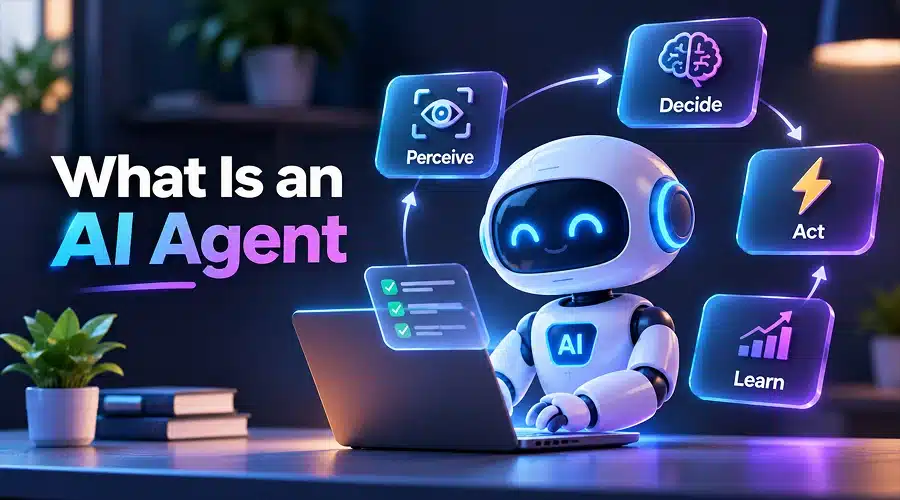
An AI agent is a software that perceives its environment, makes decisions, and acts to achieve certain goals. In comparison with a regular program following a predefined script, an agent responds dynamically to the situation. It may read an incoming message, evaluate its level of importance,
➣ How Agents Differ from Chatbots and Automation
While a traditional automation program strictly does what is coded – if X occurs, then execute Y – a chatbot simply communicates with the user. An agent does more than that: it has a goal, selects from possible moves and frequently employs various instruments for this purpose, e.g. a database, calendar or even an application interface.
New age agents utilizing LLMs in their foundation are also capable of interpreting natural language and thinking about multi-step processes in the event of unpredicted developments, which explains explosive popularity of agents in recent years.
➣ The Core Components
Most of the agents have several components in common:
- Perception: Inputs such as text, data, images, or sensor readings.
- Decision logic: Rules, models, or reasoning that choose the next action.
- Action: Outputs such as sending a message, updating a record, or triggering a process.
- Feedback: Information about whether the action worked, which some agents use to improve.
The Main Types of AI Agents
In the classical approach, computer scientists classify agents into five categories based on their level of intelligence and memory usage. Modern business also includes a sixth type of system, which is multi-agent systems.
1. Simple Reflex Agents
A simple reflex agent acts upon the current state of affairs according to some pre-programmed condition-action rules. The agent does not have any memory and does not take the past or future into account. When a thermostat detects that the room is cold, it activates the heater. If the email has the word “unsubscribe,” then the agent sends it to the folder.
Strengths: Simple reflex agents are fast, inexpensive, predictable, and easy to debug. They never surprise you.
Limits: Simple reflex agents do not work well when situations are ambiguous or when the right action depends on the context. In case the conditions of action are changing in unexpected ways, they simply stop working.
Business examples: Spam filters, automatic reply for FAQ, notifications about low-level of inventory, and simple approvals routing.
2. Model-Based Reflex Agents
Model-based agents have an internal representation of the world. The agent has a record of events that have occurred and uses that record to deal with situations that it does not completely observe. Imagine a customer service system that knows that a customer has already complained twice that week and handles the third complaint differently.
Strengths: They can handle incomplete information better than reflexive agents and can maintain a state over time, thus making them more reliable in actual work flow.
Limits: Creating and maintaining an accurate internal model is difficult. An inaccurate or outdated model results in poor decision-making.
Business examples: Fraud detection systems that detect transaction patterns, support systems that maintain conversation history, and warehousing systems that monitor item locations in real-time.
3. Goal-Based Agents
A goal-based system does more than merely react – it determines its objectives and then devises an appropriate plan for accomplishing the objective. The classic example is a route planner working out the fastest way of making ten deliveries. It takes a number of action sequences into consideration and chooses the best course of action to achieve the goal.
Strengths: These systems are very flexible. If something changes, they will not necessarily have to stick to their planned actions.
Limits: Goal-based planning takes more computing power and well-defined goals to be effective.
Business examples: Optimize delivery routes, meeting schedulers able to schedule meetings on many people’s schedules, and project assistants capable of subdividing a goal into tasks and monitoring the process.
4. Utility-Based Agents
Just the goal isn’t always enough, as there could be several ways to accomplish that goal. A utility-based agent takes into account the trade-offs and chooses the choice with the maximum total utility. The utility includes considerations like cost, time, risk, and quality.
Think of a travel agency. There are many ways to get to your destination, but one way is less expensive, another is faster, and yet another has fewer stops on the way. A utility-based agent assigns a utility to each choice based on your criteria.
Strengths: They are able to make complex decisions in multi-criteria scenarios and can be configured to suit business needs.
Limits: Formulating the utility function is challenging. If the wrong criteria are used, the agent will optimize for the wrong thing.
Business examples: Dynamic pricing algorithms, advertising budgeting, supply chains, and financial planning.
5. Learning Agents
The learning agent gets smarter from experience. It consists of the performance element, which performs actions; the critic, which assesses the outcome of actions; and the learning element, which adjusts the behavior in response to feedback. With time, the learning agent learns without any reprogramming done to it.
Recommendation systems are the typical example. The more you watch, shop or click, the better the recommendations become.
Strengths: Learning agents are flexible, respond to changes in customer behavior or the environment, and they discover patterns that may not be visible to humans.
Limits: They require good data, continuous monitoring and time to learn. Otherwise, they may pick up bad habits or reinforce hidden biases.
Business examples: Product recommendations, predictive maintenance, demand forecasting, personalized marketing, and customer churn prediction.
6. Multi-Agent Systems
Some problems are too large for one agent. In a multi-agent system, several specialized agents work together, each handling a part of the job. One agent might gather research, another analyzes it, a third drafts a report, and a fourth checks the work.
Strengths: They scale well, divide complex work into manageable pieces, and allow each agent to specialize.
Limits: Coordination adds complexity. Agents can duplicate work, conflict, or pass errors along unless the system is designed carefully.
Business examples: End-to-end sales workflows, automated content pipelines, complex customer onboarding, and large-scale logistics coordination.
Which AI Agent Does Your Business Actually Need?
➦ Start with the Problem, Not the Technology
First, before making comparisons among various vendors, explain the requirement at hand. Identify what should be done, frequency, criterion of successful performance, and consequences of failure of the agent. Many organizations often find that a simple answer satisfies most of their requirements.
➦ Match the Agent to the Situation
Here is one method you might apply for doing so:
- Repetitive activities that follow rules and have specific triggers: A reflex agent will work well in these scenarios.
- Activities that take history and situation into account: Use model-based agents.
- Activities with an outcome defined and with multiple actions involved: Goal based agents are the appropriate option here.
- Decision-making involving trade-offs such as cost vs. speed: A utility based agent will work best.
- Ever-changing environment producing lots of information: A learning agent will offer long-term benefits.
- Processes spanning across departments: Think about multi-agents systems.
➦ Consider Your Business Size and Maturity
A small company with little data and minimal workforce will generally gain the most from simple or model-based agents that perform the repetitive tasks rapidly. Medium-size firms with rich data and process flow will be able to integrate goal-based or utility-based agents for planning and pricing. The large firms having strong database infrastructure and technical staff will be in a position to implement learning agents and multi-agents systems.
Real-World Scenarios
➜ Small Online Store
The owner feels frustrated with repetitive questions from customers regarding shipping, returns, and order status. The use of a model-based agent integrated with the order system may help address all such queries based on factual data in most situations and route others to a human expert when needed. It would be a waste of money implementing a complicated learning model for this task.
➜ Regional Logistics Company
It has dispatchers who manage deliveries, traffic conditions, and drivers’ time. Goal-oriented or utility-oriented agents may generate optimal paths taking into account the costs of fuel, time frames of deliveries, and available time of drivers, helping them save money each day.
➜ Growing Software Company
The company requires prompt qualification of leads, individual contact with potential buyers, and proper onboarding. Multi-agents may qualify leads, write individual letters, schedule demos, and help onboard new customers.
Risks and Limitations to Keep in Mind
➩ Accuracy and Control
Agents can be wrong but confident. Let humans be in the loop for critical processes such as issuing refunds, dealing with legal issues, or making financial decisions, and conduct audits on the output periodically.
➩ Privacy and Security Issues
Agents frequently have access to customer databases and other systems. It’s vital to restrict access, secure sensitive data, and ensure that your vendor follows proper security standards.
➩ Hidden Costs
Licensing may only cover part of the expenses. There is a need for integration, training, monitoring, and other expenses related to maintenance. Request vendors to disclose the total costs involved.
➩ Overhyping
Be wary of technologies that are being sold as independent agents. Most successful implementations begin with small steps.
How to Get Started
➥ Pick One High-Impact Use Case
Choose a task that is frequent, time-consuming, and well understood. Customer support triage, appointment scheduling, and invoice processing are common starting points.
➥ Run a Small Pilot
Test with a limited group for a few weeks. Measure time saved, accuracy, customer satisfaction, and cost, then compare against your current process.
➥ Build Feedback Loops
Collect input from employees and customers, review errors, and refine the agent. Even simple agents improve when someone pays attention.
➥ Scale Carefully
Once the pilot succeeds, expand to related tasks. Document what worked so each new deployment starts from a stronger base.
Conclusion
AI agents come in many forms, from simple reflex systems that follow fixed rules to learning agents that improve over time and multi-agent systems that coordinate entire workflows. None is universally best. Each is a tool suited to a particular kind of problem.
The smartest approach is to resist the pull of the most impressive-sounding technology and start with a clear, specific business need. Choose the simplest agent that solves it reliably, pilot it on a small scale, keep humans involved where stakes are high, and grow from there. Businesses that treat AI agents as practical tools, not magic, are the ones most likely to see real, lasting returns.
Also Read: How Much Does It Cost to Build an AI Agent in 2026?