What if your enterprise automation had the ability to think, reason, and adapt to unexpected events without going down because you simply move a single UI widget?
At a tipping point of enterprise automation in 2026, business leaders have a major decision to make. While the shift from deterministic Robotic Process Automation (RPA) to probabilistic, goal-oriented Agentic AI will fundamentally change operational approaches, innovative organizations will not be turning their backs on automation capabilities that they currently have due to the paradigm-shifting cognitive abilities of Large Language Models (LLMs). Instead, they are expanding the limits of machine capabilities.
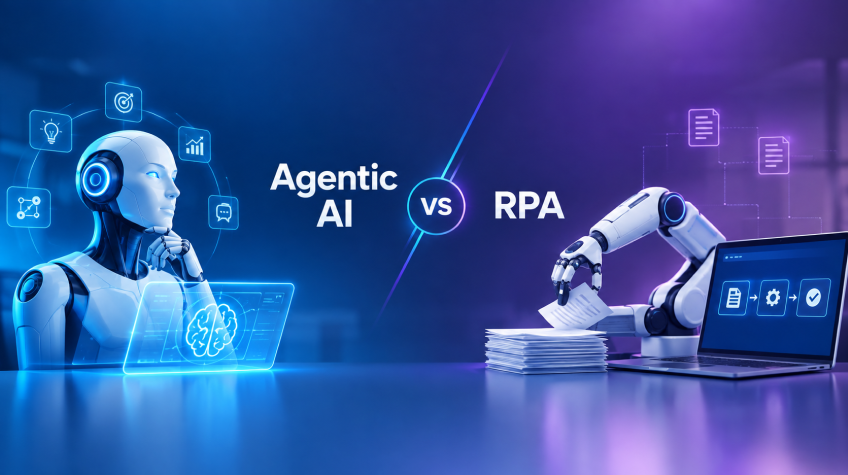
It is an architectural choice of whether your business will scale. RPA automates processes by strictly following the predetermined script, while Agentic AI automates the outcome of the process via reasoning about complex goals. Deciding when you need the rigid bot or a cognitive one is the key question of the day.
The Foundational Power of RPA: Execution by Script
Image Source Lokstech
Robotic Process Automation is the “hands” of enterprise automation. Software bots in RPA act similarly to the repetitive and rule-based human actions in digital systems, mostly working at the User Interface (UI) level or by making direct API calls.
If there is a high amount of structure in a process, business rules that are applied consistently, and predictable data – RPA provides great speed and accuracy. A bot in RPA performs whatever it is told to perform 100% of times with 99.9% accuracy.
Key Characteristics of RPA
Deterministic Logic: Execution is performed only according to pre-written “if/then” scripts. Bot cannot make decisions on their own.
Structured Data Dependency: RPA uses structured data like fixed forms, CSV with predictable structure and ER database fields.
Cost Effectiveness: RPA execution is very predictable and its average price per transaction is about $0.001.
UI-Based Execution: Bots are able to work with legacy systems without modern API infrastructure by clicking buttons and reading screens.
Vulnerability to Change: Since RPA works with exact screen coordinates and layout, any change in UI (moved field, portal updates, etc.) will break the script and require human involvement.
Ideal Enterprise Use Cases for RPA
Finance & Accounting: Entering a large number of entries, posting of invoices, and maintenance of master data.
Human Resources: Onboarding of employees, payroll processing, and generating compliance reports.
Data Migration: Large volumes of structured data migration from legacy to new cloud databases.
Agentic AI: The Leap to Autonomous Reasoning
Image Source Foundever
Whereas RPA asks “How do I execute these exact steps?” Agentic AI asks “What is the goal and how do I achieve it?”. In other words, Agentic AI is the “brain” of the operation, as opposed to the rigid automation scripts of RPA. Using advanced reasoning abilities of LLMs, these intelligent AI agents don’t need to follow a strict script but get a general goal, then figure out on their own how to break it into smaller tasks.
They are able to remember context, learn from corrections and change the plan of action if any unforeseen situation occurs – making them highly robust in the ever-changing environment in which an ordinary RPA bot would crash.
Key Characteristics of Agentic AI
Goal-Directed Reasoning: The agent finds the most efficient way to reach the desired outcome using the appropriate tools, APIs, and databases.
Handling Unstructured Data: Agentic AI easily understands messy data in all its variety, including emails, PDF files, written notes, and chats.
Self-Repairing Abilities: When the system has changed or the data format differs from the usual one, the AI uses semantic knowledge to find and fix the issue within given boundaries.
Stateful Memory: Agents retain context across a workflow, learning from previous executions to continuously improve performance.
Variable Cost Structure: Because Agentic AI relies on intensive LLM compute power, the cost per decision ranges from $0.01 to $0.10, making it more expensive per transaction than RPA.
Ideal Enterprise Use Cases for Agentic AI
Intelligent Customer Support: Unstructured ticket analysis, root cause identification, and dynamic system-wide action without prior scripting.
Complex Contracts Analysis: Clause extraction and legal risk assessment with recommendations in contract renewal process.
Exception Handling: Dispute resolution, vendor risk analysis, and compliance exception management where human judgement used to be needed.
Comparing the Total Cost of Ownership (TCO)
When calculating ROI from these technologies, it’s essential to go further than the cost of their implementation.
RPA usually promises a fast deployment period ranging from 2 to 4 weeks, offering quick value in operations. Execution costs are nearly nonexistent. But the maintenance cost is very high. Since RPA is quite fragile, many organizations need to spend extra money writing new scripts for every single time the interface of the target application changes. The ROI ratio for conventional RPA is estimated to be about 2:1 on average.
Agentic AI takes more time to set up, which typically ranges from 4 to 12 weeks due to the complexity of integrating a model, setting up guardrails, and making API connections. The per-transaction execution cost is also higher. But the maintenance cost is greatly decreased. Due to the adaptability to the changing layout and input data, the agent requires much less development effort. And thanks to the ability to perform high-cognitive-value tasks, the ROI ratio for Agentic AI is around 8:1 on average.
Industry-Specific Automation Strategies
The optimal automation strategy depends heavily on the regulatory environment and data structures specific to your industry. In 2026, leading organizations are deploying tailored frameworks:
Accounting and Finance: It is important that finance teams build their RPA baseline. Around 80 percent of the finance processes are rules-driven and include accounts payable, accounts receivable and reconciliations. The quickest ROI comes from RPA here whereas Agentic AI can be used later for exception management.
Healthcare: The healthcare industry requires a hybrid architecture right from the start. Patient record management and billing codes are deterministic and structured activities which require RPA. But understanding clinical notes, performing patient history analysis and managing communication with the unstructured language of the provider needs Agentic AI.
Real Estate: The real estate industry requires a “start with RPA” approach. Leases abstraction, tenant onboarding process, and property data synchronization are very structured processes which provide ROI by implementing RPA right away.
Insurance: The insurance companies have hybrid architectures. In claims intake, Agentic AI is used to classify the documents and understand the damage reports. When the data becomes structured, RPA can be used for policy administration and payouts routing.
Manufacturing: Manufacturers automate their repetitive production report generation and inventory reconciliation with RPA whereas the Agentic AI is used to solve supply chain and dynamic pricing exceptions.
The Hybrid Architecture: Building the Modern Tech Stack
“RPA vs. Agentic AI” is not the issue of 2026. The most efficient companies have already shifted their strategy from silo-based implementation to a layered approach, combining the power of both technologies in a hybrid system that exploits the accuracy of RPA and the smarts of an AI agent.
Layer 1: Agent Orchestration (The Brain)
On top of the stack, the AI agent acts as an orchestra conductor. It receives the overall task, interprets the unstructured data, does all the reasoning, and develops the workflow. In case of any exceptions, the agent analyzes the business environment and makes the right decision for the sake of keeping the process going.
Layer 2: API Execution (Direct Integration)
In as many cases as possible, the Agentic AI carries out its plans through direct integration into modern enterprise systems through APIs. This guarantees rapid, secure, and resilient data flow between cloud native applications.
Layer 3: RPA Execution (Legacy Access)
If the AI agent comes across legacy mainframes, an external vendor portal that does not have APIs, or a highly regulated and volume-intensive task of data entry, then the task gets passed down to an RPA bot that will execute all required clicks and keystrokes, retrieve the structured result, and pass it up to the AI agent for processing.
For instance, in an end-to-end Order to Cash automation pipeline:
The RPA bot captures the purchase order data from a poorly designed external supplier portal.
The Agentic AI analyzes the unstructured purchase order, verifies prices based on previous contracts and checks for any potential supplier risks or exceptions.
The RPA bot uses the validated structured data and safely updates the centralized ERP system and starts the payment process.
Such an architecture separates system fragility, leaving all cognitive processing to the AI and restricting RPA bots to execution of pre-defined tasks in API-less environments.
Assessing Compliance and Governance
One of the most critical differentiators between these two technologies involves compliance, auditing, and enterprise risk.
RPA offers a perfect, deterministic audit trail. Every click, keystroke, and data transfer is logged exactly as programmed. If regulators audit an automated compliance reporting process, the enterprise can prove definitively how the bot reached its outcome.
Agentic AI operates probabilistically, which introduces inherent risk if deployed without proper oversight. Because the agent generates its own plan to achieve a goal, it requires robust architectural guardrails. Enterprises must ensure that their Agentic AI systems operate within strict policy boundaries, utilizing “human-in-the-loop” approval gates for high-stakes financial or legal decisions.
Accelerate Your Digital Transformation
Treating automation as a choice between a bot that clicks and an agent that thinks is a false dichotomy. Companies stuck to RPA alone will suffocate in the maintenance costs of the fragile scripts that will be unable to process the massive amount of unstructured data available in your business environment.
On the other hand, businesses that go crazy deploying Agentic AI everywhere for every little thing will simply waste their money on additional computational power.
However, building the architecture of hyperautomation will require an intelligent approach to the evaluation of your processes depending on such characteristics as data structurization, number of exceptions and dependence on legacy systems. Then you should deploy RPA to do the boring routine flawlessly and use Agentic AI to control the complexity of things and bring about strategic benefits.
Consulting with an automation partner could help you design this architecture and decision-making frameworks for its implementation as well as integrate your new agents into your existing digital labor force.
Conclusion
RPA and Agentic AI have different use cases and an organization need not necessarily pick one at the cost of another. While RPA continues to be efficient for structured tasks, Agentic AI offers reasoning capabilities to make automation processes adaptable and flexible. It is possible for an organization to use a combination of both to benefit from the best of both worlds.