Web3 hype gripped the technology scene just a couple of years back, with promises of dApps blowing up existing Big Tech players overnight, disrupting traditional finance and rewriting the paradigm of digital property ownership. Millions of dollars were invested into experimental tokens, crypt collectibles, and new protocols.
But then the bubble burst.
As the market cooled down, all sorts of criticisms emerged about how slow, complicated, and user-unfriendly the ecosystem was. Gas fees, cryptographic keys, and security exploits have made many developers ask themselves the uncomfortable question of whether Web3 and dApp development are worth their time anymore.
So is Web3 worth anything at all?
It sure is – but for entirely different reasons than those hyped up back in the bubble era.
With the noise of the speculations gone, it has finally become possible to focus on what matters: Engineering, infrastructure, and usefulness. Development in Web3 today is not driven by fads and viral trends but rather by the construction of robust decentralized solutions where centralization fails.
This article explores the current state of Web3, the evolution of the developer ecosystem, and whether it makes sense to build a dApp for your future startup.
What Is Web3 and How Do dApps Actually Work?
Image Source Forbes
In order to find out whether Web3 deserves your effort and resources, you may need to get past all the buzz and concentrate on its architecture.
Standard web apps (or Web2) work based on a client-server system. The company owns the backend servers, has control over the database and becomes an arbiter in terms of account management, data, and access control.
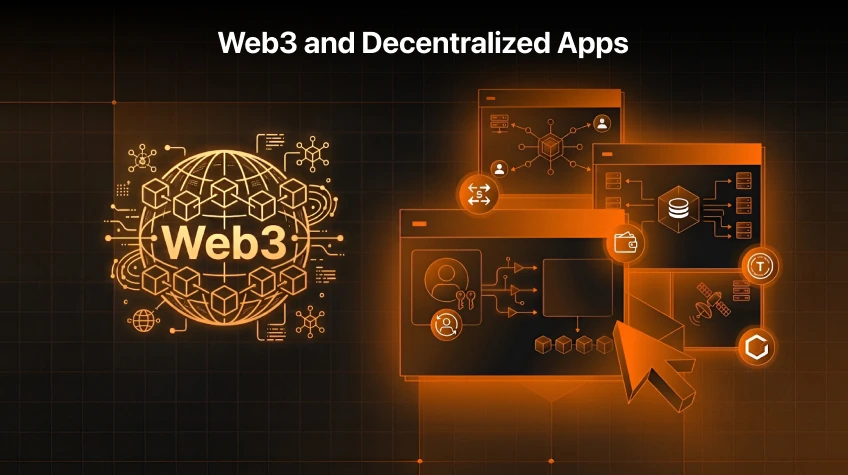
Web3, in turn, can be seen as a decentralized internet model implemented through the peer-to-peer blockchain network. A dApp (Decentralized Application) is run by means of smart contracts – self-executing code written in the blockchain.
🢥 Key Elements of a Modern dApp:
Smart Contracts: Open-source backend code running on the blockchain networks such as Ethereum, Solana, Layer-2 scaling solutions.
Crypto Wallets: User-owned accounts (e.g. MetaMask, Phantom), which become the means for handling user identities and signing transactions without any central passwords.
Decentralized Storage: Network-based storage solutions (IPFS, Arweave) for safekeeping the media, files, and off-chain data.
Open State & Interoperability: Public databases, which make possible reading, composing, and adding to one another’s data for various applications.
The Great Shift: From Hype to Practical Utility
In the first wave of Web3, projects have mostly succeeded thanks to the promise of decentralization rather than its implementation. Nowadays, however, everything has completely changed. The market now wants practicality and does not appreciate empty promises. It demands utility, usability and viable business models.
⮚ What Died Along with the Hype:
Speculative “Play-to-Earn” Games: First blockchain games were focused more on money making than on fun gameplay, which made their in-game economies collapse.
Gimmick Tokens: Projects that create tokens with no obvious use case and economy will have trouble finding long-term users.
Unusable Interfaces: Requiring average people to deal with 12-word seed phrases and calculating gas fees manually cannot be considered viable anymore.
⮚ What Is Thriving Today:
Decentralized Finance (DeFi) Protocols: Market makers, lending and decentralized exchanges with a lot of trading volumes and high availability.
Tokenization of Real-World Assets (RWA): Transfer of traditional financial assets such as U.S. Treasury bonds, real estate, and private loans to blockchain-based systems.
Decentralized Physical Infrastructure Network (DePIN): Peer-to-peer networks of hardware such as wireless hotspots, cloud compute resources and sensors powered by cryptographic rewards.
Why Building in Web3 Is More Viable Now Than Ever
Image Source Forbes
If you are currently working as a developer, founder, or enterprise architect, then now is perhaps the best time for you to explore Web3. Significant progress has been made regarding solving technical bottlenecks that plagued earlier applications running on blockchain.
1. Layer-2 Scaling Has Eliminated Expensive Gas Fees
Using a smart contract during times of peak network activity used to cost $50 to $100 for one simple interaction. However, today Layer-2 rollups (Arbitrum, Optimism, and Base) together with highly scalable blockchains (Solana), have brought transaction fees to a fraction of cents and drastically increased transaction speeds.
2. Account Abstraction Makes Onboarding Experience Like Web2
Onboarding into the blockchain used to be one of the worst parts of Web3. Due to the use of Account Abstraction (ERC-4337) and Passkeys, today’s Web3 dApps provide such options as:
Use regular Google, Apple account, or biometric authentication to log into an app.
Perform transactions without purchasing gas tokens (sponsored transactions).
Recover a lost account without losing your access due to a misused recovery key.
3. Mature Developer Tooling and Frameworks
Building smart contracts used to mean writing experimental code in isolation with minimal tooling. Today, developers benefit from robust, battle-tested development stacks:
Layer
Traditional Stack
Modern Web3 Stack
Frontend
React, Next.js, Vue
Next.js, RainbowKit, wagmi, viem
Backend / Logic
Node.js, Python, Java
Solidity, Rust, Foundry, Hardhat
Database
PostgreSQL, MongoDB
The Graph, IPFS, Ceramic, Arweave
Auth / Access
Auth0, Firebase
Privy, Dynamic, Web3Auth, Privy
Key Business Advantages: Why Choose a Decentralized Architecture?
The reason for the creation of decentralization should not be the desire to make something new. Decentralization should solve certain problems in the business which cannot be solved by traditional software products. The main competitive advantages of the development of a dApp:
Platform agnosticism and trustlessness: The user retains full control over his digital assets and data, he does not need to believe that you will not arbitrarily change terms of service, freeze accounts, etc.
Permissionless composability: In Web3 smart contracts are like open source software modules. You can easily integrate any decentralized exchange, lending protocols, or identity systems without any agreement on the terms of cooperation and obtaining any permission.
Out-of-the-box global settlement: Any payment across borders in the traditional way requires a bank system, currency conversion and several days of waiting. Web3 applications perform such operations in a matter of seconds.
Built-in micro-incentives models: Tokens and smart contracts help builders to align the economy of developers and participants of the community directly.
The Real Challenges of Building a dApp
Image Source Starknet
However, while the advantages may seem obvious, developing applications in Web3 has a number of challenges that software engineers are not used to.
⇨ Immutability Results in No Room for Mistakes
When developing regular websites and applications, developers have the ability to fix bugs by deploying a quick patch within a few minutes of discovering them. In the case of Web3 apps, once a smart contract is deployed to the blockchain, its code becomes immutable. This means that even a small logic error can result in irreparable losses.
⇨ Security and Audits Requirements
Due to the fact that smart contracts interact with finances directly, they represent an attractive target for hackers. Third-party security audit, formal verification, and bug bounties become necessary expenses when launching any dApp.
⇨ Unclear Regulations
Regulations on digital assets, compliance issues with GDPR and other data storage regulations on blockchains, and token classification are still being defined.
How to Decide: Should You Build a dApp or a Web2 App?
Not every product will need blockchain. In order to establish that you have a product that requires Web3 architecture, go through this quick check-list:
➦ Build a Web3 dApp if your product requires:
True ownership of the users of the digital goods/credentials/in-game items.
Decentralized censorship-resistant finance or cross-border payments.
Shared and immutable record-keeping for competing parties who do not trust each other.
Open governance or financial composability.
➦ Stick to a Traditional Web2 Application if your product needs:
Fast and low-latency computational algorithms.
Centralized data storage and data deletion (right to be forgotten under GDPR).
CRUD (create/read/update/delete) databases which do not require public validation.
Regular software services where there is no need at all for decentralized trust.
Conclusion
Is it worth developing a Web3 dApp after all?
If you’re aiming to create a fast project with the intention of creating hype at once, then this opportunity has passed by. However, if you have a goal of making something useful, which solves the problem of centralized systems’ vulnerabilities, then now is the best time for Web3.
The ecosystem has finally grown up. The infrastructure problems are solved, user experience is getting better, and actual enterprise use cases are being built. Web3 is no longer about creating hype, the time for building came.
Solve the user problem, keep the user interface minimalistic and use decentralization for what it’s good for trust and security.