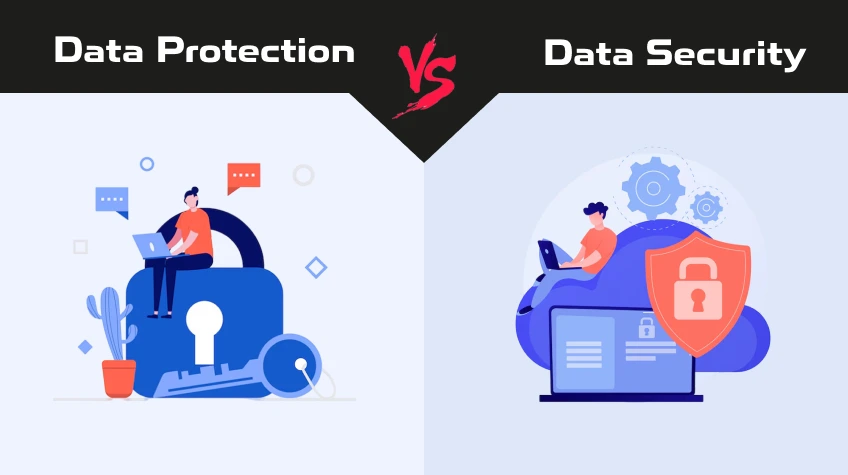
Data Security protects your data from unauthorized access, attacks, and data breaches. Data Protection does the same and a bit more by ensuring privacy, compliance with data protection regulations, and availability throughout its lifecycle.
In a world driven by data, it is critical to ensure that information online is safe from corruption or loss while maintaining availability at the same time. The terms “Data protection” and “Data security” are often confused by most people, even though they represent different aspects of protecting information. Comprehending the difference between the two concepts is necessary for crafting an effective strategy that minimizes damage and reduces risk.
What is Data Protection?
The process of safeguarding one’s sensitive information is known as Data protection. The goal of the process is to prevent data loss and corruption, and to ensure it is always available and compliant with any regulatory requirements.
One of the most effective strategies for protecting data is to replicate it and restore it if it is lost or corrupted. Unfortunately, information online is prone to various predicaments, including but not limited to cyber attacks, server shutdowns, human error, and even intentional harm. Ensuring availability is the core of data protection. This means users can access the information even if it is lost or corrupted, ensuring that daily business operations are not hindered.
In simpler terms, Data Protection is the accumulation of practices, technologies, and strategies that are designed to ensure the information is accessible, recoverable, and holds its integrity at all times.
Be it a case of corruption, deletion, or hardware failure, the promise of recovering information is the core principle of Data protection. The main goal of the strategy is to preserve data. Ensuring the information remains accessible and can be restored to its original state is the key to making sure critical information is kept confidential and reducing the chances of it being doctored.
Implementing practices such as backup, replication, and encryption can play a huge role in recovering information as quickly as possible, while maintaining daily operations.
Key Practices for Data Protection
➢Backup
Image Source freepik
The process of creating and maintaining multiple copies of the same data and storing them separately is known as backing up information. The main purpose backups serve is that they can be restored after the company goes through an unwanted scenario. During incidents such as accidental deletion, data corruption, or system crashes, backups become the lifeline of an organization. Creating multiple copies of the same data ensures companies don’t need to be dependent on a single point. The goal of this process is to ensure minimal data loss by creating multiple points of restoration.
➢Snapshots
Snapshots capture the current state of a system at a specific point in time. This can also refer to datasets. Snapshots are like an earlier version of a system or driver, while backups consist of full copies of the data. With snapshots, you can roll back updates if you are not satisfied with the current version. This feature significantly improves short-term recovery and helps organizations correct accidental changes, deletions, or software errors, ensuring that data can be restored to the last stable state.
➢Continuous Data Protection (CDP)
Tracking the changes in information in real-time or near real-time, is known as Continuous Data Protection. This is the method used to capture every version of the data present in the network. Traditional backups are created during intervals, CDP is a practice that ignores this restriction and creates points of restoration irrespective of the data location. This minimizes the window of opportunity for attacks and reduces the risk of data loss.
➢RAID (Redundant Array of Independent Disks)
The process of distributing data across multiple physical disks is known as RAID. This is mainly done to ensure redundancy and fault tolerance. In case of an immediate failover, RAID 1 is used to mirror data on two or more devices. RAID 5 and RAID 6 distribute data and parity across multiple disks. It is important to note that only RAID 6 provides the ability to restore data in the event of multiple disk failures. Earlier RAID versions and services do not offer this feature.
➢Replication
Copying data across multiple systems or locations to make sure it remains available in the event of a failure is known as Replication. Ensuring immediate failover with zero data loss, along with copying data in real time through Synchronous mirroring, is the new normal, which helps move data across multiple channels in case of a breach. At the same time, Asynchronous replication works over longer distances. Storing and maintaining copies of data in a remote location or separate geographical area increases the chances of recovering and restoring information by maintaining up-to-date copies of data.
➢Erasure Coding (EC)
Erasure coding is a data protection method used in modern storage systems where a file is split into pieces (data shards) and extra parity pieces are created. These pieces are stored across different disks or nodes so the original data can be reconstructed even if some pieces are lost.
Instead of keeping full copies of data, erasure coding does the following things:
Breaks data into k data shards
Creates m parityshards using math
Stores all k + m shards across different locations
Can rebuild the original data if up to m shards are missing
Example (6 + 3 scheme)
A file is split into 6 data shards
3 parity shards are generated
The total number of shards stored is always equal to nine.
The system can lose any 3 shards and still recover the file
That’s strong durability with much less storage overhead than making 3 full copies.
Why it’s popular in cloud storage
Erasure coding is widely used in distributed and cloud storage because it offers:
High fault tolerance
Lower storage cost than replication
Strong data durability across many nodes
Efficient use of disks and network
Organizations are often adopting additional measures along with traditional approaches to strengthen their data and to keep it protected. Some of these Data protection methods include backups, snapshots, RAID, and replication, accessibility, risk management, and encryption.
What is Data Security?
The practice of protecting data from unapproved access, data corruption, loss, and theft throughout the information’s life cycle is called Data security. This also holds whether the data is in transit or at rest, or is currently being utilized by some program.
Data security ensures that only the right people have access to the information, which in turn makes sure the data is not tampered with, is accurate and reliable, and accessible when necessary.
Key Practices of Data Security
➢Encryption
Image Source freepik
Encryption of information is done by converting data from human languages to unreadable code. This should be done at all times, whether the data is in transit or is stored. Along with secure key management, Capable encryption algorithms ensure attackers can gain nothing even if they manage to successfully penetrate the system.
➢Intrusion Detection and Prevention Systems (IDPS)
IDPS is a practice that helps monitor the network traffic and activity throughout the system to look for any potential suspicious behavior. It can help identify potential threats like malware, anomalies in regular patterns, and even sniff out hacking attempts made by cyber attackers. The only drawback this practice faces is that it has to choose between two functionalities, either detect threats (IDS) or actively prevent them (IPS) by blocking malicious traffic.
➢Data Loss Prevention (DLP)
Unauthorized leakage and sharing of information still remains as the most common cause of a data breach. Preventing unauthorized sharing, leakage, or transfer is very important. Data Loss Prevention technologies protect sensitive data and monitor the same to prevent unauthorized access. Some of the principles of DLP are safeguarding intellectual property, financial data, and personally identifiable information (PII).
Key Differences between Data Protection and Data Security
Even though the two aspects of Data Protection are closely related, they look to solve different challenges within the field of Data management. In the unfortunate event of accidental loss, corruption, or system failures, Data protection ensures the data is recoverable and tamper-proof. While data security deals with different threats to information, such as unauthorized access, theft, or cyberattacks.