
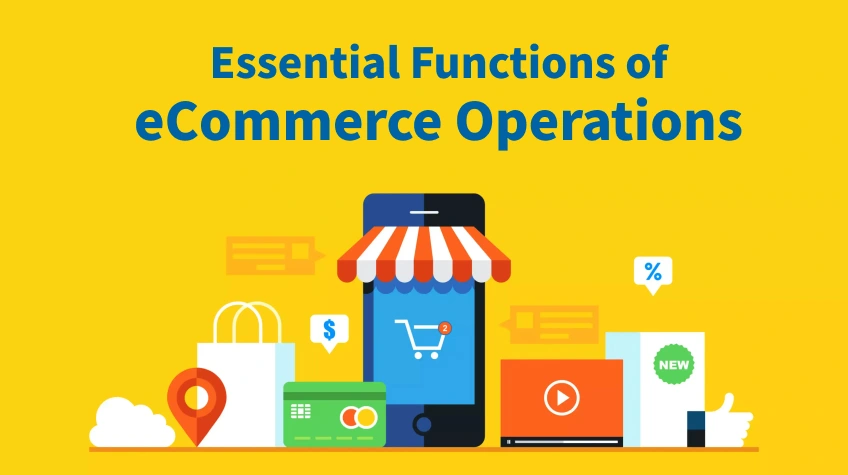
It isn’t unreasonable to believe that a fantastic product, which solves a problem, and a well-designed website to sell it are the sole requirements for success in the rapidly changing field of online retail, but the magic actually comes from behind the scenes, as any seasoned business owner will tell you. Your store’s front end manages the “wow” factor, while the rear end takes care of the “flow.”
Situational heroics and manual workarounds are not enough to scale an e-commerce business. A rigid system governing all of the functions is a necessity. This is where eCommerce operations’ functions are very useful. Namely, they are the administrative and logistical procedures of your business that keep the entire digital “engine” running seamlessly, ensuring a smooth experience from the time a consumer clicks “Buy” until the package arrives at their door.
If you want to scale your revenue without breaking you or your team mentally or going over your budget, you must master these core operational functions.
Why Operational Efficiency Matters
It is essential for owners to understand why operational efficiency is the foundation of scalability before breaking down the various functions. Growth can actually be harmful for the business if it is not supported by a strong operational base. Increased traffic without efficient processes causes shipments to be delayed, customers to become impatient and unsatisfied, and causes reputational harm.
Tightening your operations should be your first goal for the following reasons:
- Preserves Profit Margins: Effective operations cut down on waste, such as labor hours spent on tedious manual data input, excessive inventory storage fees, or expedited shipment prices brought on by delays.
- Increases Customer Loyalty: Customers want accuracy and speed in the era of modern e-commerce businesses like Amazon. A single wrong or delayed delivery can alienate a once-loyal customer. Consistent operations will always amount to consistent trust from customers.
- Makes Forecasting Easier: Data eventually becomes dependable when all your other procedures are standardized and maintained correctly. You will be able to predict transportation costs, manpower demands, and inventory needs more accurately through correct data collection and automation. This helps businesses cut down costs and save time.
- Frees Up Human Capital: Like the previous point, your team can concentrate on high-value tasks like product development, marketing strategy, and cultivating supplier relationships if and when they are not preoccupied with battling supply chain fires or other predicaments which could have been avoided if the right precautions were taken.
- Builds Capacity for increases: Effective operations have the buffer to withstand abrupt increases in order volume without collapsing, whether it’s a viral TikTok post or a Black Friday surge.
Operational Functions: The Core Four
You must see your company as a set of interrelated cogs if you want to create a scalable eCommerce empire. The main components of your business are represented by the four main functions listed below. The system slows down as a whole when one cog breaks.
➢ Marketing & Customer Acquisition

Due to its involvement in data management, finance, and technological stacks, marketing is a fundamental operational function even though it is sometimes perceived as a creative department. Not only is traffic generation the aim here, but profitable, trackable traffic is as well.
The operational side of marketing involves managing the tools that acquire customers. This includes:
- Channel management: supervising the integration of sales channels (such as Shopify, Amazon, Etsy, and social commerce) to guarantee proper pricing and inventory synchronization.
- Attribution & Analytics: Putting in place mechanisms to precisely monitor the origins of clients. You may be squandering money on non-converting channels if you don’t have the right operational setup.
- Email/SMS Automation: Creating the sequences that collect non-buying leads and follow up with them until they’re ready. This is a continuous operational loop.
For scalable growth, your marketing operations must ensure that the cost per acquisition (CPA) remains stable even as the ad spend increases over time.
➢ Transaction processing
The money exchange is covered by this function. Taking the customer’s money may seem straightforward, but the processes involved are intricate and vital to cash flow. Growth ceases if deals are unsuccessful.
- Payment Gateway Integration: Making sure that the checkout process is easy, safe, and takes a variety of payment options (credit cards, digital wallets like Apple Pay, and BNPL services like Klarna).
- Fraud Detection: Using software and rules to automatically flag or deny orders that seem suspicious. Your margins and merchant account could be destroyed by a high chargeback rate.
- Order Confirmation & Data Flow: As soon as a transaction is completed successfully, operational data must be sent to the fulfillment team to begin packing and to the inventory management system to subtract stock.
- Tax Compliance: By automating sales tax collection in many states or nations, you can maintain compliance without having to perform laborious calculations.
Any hiccup in transaction processing usually results in “abandoned carts,” which is the enemy of scalable growth.
➢ Fulfillment & Logistics
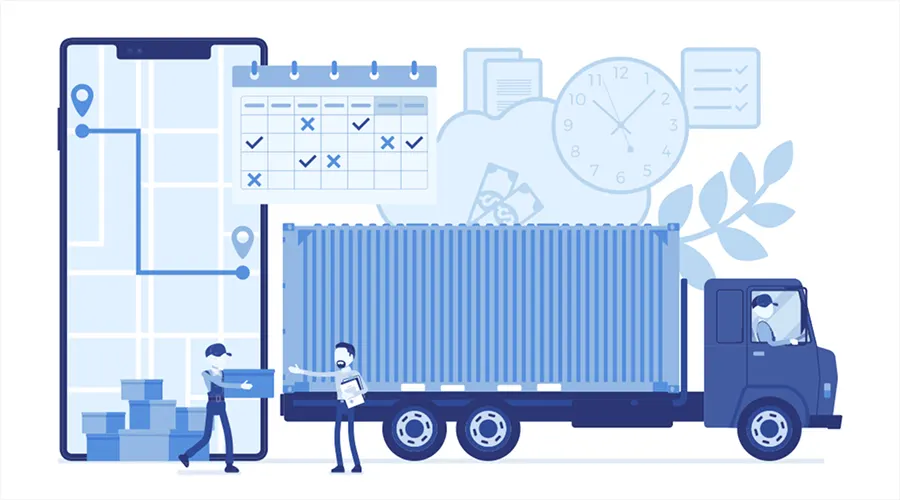
This is eCommerce’s mechanical core. The process of getting the goods from the warehouse rack to the consumer’s arms is known as fulfillment. Because it requires both physical space and manual labor, it is sometimes the most challenging function to scale.
The operational components of fulfillment include:
- Inventory management: Being aware of the precise location of your stock at all times. This avoids underselling, which wastes money, and overselling, which irritates clients.
- Warehouse Organization: Using picking and packing techniques (such as batch or zone picking) to expedite the delivery of goods.
- Shipping Rate Shopping: Using shipping software to automatically choose the fastest or least expensive carrier based on the destination and cargo weight.
- Reverse logistics (returns): establishing an effective system for managing returns. Future purchases may be discouraged by a convoluted return policy. “Easy returns” is now a differentiator.
Many companies go from do-it-yourself garage fulfillment to third-party logistics (3PL) suppliers in order to scale, delegating this significant operational burden to professionals.
➢ Customer Support & Retention
It can be five times more expensive to acquire a new client than to keep an existing one. Profitability has a direct impact on customer service operations.
Modern customer support operations rely heavily on:
- Ticket Management Systems: Helpdesk software is used to make sure that no chat, direct message, or email is overlooked.
- Self-Service Options: Creating an extensive support center or FAQ. Resolving issues before they become tickets is the definition of operational efficiency. Operational scalability is achieved when a customer can use a portal to track their own order or handle their own return.
- Post-purchase engagement: Operational sequences that request reviews, remind customers to restock consumables, or offer styling advice are examples of this. This maintains brand awareness.
- Feedback loops: methodically gathering complaints and return reasons, and sending that information back to the marketing or product sourcing departments.
Automation Opportunities

You are limiting your potential for advancement if you are performing any of the aforementioned tasks by hand. A busy store and a scalable business, as a result, are connected via automation. You can (and probably should) automate a lot of trivial tasks that can free up your time to invest in other important activities, some of which include: inventory synchronization, sending customized email sequences based on customer behavior, forwarding support tickets to the appropriate department, and updating tracking data automatically using modern technologies like Zapier, Shopify Flow, or custom API integrations. The objective is to reduce human error and speed up all of the functions by eliminating as much manual data entry as possible.
Conclusion
Having an attractive storefront is not enough to build a successful eCommerce brand. It requires a strong operational foundation. The only way to build a company that can withstand expansion without collapsing under its own weight is by becoming an expert in the four main eCommerce operations, namely acquisition, transaction processing, fulfillment, and support.
You can grow with confidence when your operations are tightly regulated, ensuring that each new client will have the same wonderful experience as the last one. In other words, consistency. Pay attention to these pillars, embrace automation, and observe how your company grows to a well-oiled growth engine.
Frequently Asked Questions (FAQs):
1. Which is not a function of e-commerce?
E-commerce is not a direct function of physical inventory management. Online sales and order administration are made easier by e-commerce platforms, but physical aspects of a business, such as inventory handling and storage, are distinct operations that companies must handle on their own.
2. Is warehousing a function of e-commerce?
The primary purpose of e-commerce platforms is not warehousing. But for e-commerce companies to fulfill orders quickly and keep customers happy, effective inventory management and warehousing are crucial. To manage storage and order fulfillment, businesses must set up their own warehouse systems or collaborate with outside logistics companies.
3. Can e-commerce functions be customised for specific business needs?
Indeed, a lot of e-commerce systems provide customization options so that the functionality of the website can be tailored to meet certain business needs. To improve the different features and performance of their online store across the board, businesses can select from a variety of layouts, plugins, and integrations. Certain systems even enable custom development to produce distinctive e-commerce experiences that complement the objectives and brand of the company.
4. Are these e-commerce functions suitable for small businesses?
Small and medium-sized businesses (SMEs) are among the businesses of all sizes served by e-commerce platforms. Setting up and running an online store is made simple for small enterprises by the numerous platforms’ user-friendly interfaces and reasonably priced plans. By efficiently exhibiting their items and reaching a larger audience, e-commerce levels the playing field and enables small businesses to compete with larger shops.