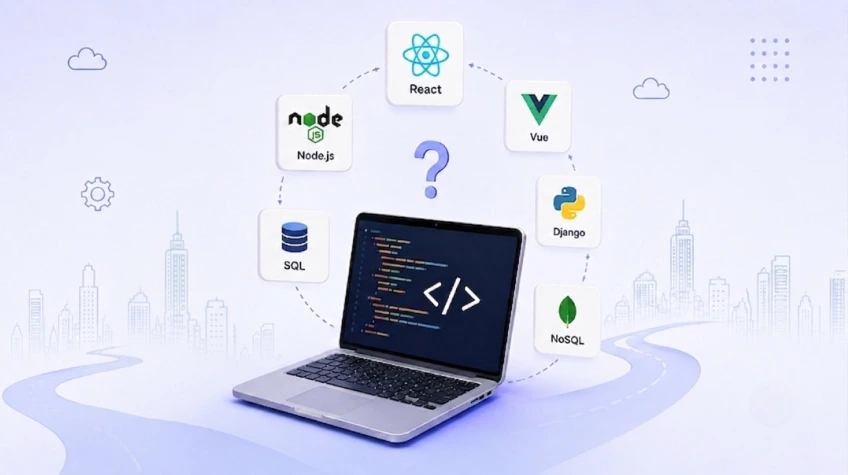
Every startup reaches a point where a simple question suddenly feels like a major decision: “What should we build it with?” You’ve validated the idea, found your first customers, and defined the product you want to build. Now you’re faced with dozens of languages, frameworks, databases, and platforms each with its own advantages, trade-offs, and passionate supporters. React or Vue? Node.js or Django? PostgreSQL or MongoDB? The challenge isn’t finding the “best” technology; it’s choosing a stack that fits your product, your team, your budget, and your plans for growth. Because the right technology stack can help you move faster, control costs, attract the right talent, and scale with confidence while the wrong one can create complexity and technical debt before your startup even gets off the ground.
What a Tech Stack Actually Means for Your Startup
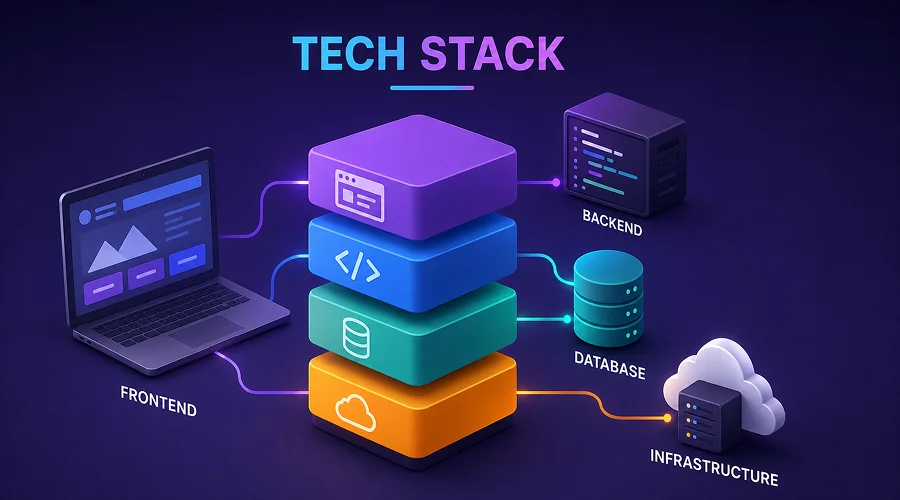
Take away the buzzwords and a stack is the set of tools, languages, and platforms that you’ve decided to use to build and run your product.
It consists of four layers:
- Frontend, what your users see and interact with
- Backend, the server-side code that makes things happen
- Database, where your data actually lives
- Infrastructure, hosting, deployment, the support gear that keeps it all running
When it comes to an enterprise, the stack is a long-term architectural decision supported by specialized teams. For your startup, it’s something that changes at the drop of a hat: a foundation laid while the plan is still being sketched out.
You’re not choosing tools. You’re choosing constraints. Each framework you choose chooses for you what is easy to build later and what you will have to rewrite.
You really aren’t deciding “what’s the best stack?” You’re deciding “best for what point, team, and goal?” A stack for a two-person product team racing to build MVP to demo day is a different beast than a stack for a Series A product team preparing to 10x your users.
Key Things To Consider When Choosing A Startup Tech Stack
There isn’t a right stack. There is a right way to get to a stack. Below is the difference. A stack that speeds you up versus a stack that stages you and keeps you hostage.
➣ Project Requirements and Features
Product over toolbox.
There’s nothing that technically relates a content-heavy marketplace to a real-time chat app or a data-crunching analytics dashboard.
Ask yourself:
- Does it need real-time: chat, live dashboards, notifications?
- Heavy media, large uploads, data crunching?
- Web-first, mobile-first, platform taste?
- Does offline sync matter?
Let the answers dictate the stack. Trying to find the right stack before you know what you’re building is equal to buying lumber before you’ve drawn the blueprint.
➣ Development Speed and Time to Market
For most startups, speed isn’t an option. It’s oxygen.
Time is geared towards testing assumptions and getting real feedback again and again. Often before you’ve hit the runway’s end . That’s where you get ripped for all the scaffolding that’s already built for you, and the sophisticated infrastructures that they provide. Rails, Django, Next.js , and so on. They’re there for a reason. So that you don’t wait months to ship. In weeks.
The catch: the fastest stack to launch with isn’t always the fastest to scale with.
But it’s not something to avoid speed for. It’s an opportunity to be conscious of which corners you’re cutting now , and with what you’ll come back later when you’ve got product-market fit.
➣ Team Expertise and Hiring
Your “best” tech is useless if you don’t have people on staff who can uphold it.
Your newest, niche language may shine like a diamond in your next pitch deck. But your co-founder only speaks JavaScript, hiring is always tight, and you’ve just made your own life more difficult , for no reason at all.
Two questions are more important than any trend report:
- What does your team already know, well enough?
- How deep does the hiring pool for this tech reach, at your cost, in your market?
Popular stacks like MERN and MEAN aren’t namesakes by coincidence. They’re faster to form into MVPs, easier to tap into freelancers, and offer a larger talent pool when you’re ready to grow.
➣ Scalability and Performance
Nobody builds an MVP expecting it to stay small. Yet plenty of startups build like it will.
Scalability isn’t a matter of over-engineering for a lot of users on day one. It’s about avoiding technical pitfalls that require an entire rebuild once you get traction.
Two ways to assess this:
- Vertical scalability, can your data store and backend scale to heavier loads and more chaotic queries as your user base grows?
- Horizontal scalability, can your architecture reliably get more servers or instances when the demand bursts?
Cloud native infrastructure, Docker, and managed services from AWS, Google Cloud or Azure have made this a lot easier. Don’t try to perfectly predict the scale, but don’t try to box yourself in.
➣ Cost and Resource Efficiency
Every choice has a cost behind it that’s not obvious to everyone.
There’s a hosting cost. There’s a licensing cost. And there’s the cost of developer hours spent learning an obscure or poorly documented tool that can’t solve your problem.
Open source is (well) what the startup world prefers: no licensing fees, an active community, no built-in constraints. But “free” and “cheap” are not the same. A free framework that triples access time is no cheaper than paying.
Weigh the equation. Upfront cost, ongoing maintenance cost and opportunity cost of being slower than you need to be.
➣ Community Support and Long-Term Maintenance
Picture this: it’s 11 p.m., you’ve hit a bug, and there’s no Stack Overflow thread, no active GitHub, no documentation to lean on.
That’s the real cost of choosing an obscure framework for the novelty of it.
Community strength translates directly into fewer roadblocks, easier onboarding, and confidence the tool will still be maintained and secure three years from now.
Before committing, check:
- Is it actively maintained, with regular updates?
- Does it have a healthy open-source ecosystem — plugins, libraries, integrations?
- Is there enough documentation to unblock a stuck developer fast?
A vibrant community isn’t a vanity metric. It’s your safety net for the inevitable 2 a.m. break.
How the Right Stack Changes With Your Startup’s Stage
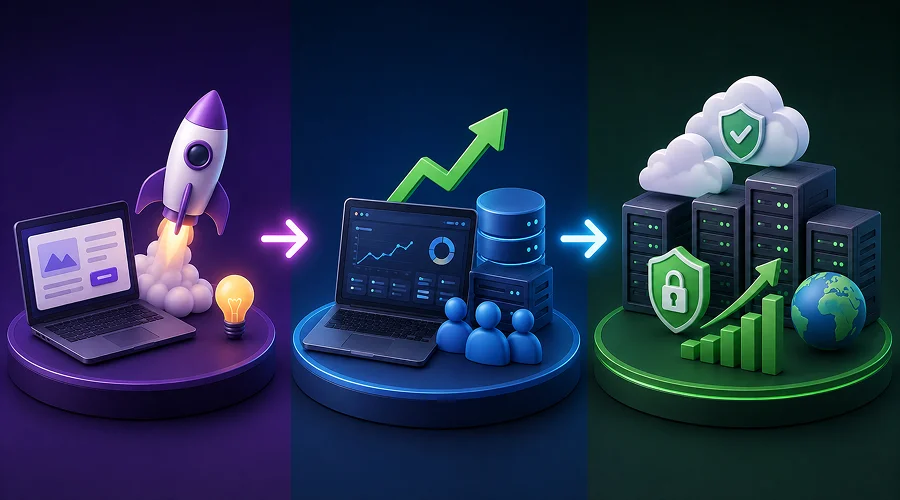
This is something that many founders often overlook: the “right” stack isn’t static. It evolves as you do.
⮚ Pre-Seed / MVP Stage
Speed is priority. Month in, month out. Get the tools so you can validate quickly, even if those tools won’t stay forever. Nobody remembers what your MVP was built with. They remember if it worked.
⮚ Post-Product-Market Fit
Now the focus changes. Can it handle real traffic? Can we bring in talent fast enough? Is the data stack starting to be a weak spot? Most smart companies at this point start to pay down the “speed debt” they accrued , typically not forcing a rewrite, but hardening the pieces most under strain.
⮚ Scale Stage
By now, performance, security, and reliability are not perks, they’re the product. Choices come down less to what’s quickest to build and more to what won’t break under pressure. By knowing what stage you’re in you’ll avoid one common pitfall: over-engineering an MVP as if it were a scale-up, or under-engineering a growing product as if it were still day one.
Choosing a Tech Stack for AI-Powered Startup Products
Building AI-powered features, recommendation engines, chatbots, predictive models, generative tools, adds its own layer that most traditional-stack advice doesn’t even touch on.
Besides the usual front-end/ back-end choices, you’ll need the usual suspects for a new AI startup: machine-learning frameworks (TensorFlow, PyTorch, etc.), vector databases for embeddings, robust APIs to plug into large language models, ideally a heavier compute capable infrastructure. Of course Python is king these days – given the maturity of its machine-learning ecosystem, most of these pieces are available in Python. But the technologies surrounding the stack often prove more important than the language of your codebase. For an AI startup, your stack isn’t just about building an application. It’s about building a responsible, affordable intelligence system at its core.
Most Common Tech Stack Combinations for Startups
Every product has different needs: some have expensive data pipelines. Some want to iterate fast. Regardless, there are some standard combinations that have proven their worth for early-stage companies over and over again:
- MERN Stack (MongoDB, Express.js, React, Node.js), a standard JavaScript-only stack that works well for fast-moving teams and dynamic web apps.
- MEAN Stack (MongoDB, Express.js, Angular, Node.js), a more structured sibling to MERN, often chosen for larger, more fleshed-out builds.
- Django + React, Python-based Django for a solid backend with great security features in-built, paired with the flexibility and responsiveness of a React frontend.
- Ruby on Rails, still popular for lean MVPs thanks to its “convention over configuration” speed.
- Next.js + Node.js/Express + PostgreSQL, a modern, SEO-friendly traditional full-stack combo that runs efficient, performance-focused apps.
- Flutter or React Native , one codebase, two platforms: for mobile-first startups that don’t want to write Java/Obj-C
- Serverless stacks (AWS Lambda, Firebase, Supabase) , paying for what you use, sleeping at night
- Python + PyTorch/TensorFlow + Flask/FastAPI , predictable science mission for AI + data-heavy products
No one is better in all cases, each has a tradeoff: speed, flexibility, scalability, hiring
Mistakes Founders Make When Picking a Stack
We see these mistakes often and they are worth naming
Chasing Novelty Over Fit: Reinventing the wheel because it looks cool, not because you need it. Novelty is NOT a requirement.
Building for the wrong size: Stretching a Netflix-scale stack when you have 12 users. That extra complexity will make you slower on day one.
Not paying attention to hiring: Jokingly picking a stack that nobody in your budget range can actually build with. Expensive tools are boring!
Emphasizing one loud engineer over the team: A good team has good opinions. But a stack chosen because one guy likes it best is a shaky foundation.
The Final Gut Check
Before you commit, run your shortlist through one last test:
- Can we build our core feature set with this in the next quarter?
- Can we actually hire for it if we need to scale the team quickly?
- Will it survive a 10x spike in users without a complete rewrite?
If you’re not 100% sure with any of those, go back and refine the shortlist. A stack switch in six months will cost you more than a week of extra research today.
Final thoughts
The best technology stack isn’t about following half the frameworks or your favourite unicorn’s tech blog. It’s about being realistic about your product, your team, your runway and your desires and finding the stack that fits all four.
The best stack will let you move fast today, without forcing you into a painful rewrite tomorrow.
Still on the fence? Talk it over with an experienced development partner, it’ll save you months of expensive trial and error and it’s a lot cheaper to get the base right at launch than to fix it later.
Also Read: Best Tech Stack for Learning Management System (LMS) Development