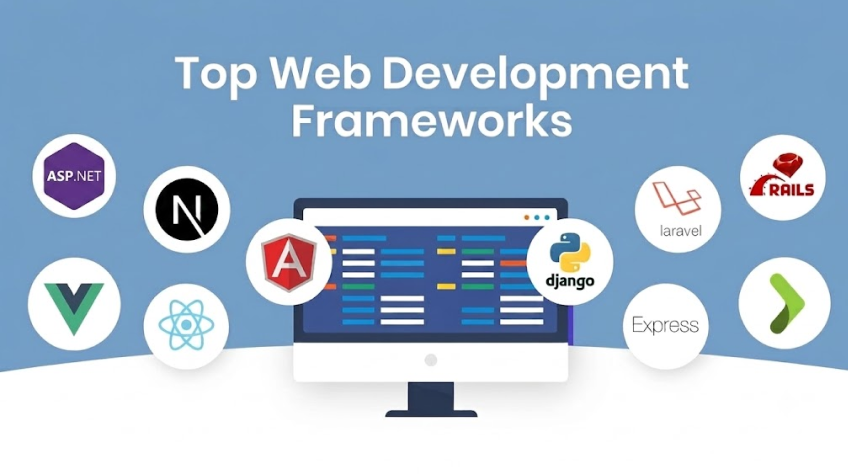
Building websites and web applications has never been easier. Modern web development frameworks provide ready-to-use tools that help developers create secure, scalable, and high-performing applications without starting from scratch. Whether it’s a simple website, an eCommerce store, or a complex enterprise solution, these frameworks simplify the entire process. However, choosing the right framework is crucial to save time, boost performance, and reduce maintenance costs. In this post, we’ll explore the 10 best web development frameworks to help you make the right choice.
First off, let’s understand the basics of web development frameworks. Here we go…
What Exactly Is A Web Development Framework?
A web development framework is a collection of tools, libraries and pre-written code. It helps developers build websites and web applications quickly. Frameworks provide ready-made foundation for developers so that the time that is spent in creating common features can be saved. Developers can use built-in solutions (included in the framework) to create common features like user authentication, routing, database connections or security, instead of creating them from scratch. Web development frameworks help developers to build applications more quickly, improve code quality, enhance security, simplify maintenance and create scalable applications that can grow with business needs.
Benefits of Web Development Framework
There are numerous benefits of using web development frameworks, which include:
Faster development
Better code organization
Maintenance becomes easy
Security becomes robust
Scalability becomes easier
Strong community support
In addition, modern frameworks are constantly updated so it becomes easier to keep up with new technologies and changing user expectations.
Top 10 Web Development Frameworks In 2026
There are numerous frameworks available out there and selecting the best may feel like task. We have outlined the 10 best web development frameworks here; you can choose the ones depending on your preferences. Take a look…
1. React
At number 1, we have React. React is by far one of the most popularly used frameworks. It helps build
modern user interfaces. React is technically a JavaScript library; however, developers often use it for building modern web applications. It was developed by Meta in 2011. This web development framework offers reusable components to make it easier for developers to create dynamic and interactive websites. Instead of rebuilding entire web pages whenever data changes, React updates only the parts that need refreshing. This, in turn, results in faster performance and a smoother user experience.
Pros:
Component-based architecture
Excellent performance
Huge developer community
Extensive third-party libraries
Easy integration with other technologies
Cons:
Requires additional tools for complete application development
Beginners may need time to understand concepts like state management
Ideal For: React framework is ideal for creating single-page applications, Dashboards, social media platforms, E-commerce websites and interactive web portals
2. Angular
Another popular web development framework is Angular. This front-end framework was developed by Google in 2009 and is still maintained by Google. This best thing about this framework is that it offers almost everything developers need for building large-scale web applications. With this, developers don’t need to rely much on external libraries. Angular uses TypeScript. This makes it easier for developers to build scalable applications. It also offers built-in testing tools, dependency injection, routing and form handling. Angular is the most preferred choice for large-scale web development, all thanks to its structured approach and long-term maintainability.
Pro:
Complete development framework
Excellent for large teams
Strong security features
Built-in testing capabilities
Long-term stability
Cons:
Steeper learning curve
More complex than lightweight frameworks
Ideal For: Angular is considered best for developing enterprise software, banking platforms, healthcare applications, government portals and business management systems.
3. Vue.js
The next web development framework is Vue.js. Vue.js is very popular among modern developers and the reason being its simplicity and impressive performance. It allows them to quickly create impressive applications. Also, it helps developer improve productive in simpler words. In addition, Vue.js allows developers to gradually introduce its features into existing projects. This makes migration easier for businesses. Moreover, Vue.js is easy to learn thanks to its clear documentation and simple syntax, but it also has advanced features for experienced developers.
Pros:
Easy to learn
Lightweight
Excellent documentation
Fast rendering
Flexible architecture
Pros:
Smaller ecosystem compared to React
Fewer enterprise-level resources
Ideal For: Vue.js is Best considered best for building business websites, SaaS applications, small to medium projects, progressive web applications and interactive dashboards.
4. Next.js
Next.js is yet another amazing framework widely used in modern web development. It simplifies complex tasks such as server-side rendering, static site generation, routing and search engine optimization. This framework is known for building websites that load quickly and are easier for search engines to find. Businesses that want to improve website speed while maintaining excellent user experience often prefer using Next.js.
Pros:
Excellent SEO support
Faster page loading
Automatic routing
Image optimization
Strong performance
Cons:
Requires understanding of React
Some advanced features need additional configuration
Ideal For: Next.js is best for building marketing websites, SEO-friendly websites, E-commerce stores, content platforms and large web applications.
5. Django
Another framework that developers often use to build impressive systems is Django. Django is a high-level Python framework. It is popular among developers as it allows them to create secure and scalable applications quickly. Its “batteries included” philosophy makes it a standout framework among others. It comes with authentication, administration panels, database management, security protections and many other built-in features. More often than not, startups and enterprise companies choose this framework because it makes launching applications much faster.
Pros:
Strong security
Rapid development
Built-in admin panel
Excellent documentation
Highly scalable
Cons:
May include features unnecessary for smaller projects
Less flexible for highly customized architectures
Ideal For: This framework is ideal for developing content management systems, educational platforms, data-driven applications, AI-powered web apps and business platforms.
6. Laravel
Here is another very popular web development framework is Laravel. Laravel is one of the most preferred PHP frameworks. It allows developers to build applications faster with clean and well-structured code. Another best thing about this framework is that it simplifies common tasks such as routing, authentication, caching, email integration, database management and background job processing. Moreover, Laravel’s clean and easy-to-read syntax makes it beginner-friendly and enjoyable to work with.
Pros:
Clean syntax
Excellent documentation
Strong security
Built-in authentication
Large ecosystem
Cons:
Performance may require optimization for extremely large applications
Depends heavily on PHP knowledge
Ideal For: Laravel is considered best for building business websites, online marketplaces, membership platforms, CRM systems and custom web applications.
7. Express.js
Now comes Express.js. Express.js is yet another widely used web development framework. This backend frameworks for Node.js is known for its minimal design. It gives developers complete freedom to structure applications according to project requirements. Express.js is widely used for full-stack development because it allows developers to use JavaScript across the entire application development. Its lightweight structure also makes it ideal for building fast APIs and web services.
Pros:
Lightweight
Fast development
Flexible architecture
Large package ecosystem
Easy integration
Cons:
Requires more setup than opinionated frameworks
Some security features need manual implementation
Ideal For: Express.js is best for creating REST APIs, backend services, real-time applications, chat platforms and full-stack JavaScript projects.
8. Ruby on Rails
At number 8, we have Ruby on Rails. Ruby on Rails is known for enabling rapid application development. It is mainly based on the principle of reducing repetitive coding while encouraging best development practices. More often than not, startups use Ruby on Rails to launch products quickly before they actually expand into larger platforms. The best thing about this framework is that its built-in features let developers focus more on building applications instead of spending time on setup and configuration.
Pros:
Fast development
Convention over configuration
Strong testing support
Large collection of plugins
Active community
Cons:
Performance may require optimization for high-traffic systems
Smaller developer community than JavaScript frameworks
Ideal For: Ruby on Rails is considered best for startup products, MVP development, SaaS platforms
community websites and marketplace applications.
9. Spring Boot
The next web development framework making traction among developers is Spring Boot. Spring Boot is a Java-based framework. It is designed specifically for creating enterprise-grade applications with minimal configuration. Spring Boot makes Java development faster and easier without compromising the stability and reliability of the Java platform. That’s the reason often enterprises choose it. It makes it easier to create highly secure and scalable applications. Moreover, applications built on Spring Boot are easy to maintain in the long run.
Pros:
Strong security
Excellent cloud integration
Solid ecosystem
Highly scalable
Reliable performance
Cons:
Steep learning curve for beginners
Higher memory usage than lightweight frameworks
Ideal For: Spring Boot is considered best for enterprise software, financial services, healthcare systems, cloud applications and large-scale business platforms.
10. ASP.NET Core
Last but not least is ASP.NET Core. ASP.NET Core is Microsoft’s framework known for being contemporary. This open-source framework makes building web applications across multiple platforms a breeze for developers. It offers high performance, excellent security and seamless integration with Microsoft’s development tools and cloud services. Businesses that use Microsoft technologies prefer using ASP.NET Core for web development.
Pros:
Robust performance
Cross-platform support
Strong security
High scalability
Long-term Microsoft support
Cons:
Best suited for organizations using Microsoft technologies
Some advanced features require familiarity with the .NET ecosystem
Ideal For: It is best for developing cloud-based services, enterprise web applications, corporate portals, financial software and business management platforms.
Let’s now talk about the most important part of this article – the steps to choose the right web development framework. Here we go…
How to Choose the Right Web Development Framework
Of course, it is crucial to choose the right web development framework. But there is no doubt that choosing the one from so many frameworks is a task. There is no single framework that works best for every project. So, here are some things to keep in mind when making the choice. Take a look…
1. Project Size:
Consider the size of your project when selecting the right web development framework. If you are creating a small project, then consider opting for a lightweight framework, such as Vue.js or Express.js. However, if the project is large in size, then Angular or React can be your best options.
2. Performance:
Another important thing to consider is the performance. If you want to launch your product quickly, then Next.js, React and ASP.NET Core make the best choice.
3. Scalability:
Scalability is yet another important consideration when making the choice. If you expect your application to grow in future, then use a framework that can handle increasing traffic and complexity without impacting the whole application. Frameworks like Django, Spring Boot, Angular and Laravel come in handy here.
4. Learning Curve:
Learning curve is yet another crucial point to consider. If you are just starting the development journey, then consider beginner-friendly frameworks, such as Vue.js, Laravel and React. However, experienced developers can consider using Angular or Spring Boot.
5. Security:
It is wise to choose framework with built-in security features. Security is important because most applications today are designed to handle sensitive information. Frameworks that include built-in security features, such as Django, Angular, ASP.NET Core and Spring Boot make the best choice here. These frameworks significantly reduce development risks.
6. Community Support:
Lastly, it is wise to choose a framework with larger community support. A larger developer community support is required for better documentation, more tutorials, faster bug fixes and a wider selection of plugins. Most frameworks, include React, Angular, Laravel, Django and Express.js already boast strong community support.
How Can A Well-Chosen Framework Help
A rightly chosen web development framework can make a huge difference. It can significantly impact the performance, maintenance, security, scalability and future growth of your application. It mainly helps developers to:
Build applications faster
Reduce development costs
Improve long-term maintainability
Deliver a smoother user experience
Simplify testing and updates
Support future feature expansion
Avoid unnecessary complexities
Speed up development
Streamline maintenance and so on.
Putting it all together…
So, these are the 10 best web development frameworks available for modern application development. These frameworks help developers save a lot of time as they allow them to focus on creating better user experiences and eliminate solving the same technical challenges repeatedly. The list contains frameworks for all kinds of developers, whether you are building responsive front-end applications or reliable back-end solutions. All of the solutions are impressive in their own ways. Select the one that matches your project’s goals, your team’s expertise and your long-term plans. The right framework can speed up development, make maintenance easier and provide a strong foundation for applications that grow smoothly with your business.
FAQs
1. Which one is the best web development framework?
Well, all the frameworks are designed to make development easier. When it comes to choosing the best, there is no single best framework. The selection mainly depends on the project requirements and development goals. For instance, React and Next.js are excellent choices for modern front-end development. Whereas, Django, Laravel, Express.js, Spring Boot and ASP.NET Core make back-end development a breeze. Hence, you are advised to consider your project requirements and development goals before selecting the best framework.
2. Which web development framework is best for beginners?
Vue.js, Laravel and React are beginner-friendly frameworks. They are pretty popular among beginners as they offer clear documentation, simple syntax and a large number of learning resources.
3. Which framework is best for building enterprise applications?
Angular, Spring Boot, and ASP.NET Core are often considered best for creating enterprise applications. These frameworks provide strong security, scalability and long-term support for large projects.
4. Which web development framework is best for SEO?
Next.js is considered best for SEO. It supports server-side rendering and static site generation. This, in turn, helps websites load faster and rank better in search engine results.
5. Which is the framework best for building APIs?
Express.js, Django, Laravel and ASP.NET Core are the best for building secure and high-performance RESTful APIs and web services.
6. Are all web development frameworks free to use?
Not all, but most of the most popular frameworks, such as React, Angular, Vue.js, Next.js, Django, Laravel, Express.js, Ruby on Rails, Spring Boot and ASP.NET Core, are open source and free to use.