
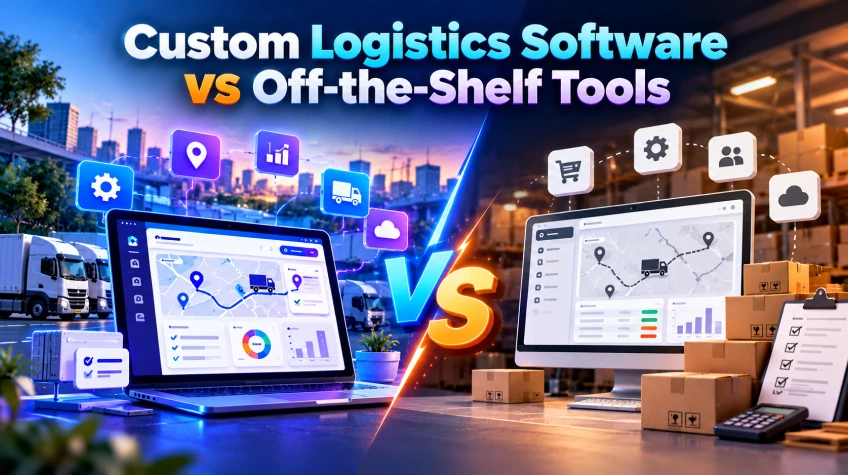
Your fleet is growing. More vehicles, new routes, new drivers, new customers and the spreadsheet tools that suffice for a fleet of twelve trucks are starting to become cumbersome as your fleet grows to thirty.
In the logistics industry, efficiency means everything. A delayed package, poor route optimization, lack of visibility of your fleet, all of these translate into increased costs, loss of credibility and bigger problems for operations further down the line should your current system not be able to cope.
Two roads branch out at this stage. On the one hand, you could go for off-the-shelf logistics platforms designed specifically for fleets like yours; on the other hand, you could design something tailor-made to your operations.
Either choice can be considered a good one. Either option comes with trade-offs. It matters less which choice will objectively come out as the better one than what the current stage in your development requires.
This article covers the main distinctions and the framework required to make the correct choice for your growing fleet.
What Is Off-the-Shelf Logistics Software?
Off-the-shelf logistics software is a ready-made platform that is created to serve the largest possible number of fleet owners. The company creates the solution that will function well for the most common logistics use cases: route planning, vehicle tracking, driver management, delivery scheduling, and reporting, and then sells the access to it to hundreds or thousands of customers.
Examples of such solutions include:
- Fleet management platforms like Samsara, Verizon Connect, and Teletrac Navman
- Route optimisation solutions like Route4Me and OptimoRoute
- Transport management systems like Oracle TMS and MercuryGate
- Last-mile delivery platforms like Onfleet and Bringg
All of these platforms are well-tested and well-maintained. They release new functionality regularly, have customer support, and provide pre-built integrations with various third-party tools (accounting software, ERP systems, customer portals, etc.).
The drawback of such a solution is standardisation. Each of the features was built for a general audience, not for your specific business model.
What Is Custom Logistics Software?

Custom logistics software is tailor-made specifically to fit just one organisation, and will have functionality, processes, user interfaces, and integrations that mirror exactly how the organisation functions – its routing schemes, its vehicles, its service commitments, its regulatory framework, and its reporting needs.
Some examples of what may be included in a custom logistics solution:
- Routing optimisation that considers your vehicles and service level agreements
- Driver apps that are designed based on the workflow processes and document creation required by your organisation
- Customer portals that take into consideration your exact communication standards for bookings and order tracking
- Your proprietary system integrations – for example, your own proprietary fuel management or maintenance log systems
- Report dashboards that consider your unique KPIs that are actually used by your management team
- Regulatory compliance that considers your unique regional laws
It takes time and money to build a custom system. The pay-off comes from having a system perfectly suited to the business.
Core Differences at a Glance
| Factor | Off-the-Shelf | Custom Build |
| Time to deploy | Days to weeks | 3 to 9 months |
| Upfront cost | Low (subscription) | High (build cost) |
| Ongoing cost | Monthly/annual licence | Maintenance and hosting |
| Flexibility | Limited to vendor features | Unlimited |
| Fit to your workflows | Generic | Exact |
| Scalability | Vendor roadmap dependent | Built to your growth plan |
| Integrations | Pre-built common ones | Whatever you need |
| Competitive advantage | Same as competitors using same tool | Proprietary capability |
| Support | Vendor support desk | Your development partner |
The Case for Off-the-Shelf Logistics Software
For many growing fleet operators, an off-the-shelf platform is the right answer at least for a defined stage of growth.
➣ Speed of Deployment
If pressure to operate comes from somewhere, it will take just days to have a ready-made platform up and running. Developing something from scratch takes months. When the existing system fails badly and there is a need for a quick solution, a preexisting platform offers a solution quicker than anything else.
➣ Initial Costs Reduced
Monthly fees for the subscription service offered by logistics software providers vary between £50 and £300 per vehicle depending on the vendor and features selected. If you have a fleet of twenty-five vehicles, then monthly costs may vary between £1,250 and £7,500 – which sounds costly, but predictable and with no development costs whatsoever.
Development of a similar system may cost between £60,000 and £250,000 until a single vehicle becomes trackable. If your business is not yet the size where such investment will pay off, then the subscription service is better suited financially.
➣ Improvement of Product Without Involving Resources
Developing a product is expensive. Pre-existing vendors of logistics software spend heavily on that. All those features you will need for your business – advanced AI-based route optimization, real-time traffic integration, predictive maintenance alerts, etc. – are available or can be made available with a subscription fee.
➣ Proven Reliability
These systems have gone through stress tests on thousands of fleets and millions of trips. Their reliability history can be seen in customer testimonials, uptime stats, and industrial case studies. Even though the reliability history of a custom system might be impeccable, it begins at zero when you begin using it.
When Off-the-Shelf Is the Right Choice
- Your fleet consists of fewer than fifty cars that are steadily but not rapidly growing
- Your business works similarly to the industry standard
- You have to go live fast and don’t have time for a build cycle
- Your IT team is tiny or doesn’t exist
- You want predictable expenses without any capital expenditures
The Case for Custom Logistics Software
There is a point at which off-the-shelf tools become the constraint rather than the solution. Recognising that point before it costs you is the key.
➢ Your Operations Are Not Standard
Logistics platforms work with standard route designs, standard vehicle types, and standard customer service approaches. If your business works differently than that – non-standard cargo requirements, multi-leg routing, special customer service SLA commitments, compliance requirements – no off-the-shelf platform will work for you.
Workarounds are created. Your people spend their time making an out-of-the-box solution work in a way that it was not meant to. This time costs money.
➢ Competitive Advantage Comes From Your Processes
There are some fleet operators who have developed real competitive advantage in the way they do things – their unique route designs, communication models, data-based pricing that no one else can copy. In the case where your competitive advantage comes from your processes, implementing these processes in an off-the-shelf platform means losing your competitive advantage.
Custom development encodes your competitive advantage into a program you own.
➢ Integration Needs are Specialized
Off-the-shelf platforms integrate seamlessly with standard third-party applications – standard accounting packages, standard CRM systems, standard ERP systems. In case of your special needs for integration – custom WMS systems, unique fuel buying processes, special customer portal systems, old-fashioned enterprise systems – the integration cost of an off-the-shelf platform equals the cost of custom development.
➢ You Are Scaling Fast
A growth of thirty to two hundred vehicles in three years calls for a different approach to software development compared to a slower growth from twenty to thirty vehicles. In such cases, demands are made at a quicker pace than roadmaps developed by vendors. In-house software is adaptable to your changing needs and can be scaled accordingly without forcing you to switch platforms each time you need an upgrade.
➢ Data Ownership and Security
With a subscription-based software solution, you rely on data stored by the vendor according to their policies. If you are a regulated operator or you store your operational data as your business intelligence asset, data sovereignty becomes important.
In-housing software is deployed to the infrastructure that you choose. You keep data where it should be stored.
When To Go With Custom Software
- Your fleet size is above fifty and you plan on continuing to grow
- Your operational workflow is different from what is considered an industry standard
- Your integration requirements are complex or unique
- Your processes create competitive advantage that you would like to preserve
- You have hit the roof of capability of off-the-shelf solutions
The Hidden Costs Most Operators Overlook
Getting the total cost of ownership right is where most fleet operators make their biggest planning mistakes.
🢧 Costs associated with off-the-shelf solutions:
- Linear per vehicle license charges as you increase the size of the fleet
- Upgrade to the premium edition necessary for functions advertised in the brochure for the base edition
- Development cost of integration if the stack does not align with vendor-built connectors
- Employee costs for accommodating the limitations of the platform
- Migration costs once you have outgrown the platform
🢧 Costs related to custom development:
- Continuous maintenance cost for keeping the system current in changing operating environments
- Internal/external cost to manage feature updates and bug fixes
- Additional lead time to start benefiting from the solution
- Cost of risk if the specification and build were done badly
Neither one is free at scale. This should always be based on total cost of ownership for a realistic planning horizon of three to five years.
A Practical Decision Framework for Fleet Operators
Work through these questions before committing to either path.
Fleet size and growth trajectory Under fifty vehicles with steady growth: an off-the-shelf platform almost certainly meets your needs today. Over fifty vehicles with rapid growth planned: the economics of custom start to shift favourably.
Operational standardisation Do your routes, vehicle types, cargo requirements, and SLA structures broadly match industry norms? Yes: off-the-shelf is a natural fit. No: custom development is likely necessary to avoid costly workarounds.
Integration complexity How many systems does your logistics software need to talk to, and how standard are they? Standard integrations: off-the-shelf handles it. Proprietary or complex integration landscape: custom is often cheaper in the long run.
Internal technical capability Do you have technical staff who can manage a custom platform, or would you be entirely dependent on a development partner for every change? Low internal capability lowers the attractiveness of custom, though a well-chosen development partner can fill this gap reliably.
Competitive differentiation Is your operational model a source of advantage you want to protect and develop? If yes, encoding it in proprietary software is worth the investment. If your operations are broadly standard, a shared platform costs you nothing competitively.
Conclusion
The choice between custom logistics software and off-the-shelf tools is not a question of which is better in the abstract. It is a question of fit to your current fleet size, your growth trajectory, your operational complexity, and your competitive strategy.
Off-the-shelf platforms deliver speed, reliability, and continuous improvement at predictable cost. They are the right choice for the majority of growing fleets up to a certain scale and complexity threshold.