Customers demand faster deliveries, real-time updates, and zero errors. Global disruptions can strike without warning, while costs continue to rise. Companies still relying on spreadsheets and disconnected systems are falling further behind.
Modern supply chain software is a total game changer. It provides the visibility, automation, and intelligence your supply chain team needs to stay agile, reduce costs, and compete in 2026 and beyond.
Why Traditional Supply Chain Systems Are Falling Behind
Legacy systems were designed for a simpler time. Lagging behind modern supply chains.
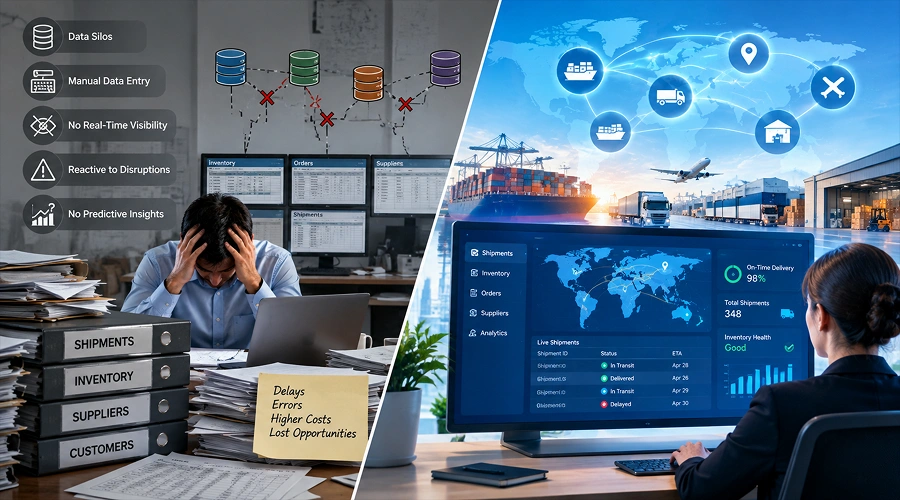
The worst of old systems:
Data stored in silos that don’t talk to each other
Data entry is manual and error prone at every button push
No real time insight into operations across your partners, shipments or inventory
Disruptions are only discovered once they cause damage
No predictive functionality to warn you of problems before they happen
A 2024 Gartner survey found that 73 percent of supply chain leaders identified lack of data visibility as their number one operational challenge. Manual processes came in a close second place.
Both of these are addressed directly with modern supply chain software.
How Logistics Software Is Transforming Modern Supply Chains
This is where the real business value sits. Modern logistics platforms transform operations across every stage of the supply chain.
➔ Complete Real Time Visibility
Gone are the days of tracking updates through emails and calls.
Logistics software provides each employee with a single live dashboard that displays:
Shipment tracking and estimates of arrival time
Inventory in all warehouses
Status of supplier orders and their fulfilment
Carrier performance and confirmation of deliveries
With this software, employees do not have to wait to be notified about problems; rather, the software informs the appropriate parties in case something happens.
➔ Automated Order Processing
Manually processing orders is costly, inefficient, and inaccurate. Logistics software makes the entire process automatic.
Order processing activities automated include:
Receiving order from all sales channels
Creating pick list and packaging instructions
Generating shipping labels and choosing carriers
Delivery confirmation and notifications to customers
Teams can process more orders with the same number of employees. Fewer errors occur. Delivery becomes quicker.
➔ Smart Inventory Management
Excessive inventory ties up capital. Insufficient inventory leads to stockouts.
Logistics software utilizes demand forecasting algorithms based on analysis of:
Sales history and seasonal trends
Promotional schedules
Lead times and reordering points of suppliers
Automatic generation of purchase orders when inventory reaches reorder points. Inventory is allocated near the customers that are most likely to buy it.
➔ Optimizing Routes for Last Mile Delivery
The last mile delivery phase is the costliest and most visible stage of the supply chain.
Today’s logistics management systems optimize every single route based on:
Current traffic information
Time window for deliveries
Capacity and fuel efficiency of vehicles
Instant route optimization during any change in current conditions
The driver receives the updated instructions instantly. The client gets access to live delivery tracking links. Delivery cost is reduced. On time performance is improved.
➔ Supplier and Partner Collaboration
Any supply chain involves dozens of suppliers and partners. Collaboration with them via email and spreadsheets always causes numerous delays.
A logistics management system unites all participants within the same portals in which:
The suppliers update the information regarding purchase orders
The partners get dispatch instructions in real time
All documents are uploaded to the platform and not via email
Performance statistics are accumulated for regular supplier evaluation.
Technologies Powering Modern Logistics Software
These are the key technologies behind everything that makes it happen:
40 to 60 percent order processing speeds up via automation of the end to end order fulfillment.
Reduction in errors in data entry and shipment documentation.
Improved customer satisfaction driven by delivery transparency and reliability.
Faster disruption response through real time alerting and scenario modelling.
Scalable growth without proportional increases in operational cost or headcount.
Future Trends in Logistics Software Development
The next wave of logistics software innovation is already taking shape.
What is coming:
Autonomous delivery vehicles and drones integrating with logistics platforms for last mile operations.
Generative AI interfaces allowing supply chain managers to query complex data in plain language.
Digital twin technology enables simulation of supply chain scenarios before implementing real changes.
Sustainability tracking measuring and reporting carbon footprint across logistics operations as regulatory pressure increases.
Businesses building their logistics infrastructure now are positioned to adopt these capabilities as they mature.
Conclusion
Logistics software is not a supporting tool. It is the operational foundation on which competitive supply chains are built.
The businesses that have made this investment operate with a level of visibility, efficiency, and customer service capability that manual and legacy systems simply cannot match.
The question is not whether logistics software will transform your supply chain.
It is whether your business leads that transformation or spends the next few years closing the gap on competitors who already have.
If your current systems are creating friction, limiting visibility, or slowing your ability to scale, that is a strategic vulnerability worth addressing now. The right technology partner helps you assess where the gaps are and build a solution around your specific requirements, existing infrastructure, and growth plans.
That conversation is worth having before the next disruption forces it.