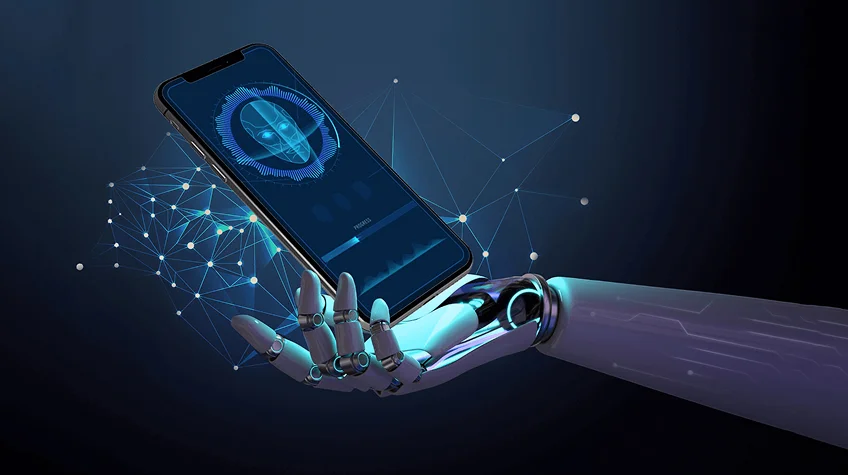
Artificial intelligence is no longer a thing of the distant future confined to research labs. Instead, AI is becoming a key part of how mobile apps are created, designed and used each day. Gone are the days where AI was in almost every app people use, from more accurate recommendations to voice interfaces, understanding this change enables developers, businesses and users to make better, more informed digital decisions.
What Is AI in Mobile App Development?
Image Source Brainvire
Do you know how Spotify is able to predict exactly what song you want to hear next even before you’ve searched for it?
That is artificial intelligence working silently in the background. AI in mobile app development is the use of machine learning algorithms, natural language processing, computer vision, and predictive modeling in mobile applications. By freeing mobile applications from dependency on pre-programmed processes, AI technology enables mobile applications to learn from the user’s behavior, adapt to their preferences and automate many tasks creating experiences that feel genuinely intelligent.
Earlier, mobile apps worked with a set of pre-defined logics. The user clicks on a button, and the app performs the assigned action. With AI, this is no longer the case. Modern applications view the big picture by recognizing patterns, processing massive amounts of data in real-time and making consuming decisions that get better and better over time. This is more than just plain old code. It is a system that thinks, learns and reacts accordingly.
Statista cites the mobile applications in AI can reach $6 billion in 2023 and can be beyond $30 billion in 2030. Using AI in mobile application development is becoming popularly spread as this AI is integrated in many areas such as healthcare, finance, hospitality, entertainment, and retail.
Now developers use AI frameworks such as TensorFlow Lite, Core ML for iOS, and Google ML Kit for Android to add AI to mobile apps without requiring an endless communication with a server.
Why AI Matters in Mobile Apps?
Mobile users expect an app to feel personal, fast and frictionless. AI allows developers to respond to users’ actions with subtlety and intelligence, making your product feel alive and human rather than simply mechanical. Including mobile AI as part of your product is a safety net that increases engagement, reduces churn and builds customer loyalty. For developers, the widespread adoption of AI gives you a huge opportunity to develop truly differentiated products in an ever-expanding, highly competitive market.
Common Use Cases of AI in Mobile Apps
Image Source Cubex Group
➢ Personalisation and Recommendations
Today’s mobile users are not served by generic content. Personalisation is no longer glamorous. It is a necessity.
Netflix, Amazon and YouTube all grew, in part, thanks to recommendation engines driven by deep learning and collaborative filtering models. These models allow you to understand what you watch, skip, pause or re-watch, and recommend unseen content that matches those preferences. McKinsey estimates that 35% of Amazon’s revenue comes from products overlooked by users but found thanks to its algorithms.
Mobile shopping apps use the same technology. When you pick a product on Myntra or Flipkart and you are shown similar items right away, behind the recommendation lies a machine learning model. The model looks at your browsing, buying and session data to understand what you might want to buy next.
Personalisation from AI goes beyond shopping. Fitness apps customise workouts based on your performance. Music apps create playlists based on your mood and time of day. News aggregators show you news stories based on what you have read before. AI-based personalisation is not just a nice-to-have. It is essential for building user engagement and loyalty over and above static experiences.
➢ Chatbots and Virtual Assistants
In the past, customer support was the most annoying part of any digital journey. This has now been transformed by AI.
Chatbots built on natural language processing can now provide instant customer support for thousands of queries at once, without a human yet involved. They can remember context, refer to past conversations and respond in natural spoken conversational language, unlike mechanical scripted replies.
Banking apps, such as HDFC’s EVA or Kotak’s Keya, use AI assistants to answer queries related to accounts, balances, transaction histories and even loan eligibility via the chat interface.
Virtual assistants do more than simple FAQ botting. The new virtual assistants include sentiment analysis that detects when users are upset and can self-escalate to an agent when the conversation gets hot. That gives you a more complete automated experience, and better customer satisfaction scores.
E-commerce apps can use chatbots for everything from helping with product selection, to connecting with merchants about processing returns and all other post-purchase support queries. This reduces operating costs, shortens response times and offers a better experience for customers, plus an itemised bill of savings for yourself.
➢ Image and Voice Recognition
What used to require expensive hardware and a complex infrastructure runs in your pocket on a phone’s camera and microphone.
Computer vision is now utilized in mobile apps that identify what object, face, text or background is within a picture in seconds. Google Lens is a good example of computer vision in action with its abilities to identify. Point your camera at a plant and it instantly identifies the species. Take a picture of a menu in a language you don’t speak and it instantly displays the translation in your language. Scan a product’s barcode and it shows you price comparisons at competing retailers.
Mobile apps that incorporate image recognition are helping with early diagnosis. A skin app, you could take a photo of a mole or rash and immediately get an idea of what it could be, based on an image database of trained dermatological conditions. These are not a replacement for an appointment with a medical professional, but they do help people get better understand what it could be, in general terms.
Voice recognition is at an all-time high. Siri, Google Assistant and Amazon Alexa interpret billions of voice commands every day. Mobile apps are capitalizing on voice recognition with a voice to app, voice to text and voice to search experience. This is a game changer for people who are visually or physically disabled and need to interact with an app without touching it.
➢ Predictive Analytics
You can do all the reacting to what has happened before. AI turns mobile apps into instruments to predict what will happen next.
Predictive analytics uses historical data to anticipate future events. Ride-hailing apps such as Ola can predict a surge in demand in specific city locations in advance, proactively calling drivers into those areas instead of reacting after the surge has occurred. Passengers spend less time waiting, and drivers earn more at the same time.
Financial apps use predictive modeling to identify anomalous spend and to predict potentially fraudulent transactions prior to their occurrence. Predictive analytics offers a proactive approach to identifying fraud, instead of flagging suspicious activity after it has occurred and waiting for “truth” to confirm your suspicion.
Retail apps predict inventory shortages before products are out of stock, and automatically notify the warehouse when to place a new order. Healthcare apps predict which patients are at high risk of readmission, allowing clinicians to intervene beforehand. Sports apps predict which players will excel, enabling you to make better fantasy league selections. Predictive analytics turns data into valuable insight to make intelligent decisions.
How to Integrate AI into Mobile Apps
Image Source ITBrokercom
➢ Define Use Case and Gather Data
The first step to building a good model is defining your use case. A vague use case leads to a vague answer. What specific user behaviour, user journey or business problem are you looking to solve? Once your use case is defined you need to identify the data that will train the model to make accurate predictions. Keep in mind that the quality of data directly affects the quality of AI predictions. No amount of fancy algorithmic wizardry can overcome bad data.
➢ Train and Test the Model
Once your data is ready the next step is to train and test your model. Choosing which algorithm or model to use is based on your use case (classification, regression, clustering, neural network …). Once you train your model, the next step is to test how accurate it really is. You need to test for bias, edge cases and performance which is a lot of training over time.
➢ Deploy and Monitor
Deployment is not the end of the road. It is the beginning of constant maintenance and improvement. After AI integration into the mobile app, you need to continuously monitor the model to find out if there is a drift in performance, changes in data, or new edge cases that may result in poor predictions or lost opportunities as a result of changing or evolving user behaviour.
Challenges of AI in Mobile App Development
Developers encounter practical concerns when it comes to performing integration of AI in mobile apps.
Data Privacy: Collecting and processing consumer data leads to concerns about data privacy with laws such as India’s Digital Personal Data Protection Act and Europe’s GDPR. Developers need to collect and process data in a careful and transparent manner. They must also implement mobile device management practices to secure devices, enforce access controls, and protect sensitive user data.
Deploying Models on Device: Deploying AI models to devices requires a lot of computational power and battery consumption that low-cost phones cannot handle well.
Models are Biased: If training data is not balanced, the models trained on such data will be biased and will fail to produce accurate results for particular user segments if unbalanced.
Integration of AI Requires New Skill Sets: Developers who do not have experience of integrating AI into their mobile apps may not have the skill set to embed AI into their existing portfolio of products.
Cost: Building, training, and maintaining models can be expensive and may increase greater than the initial budget allocated for the project.
Final word
The AI landscape has forever changed what is possible with mobile apps. The impact of intelligent assistants, hyper-personalised experiences, real-time image recognition and predictive intelligence will only grow and hike up the bar for users in every industry vertical. Those developers who can leverage this power are building tomorrow’s applications today. The ubiquity of AI-enhanced mobile apps will very likely eclipse non-AI mobile applications. This will not be a question of individual preference or novelty for developers who wish to build competitive and relevant mobile experiences.