Every serious organisation running workloads in the cloud eventually reaches the same crossroads. You started with a single provider. It worked. Then your requirements grew more complex, your compliance obligations more demanding, and your appetite for vendor dependency more cautious.
Now you are weighing two strategies that are often discussed together but solve fundamentally different problems.
Multi cloud and hybrid cloud are not interchangeable terms. Choosing between them without understanding that distinction can cost your organisation in performance, security, and money simultaneously. This guide gives you the clarity you need to make the right call.
Quick Overview: Multi Cloud vs Hybrid Cloud
Factor
Multi Cloud
Hybrid Cloud
Definition
Multiple public cloud providers used simultaneously
Combination of on premises infrastructure and one or more public clouds
Primary goal
Avoid vendor lock in, use best of breed services
Integrate legacy infrastructure with modern cloud capabilities
Data location
Across multiple public clouds
Split between private infrastructure and public cloud
Complexity
High — multiple platforms to manage
Moderate — requires robust integration layer
Cost profile
Variable across providers, optimisation possible
Higher upfront for on premises, lower long term for steady workloads
Best for
Large enterprises, cloud native companies
Regulated industries, organisations with significant on premises investment
Security model
Distributed across providers
Centralised control with selective cloud exposure
Compliance
Complex, requires cross provider governance
Easier to maintain with private infrastructure for sensitive data
Know How the Two Models Differ in Detail: Multi Cloud vs Hybrid Cloud
Understanding the summary is useful. Understanding why each factor differs the way it does is what enables genuinely confident decision making.
➤ Architecture
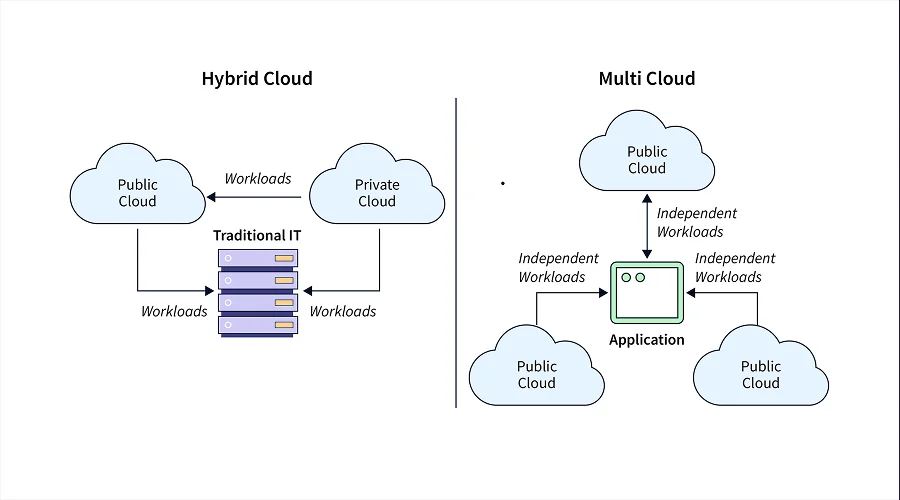
Image Source Scaler
In a multi cloud architecture, workloads are distributed across two or more public cloud providers, with each provider acting as a separate environment with its own services, API’s, tools and pricing.
Hybrid cloud architectures link an on premises infrastructure to one or more public cloud environments, which work together via networking, orchestration and tools.
➤ Flexibility and Control
Multi cloud offers more flexibility as you can pick the most appropriate cloud provider for each workload. For instance, you could use a different provider for compute, analytics, storage or AI.
Hybrid cloud offers more infrastructure control as you own an on premises infrastructure, so you have full control over how your hardware is built and secured, and how you operate your business.
➤ Vendor Lock In
Multi cloud offers less vendor lock in as you have multiple options on which cloud provider you use. However, if you use a provider specific service you can create lock in, making it more difficult to move your workload to another cloud.
Hybrid cloud offers less lock in as you are less dependent on a single provider, since you control your most critical infrastructure and workloads. So regardless of your relationship with the cloud provider it continues to operate as normal.
➤ Security and Compliance
Multi cloud security is challenging – every provider has a different identity, networking, encryption and monitoring systems. It requires strong governance and more specialised tools to maintain consistency and compliance across many platforms. This makes cloud GRC increasingly important for organisations that need to manage risk, security and compliance consistently across multiple cloud environments.
Hybrid cloud keep your regulated or sensitive data on premises, but move fitting workloads to the public cloud, where the data can be protected and the regulatory burden on your business reduced.
➤ Cost
Multi cloud gives flexibility to choose services and providers based on your workload needs and pricing, reducing costs and vendors. However, managing multiple pricing schemes, discounts and data transfer costs increases complexity.
Hybrid cloud involves investing in on-premises hardware and maintenance, infrastructure, power and cooling. But if cost optimisation and high utilisation are predictable, a hybrid cloud model is cost-effective, while also providing cloud flexibility.
➤ Complexity and Management
Multi cloud means managing workloads, identity, security, networking, and costs across many different cloud platforms. Managing more cloud service providers, services and features adds to the complexity.
Hybrid cloud means integrating workloads, identities, security, networking, and costs between on-premises and the cloud. Integration means maintaining data flow, connectivity, performance consistency and management consistency.
Use Cases of Multi Cloud and Hybrid Cloud
The right model is ultimately determined by what you are actually trying to achieve.
➔ Multi Cloud Use Cases
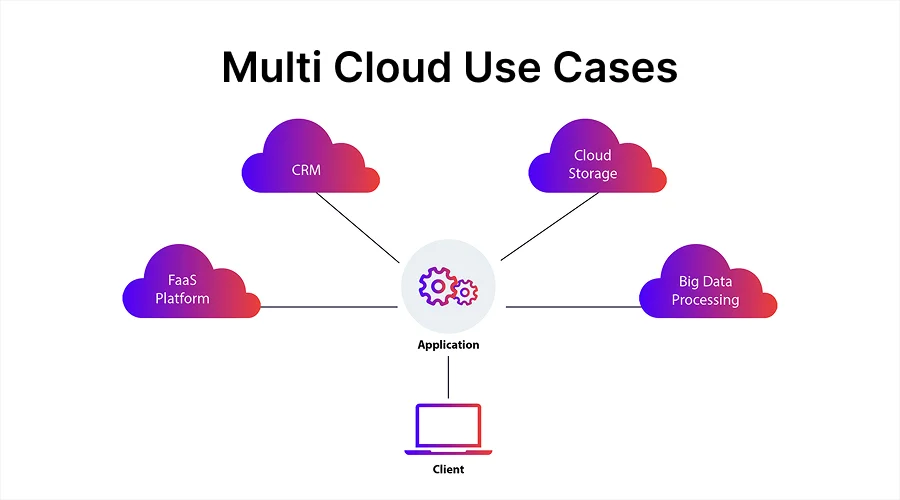
Image Source AppViewX
Best of Breed Consumption: You want the analytics service from Google BigQuery, the serverless compute from AWS Lambda and the identity management from Azure Active Directory all in one application, your best option may be multi cloud using no locks or brokeries.
Geographic redundancies: If you want your critical workload distributed across different regions then you can’t rely on a single cloud provider authority for your availability. You’ll need to deploy to more than one cloud for your truly multi cloud workloads.
Price concentration: For enterprises with a large spend on a variety of workloads like compute, SaaS and PaaS, using a single cloud provider can give you a higher concentration of spend to set up discounts on which can be difficult to negotiate.
Cloud native development: Engineering teams that put their workloads into containers, orchestrated by Kubernetes and use no vendor specific managed services can truly hop between public cloud providers.
➔ Hybrid Cloud Use Cases
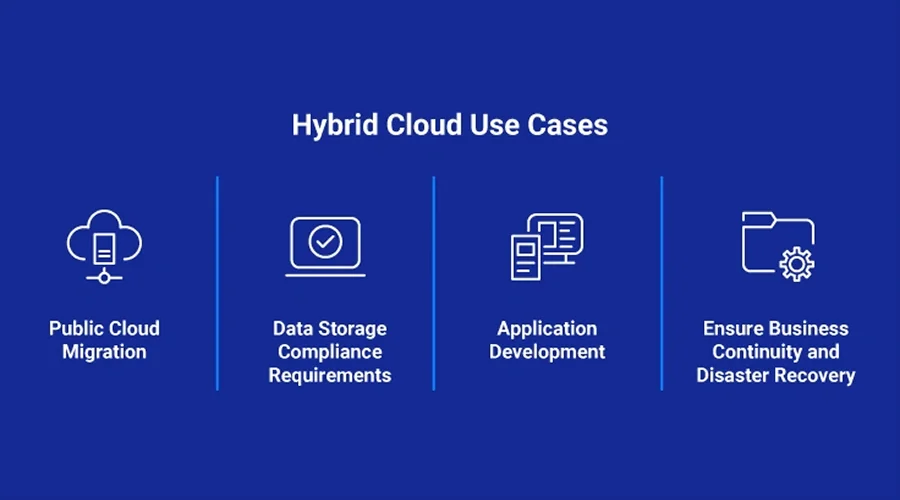
Image Source Comarch
Regulated data environments: Financial institutions, healthcare providers, and government organisations that cannot store certain data categories in public cloud use hybrid cloud to keep regulated data on premises while accessing cloud for compliant workloads.
Legacy application modernisation:Azure migration can help organisations with large investments in applications running on premise and on mainframes and would like to modernise these gradually can move them to the cloud and keep their legacy systems in place and used in combination. A lift and shift or maintain and extend approach.
Burst capacity for steady workloads: Retail, media and manufacturing, which have a relatively steady baseline compute workload for which on premises storage is cheaper for the long term, run this baseline solution on premises and burst into the public cloud when they need a fast boost in compute.
Edge, Distributed Computing: Organisations looking to deploy computing capability further from a centre point such as remote facilities, manufacturing plants, and retail stores that are not within the reach of a providerised cloud’s infrastructure can use hybrid cloud to provide a distributed on premises environment with centralised cloud management.
Which Is Better: Multi Cloud or Hybrid Cloud?
Neither architecture is superior overall. They solve different problems for different organisations.
If your organisation is cloud native, carries no significant on premises investment and wants to shop around for best in class services while avoiding concentration of dependence on a single provider, multi cloud is the way to go. If your organisation is regulated, carries significant legacy investment and wants to keep a tight lid on where the data lives, then hybrid is the natural fit.
Corporate enterprises eventually end up using both. They run legacy workloads as hybrid, and distribute cloud workloads across multiple providers. The model is tailored to the business and then leaves.
The key question is not which to choose, but which is right for your organisation and its current technical capabilities and regulatory environment. Every organisation is different. That cost comes back to you when you find out which fit you need.
FAQs
1. Can a company use both multiple and hybrid cloud at the same time?
Yes. Many large organisations use hybrid cloud for legacy workloads, and distribute cloud native workloads across multiple public cloud providers at the same time. The two models complement each other, rather than being mutually exclusive.
2. Is multi cloud more expensive than hybrid cloud?
Not by default. Multi cloud can offer savings on competition and workload optimisation. But in practice the management overhead can be costly, and will usually require particular tooling and engineering resources. Hybrid cloud can be more expensive up front, but over time can offer savings for highly predictable, highly utilised workloads.
3. Which model is better for security?
Hybrid cloud provides a tighter compliance footing, as regulated data stays on premises, under direct control. Multi cloud requires more advanced cross-provider security oversight to achieve a comparable level of assurance.
4. How do I start moving towards multi cloud or hybrid cloud?
Start by getting the basics right – build an accurate inventory of your workloads and be fully aware of what your compliance status is, your cost base is and what your team’s skill set is. Design decisions based on missing data generally result in costly mistakes rather than solutions. Engaging professional cloud architects in the design phase with adequate budget is far less costly than troubleshooting a poorly designed infrastructure.
5. What is the greatest mistake organisations make when adopting these models?
Assuming it’s all just operational complexity. Both models require a dedicated platform engineering effort to build and maintain well. Teams that think cloud is just a commodity infrastructure purchase, rather than a platform they need to feed, consistently miss the compounding benefits.