A DevOps toolchain is a digital set of tools that supports software development and maintenance according to agile principles. Learn how to build a toolchain plus three primary uses.
The concept of a toolchain is not a new one. It’s also not extremely vague, unlike many things within DevOps. A toolchain is just a digital collection of tools that support a particular goal. In the context of DevOps, the toolchain brings together the most useful tools for building, delivering, and maintaining software according to agile principles.
This article examines the DevOps toolchain, offering a short introduction to what it is and ways to use it. If you’re searching for the ideal mix of tools for your DevOps organization, you’ve landed in the right spot. We’ll also talk about specific tools, so you’ll have all the information required to choose wisely regarding DevOps toolchains.
Let’s dive in:
Introduction to the DevOps Toolchain
Within DevOps, continuous integration and continuous delivery are core principles. The DevOps toolchain helps companies realize the promise of DevOps by keeping the software development pipeline healthy. Toolchains assist team members in completing and simplifying the more complex tasks of the development process.
If DevOps represents the new industry benchmark, putting a DevOps toolchain into practice is the next version of that benchmark. Toolchains can be built, managed, and stored in the cloud using several key elements of a DevOps strategy:
Automation
Integration
Self-service
Collaboration
Although creating a toolchain is a useful way to practice your DevOps skills, it also consumes time, resources, and ongoing upkeep. So it’s wise to plan ahead to confirm that overhead requirements can be satisfied. Organizations must also be ready to encourage developers who may be stuck in their old habits to adopt the toolchain. Otherwise, the whole effort could be wasted.
If you’ve concluded that you have the need, the budget, and the determination to begin building a toolset, here’s some advice on how to construct one:
How to Build a DevOps Toolchain
Image Source GitProtectio
One goal of the DevOps toolchain is to be uniform with the standardization of the DevOps framework. In that sense, a toolchain integrates easily with other DevOps tools and processes and helps developers follow the same reliable workflow every time. Standardization and consistency serve an important role in the DevOps toolchain, within a framework that can otherwise feel abstract and open to personal judgment. A toolchain effectively gives shape to how you implement DevOps, so selecting the right one matters.
There are two methods for building a toolchain:
In‑the‑Box
Custom
An in‑the‑box toolchain is a solution created by someone else and comes with standard options you can pick from to fit your unique requirements. Using a pre‑orchestrated set of tools allows for stronger standardization and integration with less manual effort.
If an in‑the‑box solution isn’t right for you, the alternative is to build a customized toolset on your own. When you take this route, you choose the specific tools your toolchain needs and carefully coordinate them to function together in your DevOps pipeline.
Opting for this approach lets you avoid being locked into vendors or specific tools, but it can be more expensive. You’ll also have to make sure you have the staff to handle this process, and standardization is not automatically guaranteed.
A Healthy Toolchain
If you browse around the internet enough looking for solutions, you’ll sometimes come across the term “healthy” applied to a DevOps toolchain, as well as to the pipeline it supports. Building a healthy toolchain lets you produce the highest‑quality software in the shortest time. That’s because a healthy toolchain supports a pipeline that is ready for continuous integration and continuous delivery a healthy pipeline, so to speak. A note on a healthy pipeline: it uses automation and integration to move through a logical sequence to completion.
Below are some tools and categories that contribute to a pipeline’s health.
Must‑Have Tools for Your Toolchain
Image Source AI
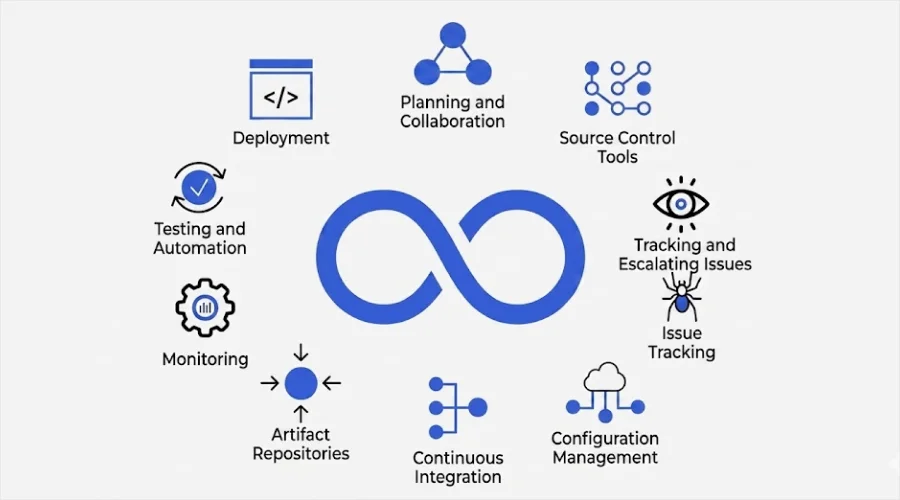
For a toolchain to be healthy, it must address the demands of your development pipeline. Smart developers should include tools for each of the following:
Planning and Collaboration: These tools assist with sprint planning, offer visibility for stakeholders, and enable teamwork. Examples include project management systems like Asana, as well as communication platforms like Slack.
Source Control Tools: These foundational tools help developers manage source code across all assets and properties. A tool like this centralizes where and how code is stored and managed. Subversion is one example.
Tracking and Escalating Issues: These straightforward tools help developers log and track issues to resolution with faster response times. For example, Jira is a tool of this type.
Continuous Integration: These are largely collaboration tools that provide dashboards for stakeholders and developers, offering transparency and chances to work together throughout the CI process. Think of Bamboo.
Configuration Management: Configuration management tools do exactly what the name implies. They give a central place to standardize configurations across assets. Puppet and Chef are two well‑known configuration management brands.
Artifact Repositories: Artifact repository tools store all the large binary artifact files that seldom, if ever, need changes. Nexus offers a tool like this.
Monitoring: Monitoring tools deliver important data about how a piece of software is performing and whether any threats or security issues exist. Sensu is a popular monitoring tool.
Testing and Automation: With automated testing tools, developers can validate code quickly. These include QTP and TestComplete.
Deployment: Finally, deployment tools such as IBM Deploy help developers achieve continuous delivery by improving the speed and quality of frequent deployments.
Uses for a DevOps Toolchain
Image Source Gombocai
You might have already realized that the DevOps toolchain can do many things, but it does have several typical applications. Below, we’ll look at what they are:
➢ Faster Time to Innovation
By standardizing a pipeline where software is constantly being deployed, a DevOps toolchain helps enterprise businesses improve and accelerate innovation. These tools ensure agile and rapid delivery of software products through monitoring, automated testing, and diagnostic capabilities. Businesses that innovate faster can maintain a competitive edge.
➢ Fine‑Tuning Incident Control
Incident management can become a challenge even for the most agile, fast‑moving teams. Using a DevOps toolchain allows developers to operate from a position of incident control. By combining automation with good old‑fashioned teamwork, teams respond faster and more effectively to incidents using tools designed to simplify that process.
➢ Quality Assurance
One of the more emphasized uses of a DevOps toolchain is resolving software defects quickly and accurately to ensure high‑quality releases. With automated notifications, everyone can get on the same page faster regarding major software problems. This serves two purposes: it boosts resolution speed and increases end‑user satisfaction.
Understanding the DevOps Toolchain
A key part of DevOps is building an integrated environment where multiple cloud tools and in‑house resources can work together with automation to produce quality software releases quickly, in a way that can be repeated over and over. Now that the DevOps toolchain is out in the open, there’s no ignoring it as an essential part of the overall DevOps process. That’s because the toolchain aligns with DevOps goals, and the same principles used to develop software can also be applied to building a toolchain. In other words, installing a toolchain requires collaboration, automation, self‑service, and integration.
Many tools and sets are available, but it’s important to cover the right ground to create the most uniform pipeline. That means selecting tools from categories such as planning and collaboration, configuration management, and deployment. Other tools might be less obvious, like binary artifact repositories. Still, those tools also matter to the big picture, so it’s wise to assess your needs before starting this process.