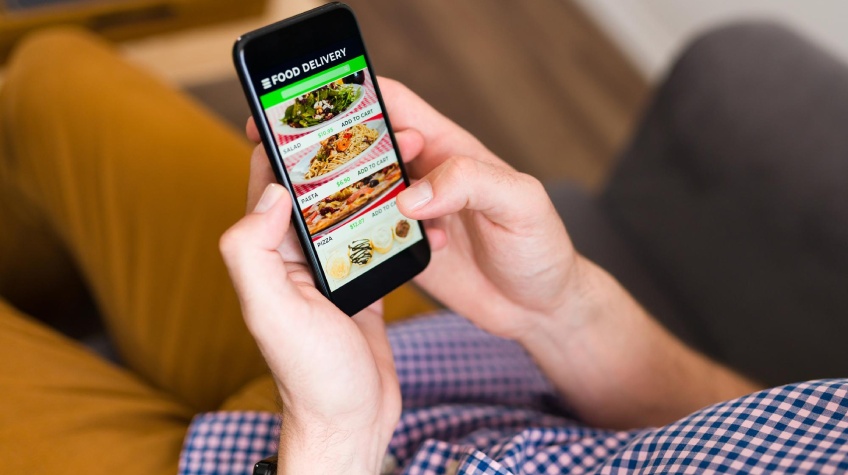
The food delivery industry is incredibly competitive, and it is brutal to poor digital experiences. Customers expect food delivery apps to be fast, intuitive, and reliable on any device. The right technology stack choice is vital to help scale your platform and not struggle under real-world traffic. Flutter has become the ultimate food delivery app development framework, and the reasons are genuinely compelling if you’re a business looking to achieve performance and scale.
Why Choose Flutter for Food Delivery App Development?
What would it be like if you could create one codebase that was native enough for iOS, Android, and web at the same time without running up both development bills?
Well, that’s essentially what Flutter does and it is revolutionizing product development for food delivery companies in 2026.
➢Cross-Platform Development From One Codebase
Image Source magnific
Flutter, an open-source UI framework developed and maintained by Google, has become a leading choice for cross-platform app development, enabling developers to build high-performance applications for iOS, Android, web, and desktop from a single codebase. For food delivery companies, this eliminates one of the biggest and most costly pains with traditional development: maintaining two codebases that need to be continuously synced for iOS and Android.
Two native lists of engineering teams running two testing processes, two deployment pipelines and two maintenance schedules are required for traditional native development. Flutter compresses all of this into one optimization. Development times are reduced by about 30 to 40 percent compared to native apps with two codebases. The cost savings are proportionate.
This cross-platform consistency costs nothing in performance. Flutter compiles directly to native ARM machine code instead of transpiling or interpreting code in a bridge or virtual machine. The end result is an app experience that is truly indistinguishable from a native app in user testing.
➢Outstanding Performance Under Real-World Demand
Food delivery apps place some of the most demanding performance demands on the app category. Real-time order tracking, real-time driver location updates, real-time menu loading, payment processing, and notification promises all work simultaneously during what we call “snack time” when users are placing orders. Your app’s framework decides whether your app can handle that load with aplomb or simply poorly.
Flutter’s rendering engine, Skia, renders each pixel of your interface directly onto your canvas instead of delegating rendering to native widgets. That gives you smooth 60 frames per second animations and transitions no matter how heavy your app’s data processing. From there, you’ll see no visual lag when your map updates, no stutter while you peruse restaurant menus, and no lag when you confirm your order.
The Dart programming language that underpins Flutter is designed for UI development and, thanks to ahead-of-time compilation, results in fast startup times and efficient memory usage. In food delivery, where diminishing load time is linked to conversion, that performance advantage is very real.
➢Rich, Customisable UI Components
Image Source magnific
Where food delivery apps went or stayed depended on their visual experience. Restaurant images, what they look like in the presentation, font sizes, promotional graphic banners, and checkout flow were all as important as the content itself. Flutter’s comprehensive widget library contains more than 200 highly customisable pre-built components that have the flexibility developers and designers need to create stunning interfaces.
Unlike other cross-platform frameworks that wrap native UI components for each platform, Flutter’s widgets are rendered on every device, so your food delivery app will look and function the same on any platform, from the iPhone 15 to a Galaxy S24. Consistent brand experience across platforms reinforces the brand and encourages repeat orders.
Custom animations. Parallax scrolling effects. Interactive maps that dynamically update live visuals. All of these innovations become a reality with Flutter’s declarative UI architecture. And, in particular, WeeTech Solution’s Suitable Eats project demonstrates this application of Flutter with a truly impressive example. A mobile and web presence that delivers a clean and intuitive UI, a highly personalized experience and a focus on truly effective user experience features such as clear, short billing, one-tap reordering and personalized client recommendations, is what you get with this project.
➢Real-Time Features and Third-Party Integrations
But, when it comes to real-time delivery features such as live order tracking, live delivery status, push notifications and dynamic pricing, you need a platform that can efficiently connect with a plethora of tools. In addition to its attractive UI, that is Flutter’s declarative UI architecture and layout system. Flutter is also a perfect fit for the third party integrations which make up much of a food delivery platform’s required features.
Real-time features such as live order tracking and delivery status, push notifications, dynamic changes within the app, can all be powered through Firebase and its real-time database, machine learning, cloud functions and analytics. For the payment gateway integration, all the popular payment gateways such as Stripe, Razorpay, PayPal as well as regional options can be integrated into a Flutter mobile and web application using well-maintained packages.
As with reputable project components, GPS integration is also no problem for Flutter. The best choices are the google maps APIs. From there, the application can be configured with mapping technology to provide routing & delivery time estimation, as well as live driver tracking to your customers.
In the end, this project used Stripe for payment gateway integration, Firebase for notifications and engagement followed by analysis, as well as Google Maps for logistics & routing. Implementing all of these technologies in the Flutter architecture was a simple yet impressive feat.
➢Faster Time-to-Market
Competitive food service delivery markets require speed. Being the first to launch in each city, the first to add a new category of services, or simply the first to respond to changes in consumer preferences confer long-lasting competitive advantage. Flutter’s Hot Reload feature gives developers instant visibility of the result of code changes during both development and design refinement stages.
Unlike other platforms, where apps must be recompiled to see changes, Flutter’s Hot Reload feature enables developers to instantly see the effect of changes made to the UI while it is running, thus greatly speeding up the usual development iteration cycle.
The Flutter ecosystem is robust, thanks to the continuous work of Flutter’s development community. With over 30,000 packages available through the Flutter package repository hosted by Google on pub.dev, developing a new Flutter application rarely requires building common application functionality from scratch. Authentication, analytics, payment processing, location services, and notification delivery all have already mature, well-documented Flutter packages available.
This maturity of the Flutter ecosystem translates into faster, cheaper, and more scalable development for your applications.
➢Cost-Efficiency at Scale
Image Source magnific
If you’re a super-fast-moving product startup or food delivery business riding Technology Web 3.0 with tight development budgets, the cost of building with Flutter is genuinely compelling. A single codebase development approach can reduce the need for hiring developers, and shared QA processes significantly lower testing costs. The same goes for DevOps, which can be speedier and more cost-effective through unified deployment pipelines.
Additionally, costs for ongoing maintenance are reduced as well. Bug fixes in the shared codebase are applied to all platforms at the same time. Feature releases are deployed to iOS and Android at the same point in time. In a typical product lifecycle of two to three years, the cost savings compared to native application development is truly commercial.
Key Features of a Flutter Food Delivery App
A well-built Flutter food delivery application should deliver the following capabilities as standard:
Real-time order tracking with live GPS driver location visible on an interactive map
Multi-restaurant browsing with intelligent search, filtering, and category navigation
Personalised recommendations driven by order history and browsing behaviour
Multiple payment gateway support including cards, wallets, and UPI integration
Dynamic promotional system for restaurant-level discounts, bundles, and loyalty rewards
One-tap reordering for returning customers to complete familiar orders instantly
Push notification system for order confirmations, delivery updates, and promotional alerts
Restaurant merchant dashboard for menu management, order processing, and performance analytics
Rating and review system for customers to provide feedback on orders and restaurants
Scheduled ordering allowing customers to place advance orders for specific delivery times
Transparent itemised billing displaying all fees clearly before order confirmation
Multi-language and multi-currency support for international or multi-region platforms
Accessibility compliance ensuring the app works for users of all abilities across devices
Challenges and Considerations
Flutter is a powerful framework, but approaching food delivery app development with clear-eyed awareness of its challenges produces better outcomes.
Package maturity variability: Some specialised Flutter packages are newer and less battle-tested than their native equivalents. Evaluation of package reliability before adoption is essential
App size: Flutter apps carry a slightly larger initial download size compared to native apps due to the embedded rendering engine. Optimisation strategies must be applied during build configuration
Platform-specific customisation: Certain deeply native platform behaviours occasionally require platform-specific code written in Swift or Kotlin alongside the Flutter codebase
Dart learning curve: Development teams experienced exclusively in JavaScript, Swift, or Kotlin require Dart language training before productive Flutter development begins
Web performance limitations: Flutter web applications, whilst functional, occasionally underperform compared to purpose-built web frameworks for content-heavy pages
Third-party SDK compatibility: Occasional delays in Flutter support for newly released native SDKs can temporarily affect access to cutting-edge platform capabilities
Testing infrastructure: Comprehensive automated testing strategies for Flutter require specific tooling investment and configuration that must be planned from project inception
How WeeTech Solution Can Help Build Your Flutter Food Delivery App
Producing a successful food delivery app involves more than just meeting technical challenges and requirements. It requires product strategy, user-centred design, and engineering rigour, and over every stage of the development process.
WeeTech Solution offers integrated, end-to-end Flutter food delivery app development, covering product strategy and UX design, engineering and quality assurance, deployment and optimisation. The team offers in-house, hands-on, production-scale food delivery app delivery experience.
Suitable Eats, a next-generation food ordering, and delivery platform, tailored to the UK market, is a proof to our food delivery expertise. We designed and engineered the platform from concept to launch, delivering a fixed-rate location-based delivery pricing engine in place of the prevailing percentage-based model that improves transparency in billing, increases customer trust and boosts ABOV.
The Suitable Eats engagement encompassed product strategy, UI/UX design, iOS and Android deliverable creation, merchant web dashboard, Stripe payment integration, Google Maps logistics integration, Firebase engagement infrastructure and AWS cloud deployment. Consequently, we can cater to food delivery businesses at any stage, from market concept to scaling to a national delivery presence.
If you’re building a food delivery platform or looking to re‑build your current product on a more scalable platform, the WeeTech team would love to get to know your project. Reach out to WeeTech Solution today to share your project requirements and receive a customised food delivery app development proposal from us.
Future of Flutter in Food Delivery Apps
The future of Flutter in food delivery apps is looking bright. With Google’s commitment to continually invest in and improve this innovative framework, including its recent release of Flutter 3 which brings even stronger support for web & desktop, businesses can rest assured that Flutter offers a long-term solution to build upon. In addition, new capabilities such as AI personalisation, voice ordering and AR menu previews are in development and will open up many new possibilities for businesses.
As competition in the food delivery space increases, the range of benefits that come with Flutter, including rapid development, top performance and lower operating costs Strengthen your food delivery strategy and place your business ahead of the competition and the technology trends for the next decade with Flutter.
Conclusion
Flutter’s unique blend of cross-platform delivery options, fully native performance, rich UI features, and deep integration options give it the unique edge as today’s best framework for food delivery app development. By choosing Flutter, businesses automatically gain time to market, reduce costs, and more importantly, build robust foundations that can scale with growing appetites without costly rebuilds. The data speaks for itself. The success of Suitable Eats, delivered by WeeTech Solution, serves as a superior result that is achieved with a well-built Flutter food delivery solution in today’s highly competitive market. Choose the best framework, the best team and then build a food delivery product that wins on every platform, at the same time.