Before DevOps, software teams employed a handoff approach. Developers wrote the code, which was subsequently given to operations, a different team in charge of its delivery and upkeep. The two teams used different success metrics, worked independently, and hardly spoke until something went wrong. A developer’s employment ended with the handoff. An operations engineer’s job was to maintain system stability, which occasionally meant resisting the constant barrage of changes developers pushed through.
Teams working on development are speed-optimized. The teams in charge of operations had stabilized. Under that concept, these goals were incompatible.
DevOps caused that foundation to collapse. Instead of two teams trading duties across a wall, development and operations become a single shared responsibility. Developers now have control over the performance and distribution of their software. It’s a simple organizational principle: if you build something, you manage it.
What Changed
The figures show how widespread this change has become. DevOps was used by more than 80% of businesses by 2024, up from 33% in 2017. The market for DevOps tools and services is expected to rise from its predicted $15 billion in 2025 to $88 billion by 2034 at a compound annual growth rate (CAGR) of 21.6%.
Instead of hypothetical demand, these numbers reflect actual demand. Polls show that 49% of companies report a quicker time to market for software and services, 61% believe DevOps has improved the quality of deliverables, and 99% of firms think it has had a good impact.
The Mechanics: CI/CD and Automation
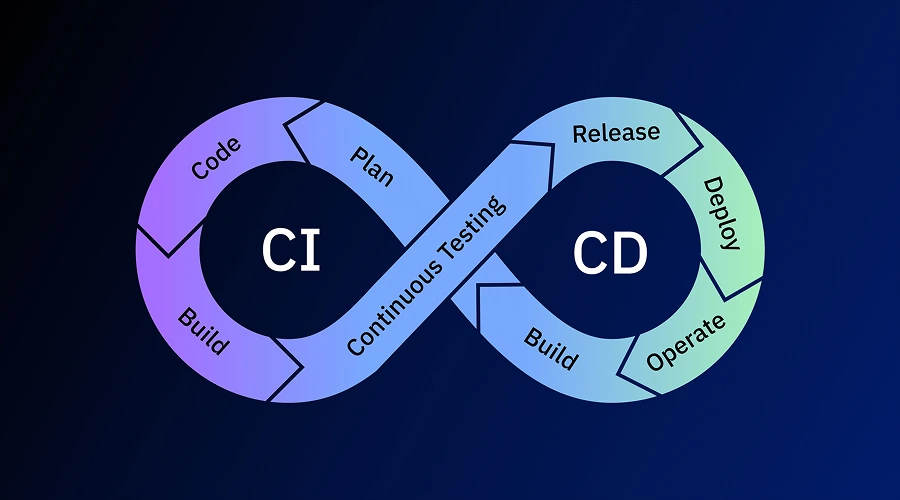
Image Source IBM
The CI/CD pipeline, which stands for continuous integration and continuous deployment, is the most obvious operational improvement brought forth by DevOps. Before being combined and tested in big, erratic pieces, code accumulated independently across teams under traditional development. Combining months of concurrent effort usually resulted in serious conflicts, flawed builds, and postponed releases.
That cycle is lessened with CI/CD. Automated tests run fast each time programmers submit code changes to a shared repository, which happens thousands of times every day. Even when the change is small and the context is still new, the pipeline may identify a patch that breaks anything in a matter of minutes. Continuous deployment eliminates the manual procedures that hinder releases and cause human error by automatically pushing verified code into production.
Atlassian uses CI/CD techniques to speed up software delivery, delivering new features more quickly while upholding quality standards via automation with Jira and Confluence. Using AWS CodePipeline and CodeDeploy, Amazon developed its own pipeline system that allows thousands of software deployments daily throughout its infrastructure.
High-performing DevOps teams deploy code 30 times more frequently and with 26 times faster lead times than lower-performing teams, according to a recent DORA research. Based on surveys of tens of thousands of engineering experts every year since 2014, this conclusion is applicable to all industries.
The Culture Underneath
Tools and pipelines make up the visible layer. The underlying cultural shift determines if any of it actually succeeds.
DevOps demands that an approach more akin to aviation safety procedures take the place of the conventional blame culture of IT operations, where mishaps prompt inquiries about the cause of the issue. Instead of focusing on specific offenders, investigators search for systemic issues when a flying disaster happens.
This method moves the emphasis from punishment to learning by acknowledging that most outages are caused by numerous contributing factors rather than a single blunder.
According to Atlassian, when there is no psychological safety or a setting where team members can voice concerns without fear, teams are more prone to repeat mistakes than to learn from them. According to the DORA 2024 study, high-performing teams continued to produce results in spite of significant organizational changes, budgetary restrictions, and layoffs. They possessed strong cultural principles, like as psychological safety, team autonomy, and well defined tasks, in place of a particular toolchain.
It takes days to set up a Kubernetes cluster and deploy Jenkins. A team’s natural reaction when production fails at two in the morning is to solve the issue or assign blame, but this calls for ongoing organizational work that no tool installation can supply.
One of the most researched attempts to institutionalize this is Spotify’s Squad model, which entails cross-functional teams working autonomously but collaboratively toward shared goals with each squad fully owning its output. Though it has since undergone several changes, the concept showed how organizational structure may subtly support or contradict the collaborative logic that forms the foundation of DevOps.
Security Moves Earlier
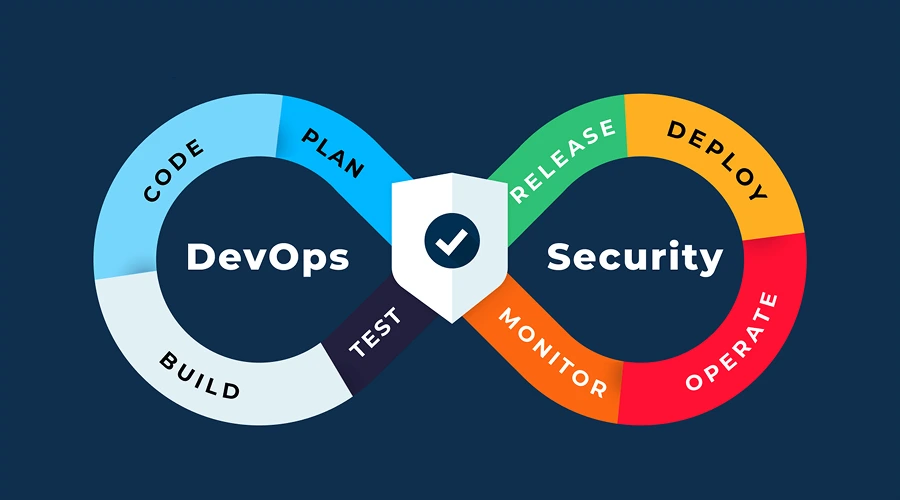
mage Source StrongDM
One area where DevOps has had the most influence on conventional practice is security. Under the previous development paradigm, security review, which was typically the final gate before release and handled as an approval process rather than a design restriction was postponed. Due to timing restrictions, security issues were either disregarded at the time or needed expensive remediation.
Security is moved earlier in the process by DevSecOps. Every time a code change occurs, security checks and functional tests are automatically carried out as part of the CI/CD pipeline. When a test fails, developers receive security feedback while the change is still minor and there is a simple, non-disruptive solution.
Toolchains are shifting toward integrated DevSecOps platforms as security moves “left” in the development lifecycle, and industry data consistently indicates that this is one of the DevOps ecosystem’s fastest-growing industries. Regulatory pressure and the rising cost of resolving production hazards have accelerated this change.
Where AI Currently Fits
The larger story of AI productivity is called into question by the findings of the DORA studies from 2024 and 2025, which both tracked the employment of AI in DevOps teams.
AI technology can help with some tasks, such writing documentation, assessing pull requests, and producing boilerplate code. Improvements in documentation quality of 7.5%, code quality of 3.4%, and code review time of 3.1% are associated with a 25% increase in AI utilization.
According to the DORA 2024 study, while AI technologies help teams speed up low-level development tasks, the three main DORA metrics lead time, deployment frequency, and change failure rate have not yet demonstrated noticeable gains.
A more thorough explanation was given in the “State of AI-Assisted Software Development Report” from the 2025 DORA study: AI increases deployment frequency and reduces lead times to increase throughput in high-performing businesses. In poor systems, it raises delivery risk, friction, and inconsistency.
The Unfinished Adoption
The amount of change that DevOps represents is only partially captured by market data. Businesses who have completely embraced DevOps see it as a methodology that dictates how work is organized, how crises are managed, and how quickly goods are delivered to clients.
Because of its depth, adoption is still unequal. The need for standardized equipment, a shortage of qualified staff, and a preference for traditional methods have all hindered widespread adoption in small and medium-sized firms. The instruments are readily available. It is more challenging, takes longer, and is resistant to acceleration to create teams that truly operate as DevOps.