Coding is generally quite a fast process. However, deploying that code is often a laborious and slow process. Because each release requires someone to manually start tests, adjust server settings, and stare at logs in hopes that nothing fails, engineering teams frequently postpone updates. These delays accumulate. Weeks pass as new features wait in line. Users become irritated when bugs persist longer than they should. This same issue is the focus of DevOps automation. During releases, it substitutes human hands on the keyboard with infrastructure-as-code and scripts. Software shipping has a completely different dynamic.
DevOps has been making its way into the software development process for a while now. It allows companies to launch products in the market at a much higher rate while enhancing collaboration among employees. It also helps the organisation remain consistent since the possibility of an “human error” is completely removed.
What is DevOps Automation?
The goal of DevOps is to remove human interference from the software development process. A machine should be used for any task that includes creating a build, configuring a staging database, or performing a security scan.
A subscription tool isn’t going to get you there. Your company’s engineering department needs to change the way it operates. The scripts must be trusted by all members of the team. In the past, developers wrote code and handed it to operations, who had to figure out how to maintain it. Deployment speeds naturally increase as both developers and operators have faith in the automated system to handle the heavy work. Quick workflows result in quick feedback, which motivates the team to further improve the pipeline.
The majority of people believe that this is limited to CI/CD pipelines. A contemporary layout, however, covers a lot more ground. Infrastructure as Code (IaC) spins up whole server infrastructures in a matter of seconds using simple text files. Without the need for a QA engineer to click through screens, automated testing finds flaws. When a server drops a connection, live monitoring immediately notifies the on-call engineer by phone.
Why DevOps Automation Matters
➢Faster Delivery and Time to Market
Humans are always going to be outpaced by machines. According to surveys, half of well-established DevOps companies have increased their release velocity by 50%. Forty percent of teams in the broader tech industry are now shipping code twice as quickly as they were a year ago. Delivery is naturally accelerated when manual sign-offs are eliminated. Procurify moved from delivering once every two weeks to pushing eight releases every day after automating its deployments. From an excruciatingly long 100 minutes, their real release window was reduced to only ten.
➢Improved Consistency and Reliability
Typos happen to anyone. Scripts don’t make mistakes. The previous justification of “it works on my machine” is eliminated by standardizing server configurations and test runs. Production and staging environments are kept exactly in sync by a consistent workflow. Server crashes are reduced when the real release is managed by code. It keeps the application operating smoothly while upgrades take place in the background and reduces maintenance windows.
➢Enhanced Collaboration Across Teams
Developers and IT operations can have a conflict because they have separate goals. While one side needs stable servers, the other expects features to be supplied promptly. Both parties must examine the same data when using a shared automated pipeline. When a single workflow is used, developers, operators, and security specialists are all accountable when something goes wrong.
➢Better Scalability of Systems and Processes
As an application expands, manually configuring and setting up servers becomes a nightmare. When you have hundreds of machines, it becomes impossible to adjust settings by logging into each one separately. Infrastructure as Code uses straightforward text files to handle large cloud architectures. When traffic spikes occur, the system automatically adjusts. Engineering departments are able to quickly adjust their development priorities to meet current market demands.
➢Increased Efficiency and Reduced Manual Effort
Engineers are too expensive to squander their time battling server fires. They can really build new reasoning by automating the tedious tasks. They cease behaving like workers on a production line. Eliminating manual bottlenecks allows the team to work on challenging design issues.
➢Built-In Security and Compliance
Your timeline may be completely destroyed by security audits that are delayed just before launch day. This is addressed by DevSecOps, which continuously checks for security flaws as the code is being written. The codebase can be protected from hackers without slowing down the release cycle by implementing digital access restrictions and automated compliance checks. Businesses that use this technique avoid significant regulatory fines and receive shipping codes more quickly.
➢Higher Developer Productivity
Without waiting for a systems administrator to authorize a ticket, a good CI/CD configuration instantly sends a saved file to the live application. This arrangement is cited by about half of engineering leaders as the most important resource for their team. When deployment mechanics are not a concern, developers write code more quickly. Currently, AI is used by more than half of businesses for testing. For teams with a rigorous DevOps culture, that percentage rises to 65%.
➢Reduced Operational Costs
Businesses that use infrastructure automation claim a 61% improvement in code quality. Failures linked to deployment fall by 57%. IT expenses are reduced by 55% overall. Paying outside contractors to repair damaged settings is discontinued. When you don’t use cloud storage, you stop paying for it. Onboarding times are reduced from weeks to hours when servers are provisioned using code. Your cloud hosting fee can be cut in half by allowing a script to scale your servers up and down based on active traffic.
➢Continuous Feedback and Improvement
Every file save triggers an automated test run. Before they get deeply ingrained in the main codebase, bugs are identified. There are fewer overall accidents for teams using these configurations. Compared to a typical IT department, a fully developed DevOps team can recover from an outage 24 times faster.
The DevOps Automation Process
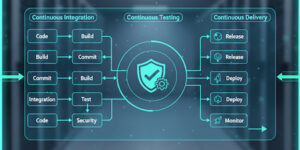
A working setup follows a rigid path from the code editor to the live server.
➢Continuous Integration (CI) prevents developers from overwriting each other’s files by automatically combining everyone’s contributions. A server compiles and executes a test suite as soon as a programmer pushes a file. To ensure that nothing is broken, the system thoroughly tests the raw code after packaging it into a functional artifact.
➢Continuous Delivery (CD) delivers the authorized code directly to the live servers. It eliminates the possibility that someone will enter the incorrect deployment command in the terminal.
➢Infrastructure as Code (IaC) uses plain text files to determine what your server needs. Without making any manual changes to a single computer, you can duplicate a server configuration a thousand times.
➢Automated testing verifies the program’s security, speed, and logic in the background. In order to free up the engineering staff to continue typing rather than looking at a loading bar, heavy and sophisticated testing is moved to cloud servers.
➢Monitoring and Observability tools watch the live application. They spot crashes, text the engineers, and sometimes run reboot scripts to fix the issue on their own.
Real-World Use Cases of DevOps Automation
➢Procurify: 64X More Deployments
Procurify operates in the financial services industry. They reached a dead end since it took a long time to push code modifications, which necessitated a huge, coordinated effort from several departments. Production was literally being broken by their manual release procedure.
They switched to a completely automated CI/CD system. One release every two weeks was replaced by eight releases every day by the technical department. Pushing a release takes 10 minutes instead of 100. The team gained an additional 48 hours of coding time per week thanks to that straightforward change.
One engineer actually moved from being the QA lead into a dedicated Cloud Infrastructure Engineer role just to manage the new automated pipelines. He noted that if you want to stop stressing over release day, you have to prioritize DevOps.
➢Meridian Cooperative: 98 Percent Efficiency Gain
After appointing a new DevOps director, Meridian Cooperative substantially reorganized its software delivery procedure. Their deployment time was reduced from an agonizing six hours to just six minutes per client, thanks to the new automated setup.
➢BharatPe: Scaling to 400 Million Monthly Transactions
Approximately 400 million transactions are handled by BharatPe each month. To manage that demand, they mostly rely on automated infrastructure. They reduced server recovery times to less than an hour, became accustomed to Kubernetes in three weeks, and began pushing code 12 times quicker with daily deployments after fully committing to automation.
Measuring the Success of DevOps Automation
➢DORA Metrics
The DevOps Research and Assessment (DORA) team at Google established a set of industry-standard metrics to evaluate engineering performance and efficiency. These metrics provide a data-driven approach for measuring the success of DevOps practices.
➢Deployment Frequency
This metric measures how often new code is released to production. High-performing teams deploy code multiple times a day, indicating a fast and efficient delivery pipeline.
➢Lead Time for Changes
Lead Time for Changes tracks the time it takes for code to move from commit to production. Elite teams achieve this in a matter of hours, reflecting streamlined workflows and rapid delivery capabilities.
➢Change Failure Rate
This metric indicates the percentage of deployments that result in failures in production. Monitoring this helps teams maintain a balance between speed and quality, ensuring that rapid releases do not compromise system stability.
➢Time to Restore Service (MTTR)
Time to Restore Service measures how quickly a system recovers from a failure or outage. A lower recovery time demonstrates strong incident response and system resilience.
➢Deployment Rework Rate
Introduced in the 2025 DORA report, this metric measures the amount of effort spent on rework due to failed or incomplete deployments. It highlights inefficiencies and helps teams reduce wasted effort.
These benchmarks, updated annually, enable CTOs and engineering leaders to assess whether their DevOps initiatives are delivering real improvements in performance, quality, and efficiency
Conclusion
Shipping completed code is a very different task from writing the said code. There are slowdowns and crashes when individuals are used as a bridge between the two. The entire process is quicker and less expensive when that bridge function is delegated to an automated pipeline.
Companies that fully embrace automation see an increase in deployment rates and a decrease in hosting expenses. This is supported mathematically by the DORA benchmarks. The release process can no longer be handled manually quickly enough to meet the needs of modern engineering.