Choosing an API architecture can be intimidating because it seems so critical to do it right. REST has been the king of web development for a long time (and is still king), but suddenly GraphQL popped up and you are unsure whether REST or GraphQL is the right choice. Understanding both architectures will give you the confidence and flexibility you need for the decision. In this guide we find out what they are, how they work, what’s good about them, and when they’re good choices.
REST API: The Standard Approach for Web Services
REST (Representational State Transfer) is a widely adopted API architecture that uses standard HTTP methods to manage resources across systems. In REST, everything is treated as a resource such as users, products, or posts and each resource is identified by a unique URL. Developers interact with these resources using methods like GET (retrieve), POST (create), PUT (update), and DELETE (remove).
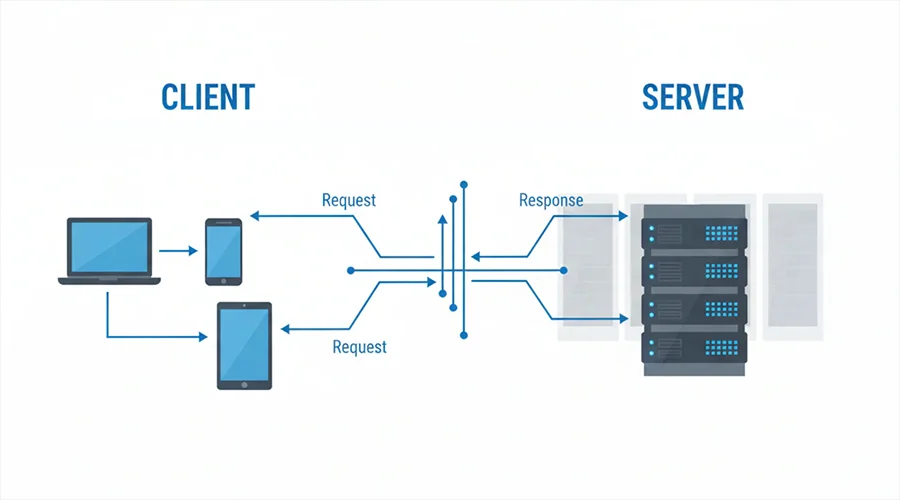
A key feature of REST is its stateless nature, meaning each request contains all the necessary information for the server to process it. This makes REST highly scalable and easy to implement. Its standardized structure and simplicity make it a popular choice for traditional web applications, public APIs, and systems that rely on straightforward CRUD operations.
GraphQL: A Flexible and Efficient Data Query Language
GraphQL is a modern API approach that gives clients more control over how they fetch data. Instead of multiple endpoints, GraphQL uses a single endpoint where clients send queries that define exactly what data they need. The server processes these queries and returns only the requested data, eliminating issues like over-fetching or under-fetching.
GraphQL supports three main operations: queries for fetching data, mutations for modifying data, and subscriptions for real-time updates. This flexibility makes it especially useful for complex applications, mobile apps, and platforms with multiple frontends. By allowing precise data retrieval and efficient communication, GraphQL improves performance and enhances the overall developer experience.
GraphQL vs REST: Key Differences
➢ Data Fetching (Overfetching vs Precise Queries)
RESTful services require the fetching of entire resources if partially required. Selecting user profiles brings you all fields. To get related data, one must then perform additional requests. This “over fetching” can significantly waste bandwidth.
GraphQL removes this need entirely. Instead clients request precisely that data they need. Related data comes as part of the same queries, reducing bandwidth usage substantially, especially on mobile networks.
REST requires separate endpoints for related data. One endpoint for a user’s information, another for the user’s posts. Another request is required to load comments. This creates a large number of roundtrips for loading complex relationships.
Data is loaded in GraphQL single request using nested queries, allowing us to fetch users with posts and comments in a single request. Developers thereby strike huge savings in code complexity.
➢ Endpoint Structure (Single Endpoint vs Multiple Endpoints)
RESTful applications can contain dozens of endpoints. Separate endpoints are required for different resources and endpoints are needed for different operations. This becomes burdensome as the application grows in complexity. GraphQL keeps a single endpoint regardless of complexity. All requests pass through the same endpoint. This reduces endpoint complexity drastically.
➢ Response structure and flexibility
REST responses are dictated by the server. The client receives evenly-structured objects or generic arrays. To customise them, a new endpoint is often needed. GraphQL requests specify exactly what is needed. The client creates the specific structure itself. The response contains nothing extraneous.
➢ Performance & Efficiency
REST is easy to cache. HTTP caching works. Servers can cache objects. Browsers cache the responses. CDNs cache them. GraphQL is hard to cache. Every query is unique. HTTP caching is more difficult. Custom caching strategies may be needed.
REST requires multiple requests to return the same data that GraphQL could return in a single query. The latency adds up. Mobile users will notice. GraphQL reduces the number of requests. Transmitted data is smaller with compression. Performance on mobiles can increase dramatically.
➢ Versioning Approach
REST is versioned through its endpoints. Updating an API in a breaking way is typically a new endpoint. This adds to maintenance over time. GraphQL APIs don’t version. The schema itself is versioned. New fields and types are added without breaking existing clients. Deprecated fields remain for a while.
➢ Server-Side Schema Vs Resource-Based Design
REST resources are designed by the server. The data model is converted into a set of API endpoints. The client adapts. GraphQL APIs have a typed schema. type safety is enforced. The rich schema makes documentation useless.
➢ Client Control vs Server Control
REST APIs place use of the server to make decisions about clients. The data schema, interfaces, etc. are defined by the developer. GraphQL APIs let the clients make all the decisions. The server simply responds to what the client asks for.
➢ Caching Mechanisms
REST can use HTTP caching to a great extent with browser cache, proxy, CDN etc. Cache invalidation and invalidation is usually manageable. GraphQL can’t use HTTP caching because every query can be distinct. Subtle behaviour needs to be implemented manually. The client can store a cache in memory. Apollo Client is one implementation.
➢ Learning Curve and Complexity
REST is fairly easy to learn. The concepts are fairly simple. You probably already know all you need. Documentation is often not required. GraphQL is hard to learn. Understanding the query language and schema is required. TypeScript help a lot.
Similarities Between GraphQL and REST
Both architectures serve identical purposes fundamentally. They transfer data between clients and servers efficiently.
Aspect
Similarity
HTTP Protocol
Both typically operate through HTTP
Authentication
Both require authentication mechanisms
Error Handling
Both provide error responses to clients
Data Format
Both commonly use JSON responses
Server Validation
Both validate incoming requests
When to Use GraphQL vs. REST
Use REST when:
Simplicity is key. Small projects want simplicity over anything else. The standardised public APIs you build should benefit from REST. Rest is what most third parties expect when calling APIs. The ability to cache more efficiently becomes critical. You need to handle file uploads via HTTP.
Use GraphQL when:
Multiple clients have separate needs. Mobile clients are bandwidth-hungry. You have strong data relationships throughout your system. You need real-time capabilities. Your front ends change rapidly. Strong typing helps avoid mistakes.
Can You Use GraphQL and REST Together?
Of course. Many applications use both at the same time. REST is great with file uploads. GraphQL is great with data fetching. You can be hybrid when done right. You can expose some endpoints via REST and some via GraphQL. It takes care of both legacy and future systems.
Both GraphQL and REST (in many respects) solve different problems. One is more simplistic, while the other offers more flexibility. Depending on your needs, one can be preferable to the other. There’s really no one size fits all. You should evaluate your needs honestly before making any decisions. Think about scalability, team skill sets, future maintenance, and more. Nowadays it can help to have knowledge of both.