30.55% of developers globally use Java. That is counted by Statista. Three billion gadgets use the language. Without the Java API, none of it would be possible. Learn everything you need to know about it here.
A product is not what the Application Programming Interface is. It’s a contract. The Java Development Kit contains a collection of prewritten classes, methods, and interfaces. Developers don’t start from zero. They take out a component from the API toolkit and go on.
Consider it this way. A list of names has to be sorted. An algorithm for sorting might be created from the ground up. Alternatively, you might use java.util.Collections.sort() and proceed. The code was already written by the API. You just take advantage of it.
The Architecture
Your software and the operating system are separated by the Java API. The API is called by your code. The Java Virtual Machine is called via the API. The OS communicates with the JVM. Java’s “write once, run anywhere” promise is a result of this layering. Every machine-specific information is abstracted away via the API. The same API calls are compatible with Windows, macOS, Linux, and Android.
There are three parts to the JDK. Your code is converted to bytecode by the compiler. That bytecode is executed by the JVM. Additionally, the prebuilt functionality you really utilize is provided via the Java API.
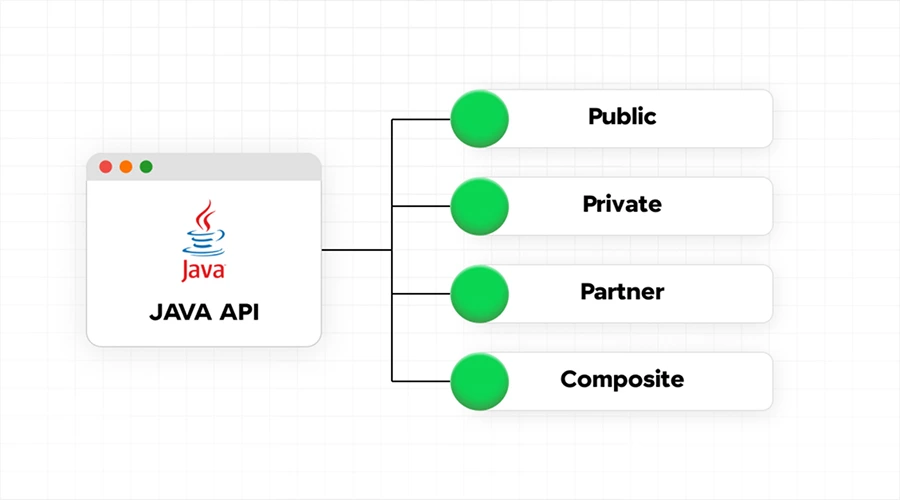
Four Ways to Categorize Java APIs
Image Source HCL GUVI
Not every API has the same function. Accessibility is examined in the first classification.
The JDK comes with public APIs. They are usable by everybody. The collections package is called java.util. For file operations, use the java.io package. No additional installation is needed.
Private APIs are internal to a company. They are constructed by a firm for internal tasks. The documentation is never seen by an outside developer. These APIs manage internal data flows, business-specific tasks, and proprietary logic.
Public and private APIs are separated by partner APIs. Under formal agreements, businesses provide them to certain business partners. API keys and contracts must be signed in order to gain access. The feature is integrated by the partner. Who is admitted is controlled by the corporation.
Composite APIs create a single interface by combining many underlying APIs. One composite endpoint is called by a developer. The system calls three or four different services behind it, then compiles the results. Microservices architecture is dominated by this style.
The Second Categorization: Functionality
An alternative perspective classifies APIs according to their real functions.
Third-party data is pulled in by external API providers. gateways for payments. meteorological services. APIs for social media. Your Java program may be connected to an external system with a few lines of code.
Business logic is handled via internal API services. To handle claims, an insurance firm may develop an API. One is constructed by a bank to validate transactions. The public internet is never touched by them.
CRUD APIs work with data. Make, read, edit, and remove. The classic example is JDBC. It converts Java objects into database rows and vice versa.
Why Use Java APIs
There are four distinct advantages.
Speed. Development time is significantly reduced by prebuilt functionality. Sorting, networking, and file management are not reimplemented by a developer. Those issues have previously been resolved by the API.
Consistency: APIs impose uniform methods. When a Java developer invokes Collections.sort(), the same results are obtained. Don’t speculate. No, “it works on my machine.”
Abstraction. Complexity is concealed by the API. Without understanding how SSL handshakes or TCP packets are formed, a developer calls HttpURLConnection. The low-level work is handled by the API.
Dependability across platforms. All JVM-supported systems exhibit the same behavior for the same API requests. Write only once. Go wherever and run. It is guaranteed by the API.
The Frameworks That Deliver
Image Source Newwave Solutions
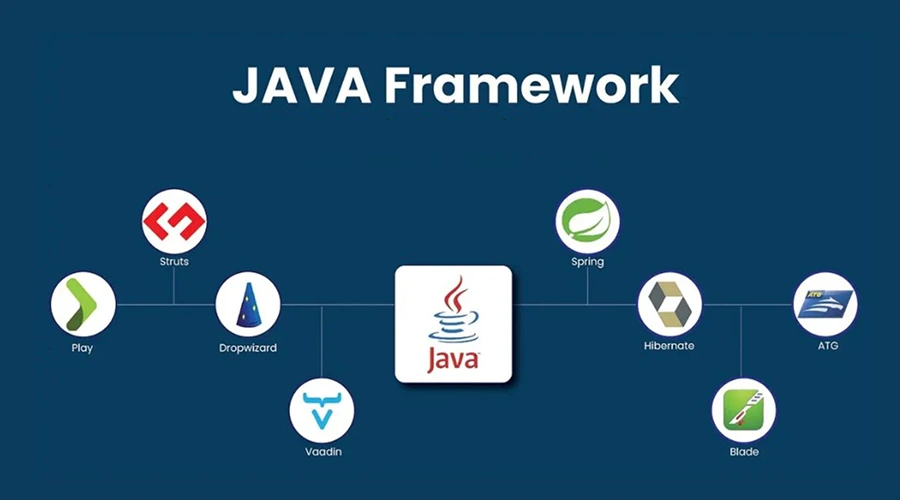
The building blocks are provided via APIs. Frameworks put them together to create structures that are ready for production.
Spring Boot is one of the most popular Java frameworks for API development.. In 2025, use reached 14.7% worldwide. The framework’s integrated servers (Tomcat, Jetty), auto-configuration, and production-ready defaults make developing RESTful APIs easier. First-class REST API versioning, integrated resilience features like concurrency throttle and retry, and standardized null safety via JSpecify annotations were all added in Spring Boot 4.0.
Jersey directly implements the JAX-RS specification. Open-source. Part of the Java EE ecosystem. Jersey is used by developers who desire standards compliance without Spring’s biased framework.
Both SOAP and REST are handled by Apache CXF. JAX-WS for services based on XML. JAX-RS for REST. CXF is essential for large companies with mixed service architectures.
Cloud-native deployment is the goal of Quarkus. quick beginning. little memory use. For serverless settings, sub-second cold starts are important. That’s what Quarkus does.
Micronaut’s solution is different from Quarkus’s, yet both have a cloud-native focus. Reflection overhead is removed using compile-time dependency injection. reduced memory use. quicker boot times.
The RESTful Specifics
Modern Java programming is dominated by REST APIs and API design best practices. The architecture adheres to five guidelines.
Stateless interactions: all required data is included in every request. No session storage on the server. There is no inter-request context dependence.
Resources are mapped to URLs via a uniform interface. Actions are defined using HTTP methods. PUT updates, POST creates, and GET retrieves. DELETE eliminates.
Front-end and back-end develop separately due to client-server separation. The API contract remains unchanged. Without destroying one another, both sides evolve.
Cacheable responses: The server clearly indicates whether or not a response is cacheable. Data is reused by client caches. Latency decreases and server load decreases.
Layered architecture: without changing client or server code, intermediary layers manage security, load balancing, and caching.
Finally
The trend is validated by the Java API market. The size of the worldwide API market was 735.9 million in 2025 and is expected to grow at a 10.8% CAGR to 2.05 billion by 2035. This expansion is fueled by Java’s sizable development community, cross-platform interoperability, and established ecosystem.
There is no feature for the Java API. It serves as the basis. It is the foundation of any Java program developed today. Java itself must be understood in order to comprehend the API.