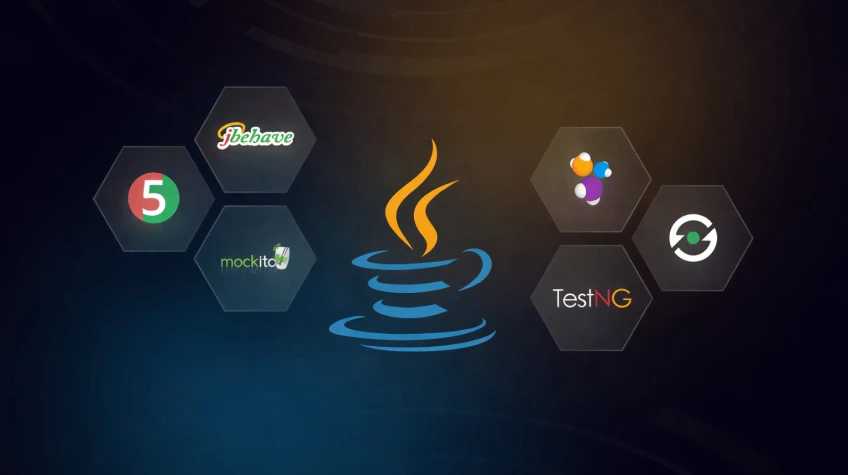
It’s not luck that the code doesn’t break. It is discipline. Java developers use testing frameworks to maintain such discipline.
The most popular frameworks are listed below.
1. JUnit 5
The norm for the industry. JUnit 5’s modular architecture set it apart from earlier iterations. The core consists of three parts: JUnit Vintage (backward compatibility with JUnit 4), JUnit Jupiter (a new programming style for building tests), and JUnit Platform (which launches testing frameworks on the JVM).
Dynamic testing, which create tests at runtime, parameterized tests, which execute the same test with varied inputs, and lambda support for assertions are some of the key features. Early in 2026, version 5.12 was published, adding parallel test execution without configuration cost.
For unit testing any Java program, use JUnit 5. Quarkus, Micronaut, and Spring Boot all use it by default.
2. TestNG
The real rival of JUnit. Java annotations served as an inspiration for TestNG (Test Next Generation), which incorporated more potent features.
Dependency management (test B only runs after test A succeeds), native support for test groups (run just smoke tests or only database tests), and data providers (inject complicated test data directly) are important differentiators. In many situations, TestNG performs integration and end-to-end tests more effectively than JUnit.
Popular among business teams who automate browsers with Selenium.
3. Mockito
Isolation is necessary for unit testing. Mockito simulates dependencies by creating fake objects.
A database repository is called by a class. Mockito substitutes a mock repository for that one during testing. You specify the behavior of the mock: return Y when method X is invoked. Check later to make sure the test appropriately called the method.
Inline mocking for final classes and methods was made available by Mockito 5.0. Automatic constructor injection was implemented in version 5.12. Mockito is preferred by more than 60% of Java developers that use mocking.
4. Selenium
Automation of browsers. not a framework for unit testing. a framework for functional testing.
Real browsers, such as Chrome, Firefox, Safari, and Edge, are driven by Selenium to carry out user activities. Press the buttons. Complete the forms. Go through the pages. Verify that the site is updated accurately.
Connects to JUnit or TestNG for test structure and assertion syntax. The majority of Java web application QA pipelines are built around the combination of JUnit and Selenium.
5. REST Assured
Seldom does API testing receive special attention. That is fixed by REST Assured.
Use a fluent Java API to write declarative tests for REST endpoints. No boilerplate for HTTP clients. No construction requests by hand.
For instance, given().param (“id”, “123”).when().get (“user”).then().body (“name”, equalTo (“John”)). The syntax has a natural language feel to it. Response validation, serialization, and authentication are all automatically handled by REST Assured.
6. Cucumber
Testing is moved from implementation to intention via behavior-driven development (BDD). Cucumber enables non-technical stakeholders to create Gherkin test specs in simple English.
A requirement: When a user clicks “checkout,” they are logged in. The cart total then appears accurately. These phrases are mapped to Java step definitions by Cucumber. Automated test code is created using the same English specification.
Teams that use Cucumber report improved communication between QA, developers, and product owners as well as fewer requirements misconceptions.
7. AssertJ
Basic assertions are included in JUnit. AssertJ provides over 100% improvement.
AssertThat(user.getName()) is a more readable example of fluent assertion chaining.as (“check name”).isEqualTo (“John”).isUpperCase(). Descriptive error messages that contrast real and intended values are displayed when the library fails.
Additionally, AssertJ offers soft assertions, which gather several assertion failures prior to reporting rather than failing at the first mistake. Assertions for Java 21’s sequenced collections were included in version 3.27.
8. Testcontainers
Real dependencies, such as databases, message queues, and caches, are necessary for integration tests. Making fun of them frequently overlooks actual failure modes.
Docker containers are launched straight from Java test code using Testcontainers. A new PostgreSQL container is spun up, the test is executed, and the container is then destroyed. Not a common state. No setup by hand.
Kubernetes clusters are now supported by Testcontainers 2.0. Teams who use Testcontainers claim a 40% boost in integration test reliability.
9. Apache JMeter
Testing is performance testing. Any system may be loaded and tested using JMeter.
JMeter mimics hundreds of concurrent users performing message broker calls, database queries, and HTTP requests. It gauges error rates, throughput, and reaction times.
It’s not only a framework for developers. Using a GUI, QA engineers create test plans. Within CI pipelines, programmatic test execution is made possible using the Java API.
10. Pact
Contracts are used by microservices to communicate. Consumer-driven contract testing is implemented by Pact.
Expectations on what is required of the supplier (service B) are written by the customer (service A). These expectations are documented in a contract. During its own test suite, the supplier confirms that it complies with the contract.
This detects integration errors prior to deployment. minimizes end-to-end test suites. Pact’s language-neutral communication structure makes it cross-linguistic.
Selecting Your Stack
Every demand cannot be met by a single framework. The majority of teams construct a stack:
Mockito with JUnit 5 for unit testing
For API testing, REST is guaranteed.
Integration test containers
JUnit and Selenium for UI testing
Select the instruments that correspond to your regions of risk. Deep unit and API coverage is necessary for a financial application. Performance testing is necessary for a content website. Contract testing is necessary for enterprise integration.
The frames are waiting. Your bugs don’t.
FAQs
1. Do I need to learn all ten frameworks?
No. Start with Mockito and JUnit 5. Eighty percent of the daily testing requirements are met by it. Add more only when particular issues arise: Selenium for browser automation, REST Assured for API validation, and Testcontainers for database testing.
2. Is JUnit 5 backwards compatible with JUnit 4?
Yes, using the Vintage engine. During the migration, you may run both new JUnit 5 tests and current JUnit 4 tests. Annotations and assertions from JUnit 4 are translated to the new platform by the engine. After the migration is finished, remove Vintage.
3. How do I choose between Mockito and EasyMock?
There’s a reason why Mockito has such a large market share. When(mock.method() is a more logical syntax.thenReturn(value) in contrast to EasyMock’s expect(mock.method()).and Return (value).then().check(). Final classes and methods are likewise mocked by Mockito (EasyMock requires setup). Unless EasyMock is required by older code, select Mockito.
4. Can Testcontainers run on my local machine without Docker?
No. A Docker daemon is necessary for Testcontainers. Use the Ryuk container deactivated and remote daemon support for CI setups without Docker; nevertheless, Docker Desktop or Podman are required for local development. Although there are alternatives (such as the H2 in-memory database for rapid testing), they do not capture actual production behavior.