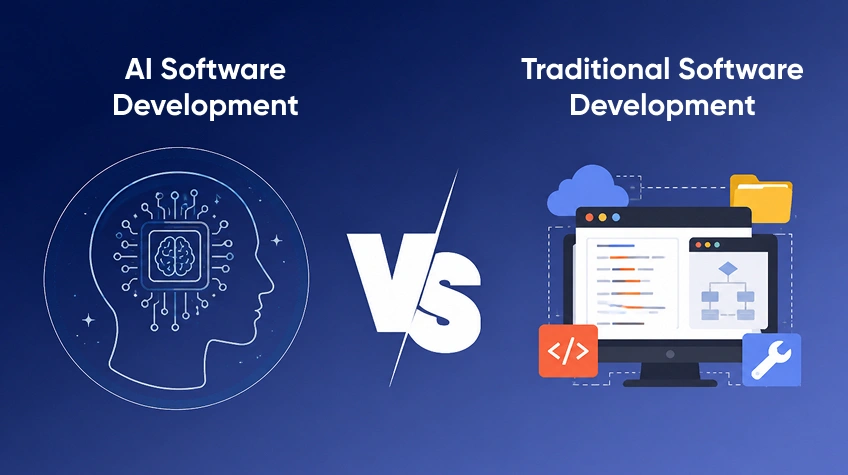
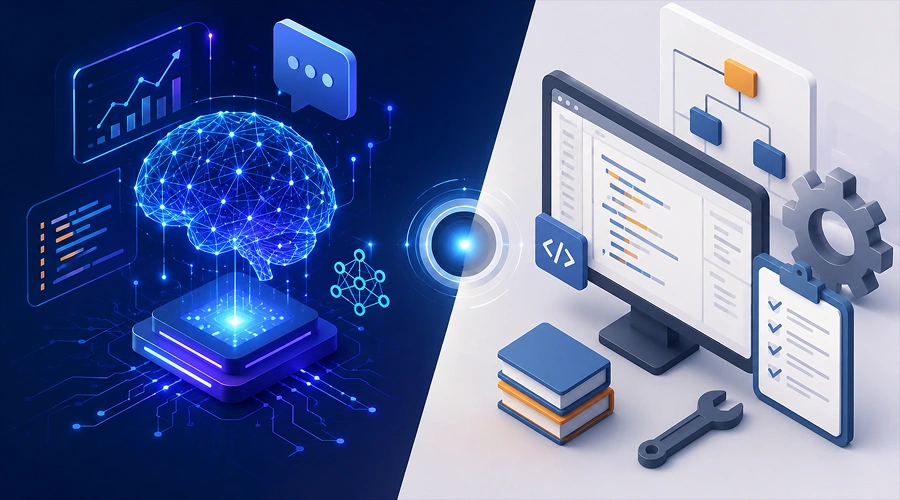
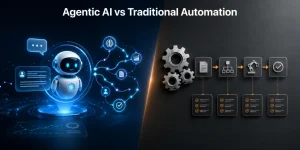
Two radically different approaches to building software now quarrel for the spotlight at every development repo. One respects structured human logic. The other learns from data and adapts on the fly. Knowing how AI driven and traditional software development truly differ is key for businesses to make better technology choices and prevent costly misalignment between strategy and purpose.
Why the AI vs Traditional Software Development Debate Matters
The way software is built is evolving at a pace that most organisations have a hard time keeping up with. Software built on traditional development has delivered reliable, predictable outcomes for decades. AI development today is building capabilities that explicit programming cannot match at scale. The decision of which to use is a practical business decision that has direct effects on cost, schedule and earnings. Choosing wrongly means you lose money now, and build up technical debt that will make it hard to change later on.
AI vs Traditional Software Development: Key Differences
➢ Defining logic
In traditional software development, logic is explicitly authored. A programmer writes conditions, responses, and outcomes. The program follows instruction, so nothing else.
In AI driven development, logic is trained. Instead of writing logic, a team trains models on data. The models learn patterns, learn to predict, and learn to improve. The logic is derived from data rather than programmed by humans.
➢ Predictability and control
Traditional software is predictable. Run the program twice with the same input and you get the same output twice (every time). That predictability is what makes traditional software testing and debugging relatively straightforward.
AI systems boil down to variants. Depending on the model version and context, slightly different outputs can come from the same input. That flexibility lets AI balance nuance and ambiguity, it just makes testing harder.
➢ Development process
Traditional development follows a methodology. Identify requirements, write code, test, and deploy. Nominate a human every line of logic the program will execute.
AI development follows a pipeline. Collect and clean data, choose a model, train, validate, and fine tune. You need a team of software developers, machine learningengineers, and data scientists.
➢Scaling and adaptation
Traditional software scales infrastructure. More users need more servers, but no more advanced software.
AI systems scale more data. A recommendation engine that has processed one million interactions is measurably more effective with ten million interactions. That delivers compounding commercial value that traditional software can’t achieve.
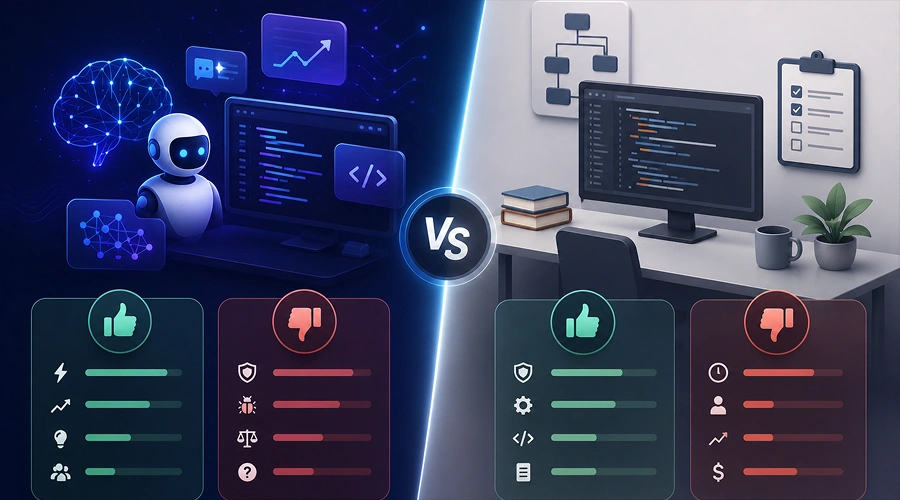
Advantages and Limitations of Each Approach
Traditional Software Development
⮞ Advantages:
It’s behaviour is highly predictable and fully auditable
It is easier to test, debug and maintain
It does not rely on large labelled datasets
It offers stronger regulatory compliance for applications that need explainability
It has lower complexity at start for problems that are well defined
⮞ Limitations:
It cannot scale up to solve pattern recognition problems
Its rules have to be updated manually if the requirements change
It performs poorly on ill-structured data such as images and natural language
It cannot learn from operational experience without having its code changed
AI Driven Development
⮞ Benefits:
Capable of complex pattern recognition that rules cannot be written for
Continually gets better with addition of new data
Reads unstructured data like text, images and speech
Builds entire new categories of products that were not possible before
⮞ Limitations:
Requires substantial high quality training data to perform reliably
Harder to control the behaviour creates compliance risk
Significant data collection and skilled staff needed up front
Monitoring costs and periodic retraining are ongoing costs
When to Choose AI vs Traditional Development
Traditional software development makes sense for problems that have well-defined rules that aren’t often changed: for example financial transaction processing, scheduling, inventory, and workflow. When please auditability and explainability are fundamental requirements, traditional development is a good baseline.
Opt for AI development when your problem is based on recognising patterns in considerable amounts of unstructured data. Fraud detection, personalised recommendations, natural language processing and demand forecasting all use AI methods to solve problems that cannot be achieved by explicitly written rules. You should also prefer AI when your problem is one that could improve upon itself or when the problem definition is too complicated for humans to program all the rules manually.
Choose a hybrid approach when multiple pieces of your system need to operate under different conditions. For example, a customer service system might use off-the-shelf software for account management but use AI to understand customer queries. Production systems almost always require a blend of the two methods.
Conclusion
AI and traditional software development are complementary, not competing. They solve different problems. Traditional development creates predictable systems for well defined problems. AI development creates systems that benefit from pattern recognition and scaling. The best technology strategy uses the right tool for each component of the problem.
FAQs
1. Is AI replacing traditional software development?
No. AI is adding to ability, not replacing structured programming. Most production systems use a mix of both.
2. Which approach is more costly?
AI development is usually more costly, especially for early stages building data pipelines and hiring specialists. Traditional development is easier to budget and predict for well scoped projects.
3. Does it require a large team?
With use of pre- trained models and cloud AI services, it’s absolutely possible to build AI solutions with a small team without specialised AI skills.
4. How do I know if my problem needs AI?
Anything else than a problem with large data volumes and where pattern recognition or learning from experience is needed would be a good candidate for AI development. If your solution can be written based on an integer set of rules, traditional development is likely to be sufficient.
5. What extra skills does AI development require?
Data engineering, statistical model and machine learning fundamentals such as classification, clustering and regression, and model validation and evaluation are essential skills for AI development.