
Some years back, creating an AI business entailed recruiting experts and investing in massive computing resources. Nowadays, there are advanced models that can be created using basic tools and interfaces, which means that a single entrepreneur using a laptop can build something of substance. The problem is no longer technological; it is about knowing where to apply it.
As we move closer to 2027, the best ideas are those that do not make any noise. Rather, they address mundane but costly issues for particular individuals. This article explores the top AI business ideas to pursue, what they entail, who they serve, and how to pick and start them.
Why 2027 Is a Strong Time to Start
➣ Lower Costs, Easier Tools
Creating AI-driven products has become more affordable. Pre-trained models, no-code applications, and automated tools allow you to test your idea within weeks instead of months. Thus, you can check whether there is a market for the product before investing in its development.
➣ Businesses Are Ready to Invest
Companies are no longer just curious about the benefits of automation. Many have funds allocated for automation and need help in deploying it, but don’t have enough time or expertise to do it. The difference between desire for AI and actual utilization is the niche for startups.
➣ Specialization Trumps Generalization
General AI-driven chatbots have already been developed by all major players. Opportunities for startups lie in industry-specific tools that know the lingo and processes of a certain professional sphere.
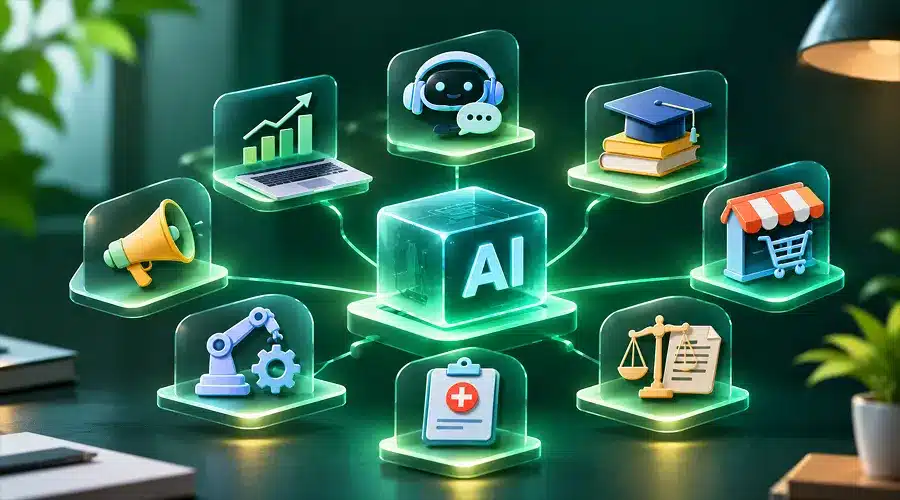
Top 12 AI Business Ideas Worth Considering
1. AI Automation Agency
Small and medium-size businesses would like to reduce time spent on work but don’t know how to start. The agency performs process audit and develops AI-driven workflows for lead follow-up, invoicing, appointment scheduling, and reporting.
Why it works: Small initial investment, quick wins, and subscription-based income from support.
Best for: People with expertise in operations, marketing, or tech.
2. AI Assistant for One Industry
Instead of developing a generic chatbot, develop an assistant for one industry, such as real estate agents, dental clinics, accountants, or recruiters. A well-trained assistant who writes descriptions of properties, reminds about appointments or filters resumes would save much time for professionals every week.
Why it works: Niched products have fewer competitors and allow a subscription model.
Best for: Founders who know one industry well.
3. AI-Based Customer Service Offering
Customer support services are costly and repetitive. You could develop an AI-based support layer that can provide answers to popular queries, check order status, and direct difficult inquiries to humans. It can be positioned as a managed service so that clients don’t have to configure anything.
Why it works: ROI is evident due to the decrease in cost and time of support.
Best for: Entrepreneurs with knowledge in customer support and/or e-commerce.
4. Human-Edited Content Production Service With the Help of AI
Companies require blogs, product descriptions, newsletters, scripts, and social content on an ongoing basis. Your business may develop a service where such content is provided by the help of AI with human editors that ensure quality and brand voice.
Why it works: Demand is constant and it can work well for numerous clients.
Best for: Writers, editors, and marketers.
5. AI Training & Upskilling Services
Many employees don’t know how to incorporate AI into their job duties. Workshops, courses, and company-specific training are much in demand. Concentrate on practical implementation in a certain role – something like “AI for HR departments” or “AI for salespeople.”
Why it works: Companies are ready to pay decently for training resulting in productivity improvements.
Best for: Trainers and consultants.
6. Personalized Online Stores
Stores want improved recommendations, intelligent search, automatic product description, and abandoned cart messages. Create plug-ins or services for the most popular online stores that do all that for you on a monthly basis.
Why it works: The owner of the store sees increased sales in real time.
Best for: Developers & e-commerce specialists.
7. AI Tools for Healthcare Administration
Clinics expend an enormous amount of time on scheduling, documentation, coding, and insurance forms. AI tools which help alleviate these problems are useful, although it is a domain where strict adherence to privacy rules and correctness is important. Begin with administrative activities, not clinical decisions.
Why it works: High pain point and high willingness to pay.
Best for: Founders with expertise in healthcare or compliance.
8. Legal and Compliance Document Assistants
Lawyers and compliance officers check contracts, interpret regulations, and write standard documents. An AI tool which can identify risky clauses or summarize lengthy agreements can save hours. Manual verification must be at the core, as mistakes are costly.
Why it works: Professionals work per hour and appreciate time savings.
Best for: Legal professionals and legal tech enthusiasts.
9. AI-Powered Tutoring and Educational Services
A very interesting application of AI is personalized learning. It will be possible to create an educational platform, which will focus on particular subject matter, test prep, or students’ ages. The platform will work at an individual pace of a learner and explain various concepts differently. Parents and educational institutions will pay for those services.
Why it works: Massive market with high motivation and subscription models.
Best for: Educators and e-learning entrepreneurs.
Also Read: How Can AI Improve The Quality Of Education?
10. Local Business Online Marketing Services
Local businesses (e.g., restaurants, spas, gyms, doctors’ clinics, etc.) require marketing services, yet they don’t have time to manage it themselves. Therefore, offer them your assistance, using AI to help you create all the content required.
Why it works: There are many potential customers and very repeatable deliverables.
Best for: Digital marketers and freelancers willing to scale.
11. Data Insights and Analysis Services
Businesses often have many spreadsheets and dashboards that they don’t actually make use of. An analyst who knows how to work with both AI technology and business acumen could take your data and transform it into insightful conclusions, projections, and advice.
Package it as an ongoing reporting service.
Why it works: Decision makers appreciate clarity over complexity.
Best for: Analysts, accountants, and finance experts.
12. AI Voice and Scheduling Assistants
Missed calls = missed opportunities. Voice assistants can take calls, leave messages, schedule appointments, and even handle simple customer questions for service businesses such as plumbers, clinics, or salons. A very practical product to pitch.
Why it works: Its value is obvious.
Best for: Entrepreneurs experienced with telephony.
How to Choose the Right Idea for You
🢧 Start With Your Strengths
The ideal AI business is built upon AI in addition to something you already know. Your experience with the industry, professional contacts, and knowledge of customer issues give you an advantage that no technology can replicate.
🢧 Seek Out Painful, Repeated Challenges
Great ideas solve challenges that are expensive, repeated, and painful. Weekly frustrations expressed by a business owner provide an excellent indication of interest.
🢧 Determine Whether People Will Pay
Interest does not equate to demand. Before moving forward with development, speak with at least ten potential clients. Find out what they pay now for the challenge and if they would pay to get rid of it.
🢧 Think About Copying
If an idea can be copied overnight, your competitive advantage must be something else. This could be relationships, reputation, specialized data, or unique service levels.
A Simple Plan to Launch

⮚ Step One: Validate
Briefly explain your offer in a single sentence and communicate it to potential customers. Use a free pilot or discounted first project in order to get feedback and testimonials.
⮚ Step Two: Create the Minimum Version
Use already available software wherever it is possible. It is better to have a good and reliable workflow rather than an excellent but half-done product.
⮚ Step Three: Price for Outcome
Price your services according to the outcome produced, not the time you spend on it. If you save your customer ten hours per week, then charge appropriately. The monthly subscription provides steadier cash flow than one-time projects.
⮚ Step Four: Get Your First Customers
Do direct communication, network with professionals, join local organizations and demonstrate how your tool solves their problems.
⮚ Step Five: Iterate and Scale
Measure, listen to feedback, and improve. Once you have succeeded in one area, try other services or industries.
Mistakes to Avoid
- Chasing trends instead of problems: A fashionable idea with no real customer need will stall.
- Ignoring data privacy: Handling customer information carelessly can destroy trust and invite legal trouble.
- Overpromising results: Be honest about what AI can and cannot do.
- Removing humans too early: Review steps protect quality and reputation.
- Building before talking to customers: Assumptions are expensive.
Risks and Responsibilities

⮞ Accuracy and Reliability
AI systems can produce confident but incorrect answers. Build checks into your process, especially in healthcare, finance, and legal contexts.
⮞ Rules and Regulations
Laws around AI, data protection, and advertising claims continue to evolve. Stay informed about the regulations in your region and any industry you serve, and consult a professional when handling sensitive data.
⮞ Platform Dependence
If your business relies entirely on one provider’s tools, price changes or policy shifts could disrupt you. Design your workflows so you can switch providers if needed.
Conclusion
There is one key similarity between the best AI business ideas for 2027: they all offer solutions to particular problems of particular people using AI as a tool, but not the core feature of the product. No matter whether you are going to start an automation company, a niche assistant, a training course, or a local marketing company – all of these businesses require deep customer insights and reliability.
You don’t need any revolutionary invention or huge funds to succeed. Just pick some issue that you know well, check its validation by real people, create a solution, and polish it. It’s going to be these founders who will succeed next year.