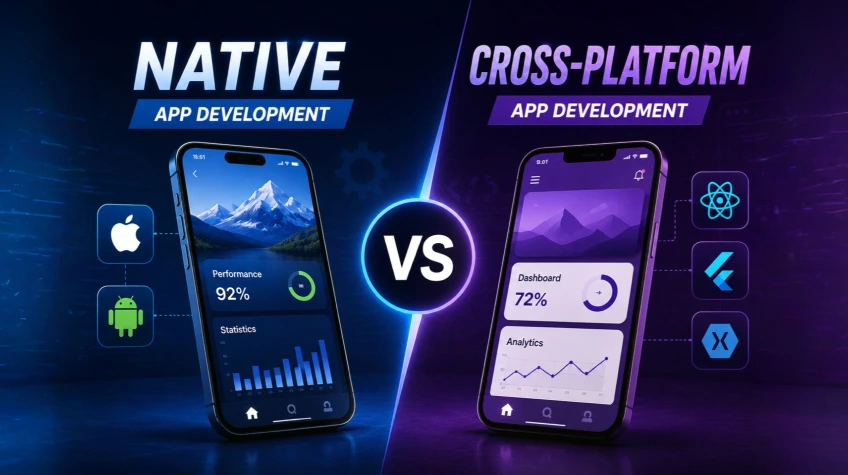
Mobile apps are the way we connect with customers, deliver services and build an online presence. But, before you build an app, you make a vital selection – the choice between native and cross-platform development. With native apps, you would develop one app per platform, such as developing an app for iOS and one for Android. But, with cross-platform development, you can develop it once and use that same code to launch on multiple platforms.
Each one is advantageous in its own way, and each suffers some drawbacks. Native development ensures a more powerful device integration and better performance; cross-platform can support faster and cheaper result delivery. It depends on a variety of factors – your requirements, business strategy, budget and future plans, what your app can handle, and what you expect from your app. Knowing the pros and cons of both is an imperative part of making a decision.
Where Native and Cross-Platform Development Take Different Paths
They might appear to be a similar choice, deploy an app to a user’s device , in that they both do the same work, but they differ in execution.
With native development, you’re essentially developing a separate app for every platform, using a dedicated language. Depending on the platform, you will be using Swift or Objective-C for iOS, Kotlin or Java for Android. This means you will have two codebases, likely to involve two separate teams, two separate development cycles, or more respectively.
Cross-platform development takes a different spin. Instead of separate code bases for each platform, a single shared codebase, built using frameworks such as Flutter or React Native, compiles to run on both iOS and Android. This will give you one development team, one timeline, and one codebase to maintain going ahead.
So the fork in the road is as simple as platform-specific excellence or shared time, cost and maintainability. All everything that follows – cost, speed, performance and user experience – will follow from this specific choice.
Native vs Cross-Platform App Development: Key Differences
Choosing between native and cross-platform development hinges on a whole host of variables, such as performance, budget, user experience, maintainability, scalability, and access to device features. While native apps are developed specifically for iOS or Android, cross-platform apps share a single codebase to support multiple platforms.
⮫ Performance and Speed
A native application interacts directly with the operating system, which yields faster performance, smoother animations and more responsive feedback. Native apps also work well for graphics-intensive apps, games and apps with heavy graphics or complex animations.
Cross-platform frameworks such as Flutter, however, have made a huge leap in narrowing their performance gaps. For typical business apps e-commerce sites, booking apps and content-based apps most users won’t pick up the difference.
⮫ Development Cost and Time
Cross-platform development comes with a big advantage of saving time and money. One codebase for iOS and Android saves the development effort, testing effort and time to market. Developing native apps requires building two separate applications with developers specialised in each platform, and testing on two platforms. This adds costs, however, for performance-sensitive or highly interactive mobile apps this cost can be justified.
⮫ User Experience and UI/UX
With development on native platforms, you’re incorporating native components, gestures and use animations. Your user feels it’s a true native app. Both cross-platform technologies and hybrid apps are highly customizable in UI interactions and offer an almost native experience. However, such apps can have certain blips that make it become easily noticeable like different gestures, animation or UI/behaviour when compared to native apps. For premium consumer applications where the experience is a key differentiator, native development offers more control.
⮫ Maintenance and Updates
It is simpler to maintain cross-platform apps as developers maintain a single code base. Major design and feature changes can be deployed with a single code update. Native apps need to be updated and tested separately for iOS and Android, making maintenance and coordinating releases more difficult.
⮫ Scalability
Native apps give high performance and instant access to new operating system features. They are a good choice for more complex and technically advanced applications. Cross-platform development makes it easier to use your engineering team by assigning them all the same codebase, which may allow you to handle more features. But ultimately hardware complicated ones may be handled only natively re-coded for each operating system.
⮫ Access to Device Features
Native apps can use device features such as cameras, GPS, biometrics, bluetooth and new operating system features as soon as they are released. Cross-platform apps can use these features via plugins or bridges to native functionality. Most plugins support common features, but you may have to wait for new features to be available on third-party frameworks and their plugins.
⮫ Security
Both approaches can be secure, but native apps integrate easily with interactive features such as platform security features that restrict access to code. Security depends on the source code from third-party cross-platform frameworks and plugins, which should be checked regularly for changes and updates.
Which Development Approach Fits Your App’s Goals?
Put aside the technical considerations and this is really a question of what you want your app to do.
If you’re looking to validate a market hypothesis in an MVP, then cross-platform development will get you into the market faster, at lower cost, and allow you to iterate before you have poured too much capital into one platform’s native code.
If you’re building something like a performance driven product, game, AR experience, or pro creative tool, then native development is usually the better-bet to achieve your goal.
If your goal is to build a content, booking, or service app where speed to the market and consistency are paramount, then cross-platform is often the better bet.
The objective is not to identify the objectively “superior” technology, but to align the technology with the specific outcome the business intends to achieve.
How Your Business Model Can Influence the Development Approach
An organization’s business model shapes this decision as significantly as its feature requirements do.
Bootstrapped and early-stage startups typically cannot justify the expense of two parallel native builds. Capital efficiency is paramount, and cross-platform development allows for market validation without committing the majority of available runway to the initiative.
Venture-backed startups scaling rapidly may reasonably favor native development sooner, particularly when performance or platform-exclusive functionality forms a core part of the value proposition underpinning investor confidence.
Enterprise organizations building internal tools or B2B platforms frequently prioritize long-term maintainability and cost control, making cross-platform development an increasingly common enterprise standard rather than solely a startup expedient.
Consumer brands built around experience — luxury, fintech, and premium lifestyle applications — often justify the additional investment in native development, given that user experience is central to the brand proposition itself.
Allowing the business model, and not solely the feature roadmap, to inform this decision is a reasonable and often advisable approach.
What to Consider Before Committing to Native or Cross-Platform
Prior to finalizing this decision, organizations should evaluate the following considerations:
Budget constraints Can the organization realistically fund two parallel native builds, including ongoing maintenance for both platforms?
Timeline pressures Is the organization working toward a funding milestone or market window in which speed takes precedence over refinement?
Feature complexity Does the application depend on advanced hardware integration, augmented reality, or other performance-intensive functionality?
Target audience composition Is the user base concentrated on a single platform, or distributed relatively evenly across iOS and Android?
Long-term product vision Is the objective a rapid MVP for validation purposes, or a flagship product intended to compete on experience over an extended period?
None of these factors, considered in isolation, provides a definitive answer. Collectively, however, they offer a clear indication of which approach best aligns with the organization’s circumstances.
Conclusion
In terms of thinking, the native vs cross-platform question has never been purely a technical question, but instead a business strategy question rendered in technical form. Native has speed, intensity, depth, and platform-purism, but it comes with a hefty price tag and considerable time investment. Cross-platform has speed, cost effectiveness, and code re-use, but it may come with a liability in some performance demanding scenarios. Choosing between them is not about following the crowd, but choosing what is truly valid for a particular product, its developers, and which runway an organization is allowed. If your company is in the midst of deciding the best approach for a particular product, consider talking with a development team, to avoid a costly mistake and set the foundation right the first time.
FAQs
Is cross-platform development an option for a full-fledged serious product?
There are a number of full-fledged category leaders using Flutter or React Native today. For the majority of business applications the framework is not a constraint, but the complexity of features is.
Can development start cross-platform with a plan to go native later?
Technically speaking, yes, usually at the cost of a full rebuild rather than simple migration. It’s a suitable MVP validation technique as long as the organization is willing to pay the cost if scale demands it later.
Which approach is more cost-effective over time?
Cross-platform is cheaper up front and for ongoing maintenance unless there’s a case for heavy platform-specific optimization that would otherwise require a maintenance burden of constant tweaking. In those cases, native may become cost competitive over time.
Is cross-platform development necessarily less quality?
No, not any more than the choice of language is less quality, although we are rapidly getting closer to parity in terms of performance and UI across platforms. It comes down to the quality of the execution and the development talent hired.
How can an organization know which platform the user base prefers?
Existing web analytics, benchmarking against competitors, or a quick pre-launch survey. If the user base is heavily weighted to one OS, then that alone can provide a true, intuitive simplifying factor.