Artificial intelligence co-pilots are changing the way developers write code. The intelligent assistants offer advice, fixes, and optimization methods in real-time. In this blog post, we look at how this technology is changing software development, giving developers more time while keeping code quality on track.
Understanding AI Co-Pilots
What makes an AI co-pilot different from the other development tools in the market today? An AI co-pilot is a smart tool that can understand the context of your code base. Whereas many other code editor tools only offer automatic completion capabilities, an AI co-pilot has access to code patterns and can generate solution suggestions and thinking pointers based on your project.
The modern AI co-pilots use machine learning models trained on millions of projects. That makes these tools capable of identifying syntax patterns, common mistakes, and good practices in all kinds of programming languages. The AI technology is integrated in your editor.
How AI Co-Pilots Are Transforming Software Development

➢ Boosting Developer Productivity and Speed
Do you notice how many hours programmers spend writing irrelevant boilerplate code? The technology that is called AI copilots helps to improve productivity. Developers will be able to concentrate on architecture design instead of implementing repetitive code.
It is proven that developers finish work 30% faster. They meet deadlines and don’t compromise quality. This technology implements trivial solutions and allows software engineers to focus on solving hard problems. Improvements reflect that they spend less time implementing trivial things and more time to innovate and be creative.
➢ Improving Code Quality and Reducing Errors
Why does code reviews take so much time? Copilots identify possible problems before a human starts to check the program. Bugs, performance limits and security vulnerabilities are identified.
Fixing issues found early needs much less effort than fixing issues found in production. Suggestions for better implementation and anti-patterns are dealt with by copilots. The code becomes more consistent for every team member.
➢ Accelerating Learning for Developers

Can junior developers climb their skillset faster with AI-powered mentorship rolling out? Yes. Copilots are smart mentors who always suggest best practices when writing production code. So junior engineers just naturally spend their time writing code using the right conventions and patterns without having to read up on them.
There’s no need to have a senior developer constantly reviewing code or best practices. Junior engineers don’t have to wait to hit the onboarding wall because the tool nudges them in the right direction instantly. Knowledge transfer happens by the way everyone writes code, no more knowledge sharing sessions needed. Career progress is just so much faster for junior staff.
➢ Enhancing Team Collaboration and Knowledge Sharing
How is institutional knowledge good for organisational performance? It’s so obvious that it’s never been captured through the efforts of an entire development team before. AI copilots do it! Your team ends up learning the best way to solve a problem that you can apply with the other developers across your organisation.
There’s no point writing that documentation, the tool is now providing the optimisation. The code that is by its very nature is consistent as it’s developed and maintained without any communication overhead or continuous mentoring from managers.
➢ Enabling Faster Prototyping and Innovation
What if prototypes took hours not weeks, as is the norm? AI dramatically shortens prototype development cycles because developers can quickly try out ideas and not worry about difficult implementation details all the time.
Teams are free to experiment because infrastructure code generation happens automatically. Rapid innovation is possible when setup overhead disappears entirely. Market responsiveness increases tremendously when the time to ship products is much reduced. The way to seize market opportunities is now available to organisations that do it faster than their competitors.
➢ Reducing Repetitive Development Tasks
What consumes developer time without using creativity? Projects require database operations, API integrations, testing frameworks and configuration files. AI copilots produce these artefacts on demand.
Developers can describe what is needed, and the system takes care of implementation. Developer focus stays on the hard, unique, problems. Monotonous coding fatigue is heavily mitigated.
➢ Supporting Better Decision-Making During Development
Does the code architecture fit the project? AI can give suggested architectures based on what is known to work. The technology can model many different approaches in parallel.
Developers are in a better position to make the right decision when all options are presented to them. Decision making is evidence based rather than intuition based because risk is assessed on suggested alternatives.
➢ Increasing Efficiency Across Development Workflows
What if every part of the development process becomes more efficient? Incremental gains stack across the development pipeline. Writing, testing, documentation and maintenance are all improved.
Development pipelines become smoother as bottlenecks disappear. Time to market compresses over every project in an entire product portfolio. Capacity increases without hiring more people.
Real-World Applications of AI Co-Pilots
| Application Area | Impact | Benefit |
|---|---|---|
| Full stack development | Rapid API plus UI generation | Faster feature delivery |
| Cloud migration | Infrastructure code creation | Reduced migration complexity |
| Legacy modernisation | Automatic refactoring suggestions | Safer code transformation |
| Test automation | Test case generation | Improved coverage metrics |
| Documentation | Auto generated summaries | Current technical records |
| Security hardening | Vulnerability pattern detection | Enhanced protection levels |
Enterprise software development experiences massive gains in enterprise giants like the Fortune 500. Enterprise application API design, database schema creation, and middleware configuration arise out of natural language specifications. Integration platforms that once took months are now available in weeks. Boilerplate backend infrastructure generation becomes natural.
Startup acceleration creates rapid release cycles. Small teams work efficiently with constant artificial intelligence support. Small firms compete with larger businesses through optimum resource utilisation. Fast release into the market is possible without costly employee recruitment.
Professional software developers are one-to-one contributions to open source projects. Quality remains high despite lower numbers of professional committer support. Successful open source projects show that effective volunteer software development can match commercial quality.
Financial services benefit from modernisation of legacy systems. Audit and regulation compliance is helped through natural language specification integration. Security and other risk prone operations are highlighted and improved through intelligent tools.
Challenges and Considerations
➢ Security and Privacy Concerns:

Organisations must evaluate whether intellectual property remains internal. Sensitive algorithms require careful handling during code submission. GDPR requirements may conflict with cloud hosted analysis systems. Confidential business logic faces exposure risks when analysed externally.
➢ Quality Assurance Challenges:
AI systems occasionally suggest suboptimal solutions. Human review remains essential before production deployment. Excessive reliance creates risks when developers accept uncritically. Complex business logic demands developer expertise regardless of automation.
➢ Integration Complexity:
Existing workflows require adaptation for successful adoption. Team training demands investment upfront. Legacy systems sometimes lack modern compatibility. Version control integration requires configuration planning.
➢ Accuracy Variability:
Performance varies based on programming language specificity. Less common languages receive weaker support generally. Emerging technologies provide minimal suggestions. Framework specific patterns sometimes get misidentified.
➢ Cost Considerations:
Enterprise subscriptions represent ongoing operational expenses. Financial return calculations vary by organisation scale. Smaller teams evaluate justification differently. Seat licensing multiplies across growing teams.
The Future of AI Co-Pilots in Software Development
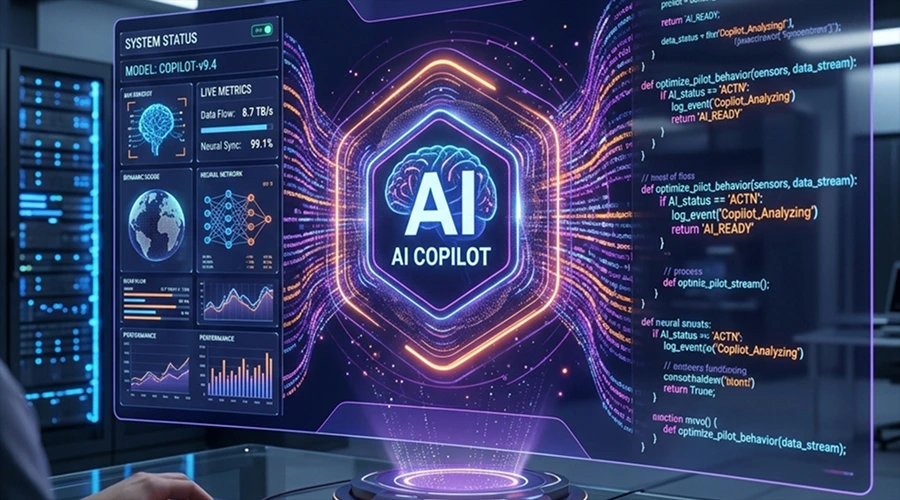
These advancements predict substantially more impact, however, is achievable in the coming days as neural networks grow rapidly. System-wide refactoring will now automatically be possible, covering multiple files. Pattern identification now allows for architecture decisions at scale. Industry will aim to leverage AI to beneficial effect in strategic ways to differentiate themselves and their offerings.
AI beaming into the delivery pipeline continues, now automating the release processes to a much greater extent than before. DevOps work consolidates significantly, AI identifying, and operating the infrastructure. Development and operations become blurred in many modernised organizations. Continuous integration pipelines no longer require manual intervention.
Tailored models trained specifically on proprietary code will become more mainstream very soon, and organisations will build ‘people’ copilots to optimise for their technology stack. Industry-specific models will also be available, with each sector needing to cater for different business contexts. Technologies such as those tailored for finance, retail and healthcare will continue to be optimised for specialised use cases.
Security focused variants will be proposed that can identify threats, as well as compliance violations. Models that protect privacy whilst still enabling sophisticated assistance, will be released. Specialisation will continue to increase utility for all organisations as they adopt AI-based solutions. Regulations will evolve alongside uptake and maturity within industries.
Workflows for MLOps will exist in tandem with the standard development and release pipelines for software. Automatic suggested code can now be tracked alongside human contributed code in version control systems. Measuring development productivity, through objective data, will see an increase. Comparisons across organisations will become possible.
Conclusion
AI copilots change the game for software engineering. When you have productivity increases, quality improvements and faster innovation as a baseline, the benefits of investing in AI copilots multiply. The early adopters will advance and have an advantage over competitors that is significant. Starting now versus later helps you to develop expertise before competitors make the leap.
Consider theoretical pilot programs to determine their appropriateness to your use case. Reach out to us today to talk about the implementation approach for the specific technology relevant to your enterprise architecture!