The field of Artificial Intelligence has advanced beyond simple automation by single models. Businesses now need smart solutions that can orchestrate, adapt and solve complex problems collectively. Multi Agent AI systems address this need by allowing many intelligent agents to communicate, make decisions and achieve tasks efficiently, thereby improving productivity, accuracy and customer experiences for organisations.
What Is a Multi Agent AI System?
Imagine that a single AI assistant can no longer handle your business operations. Modern organisations handle thousands of business operations every day, from customer support and inventory management to financial reporting and predictive analytics. Having one AI model assume every responsibility usually creates bottlenecks. Multi agent AI systems are a hands-on solution.
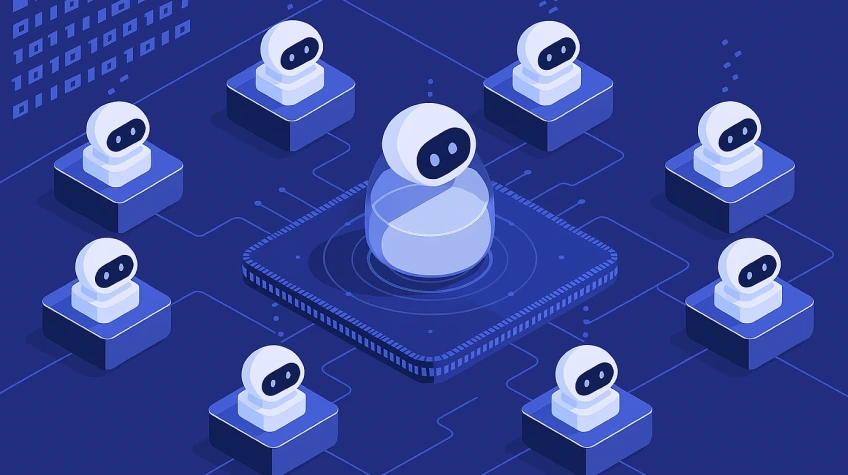
A multi agent AI system is a collection of autonomous AI agents that perform their own duties to achieve a shared goal. Each agent assumes a specialised role, allowing the holistic system to execute more complex workflows at a faster and more accurate rate.
Instead of utilising a single intelligent assistant to perform every task, organisations divide responsibilities across multiple agents. Each agent processes information and makes decisions within its assigned role while also sharing updates with other agents whenever necessary.
Let’s look at an ecommerce platform
Instead of using a single AI model to assume responsibility for every operation, we can use unique agents to perform:
These agents are constantly exchanging information. If inventory runs low, the recommendation agent instantly receives updated product availability. If a transaction is suspected to be fraudulent, the payment verification agent can stop the purchase from being processed.
This orchestrated approach becomes an intelligent ecosystem where every actor serves a greater business goal.
Multi agent AI systems are not static automation. They’re dynamic; capable of adapting to changing circumstances, sharing contextual information, and making decisions without constant human supervision.
Core Components of a Multi Agent AI System
Although implementations may differ across industries, most systems include the following components:
➢ Intelligent Agents
Each agent performs a specialised function based on predetermined objectives and learned behaviour.
➢ Communication Layer
Agents exchange information using structured communication protocols, ensuring everyone operates based on updated information.
➢ Decision Engine
The decision engine analyses incoming information, and determines the appropriate course of action based on a set of business rules or a machine learning model.
➢ Shared Knowledge Repository
Agents can often access a common knowledge repository containing organisational information, historical records or operational data.
➢ Task Coordinator
Complex business operations involve allocating responsibility to different agents. A coordinator assigns work and avoids duplication. This architecture allows businesses to automate complex operations without creating bottlenecks.
How Multi Agent AI Systems Work
For what reason do numerous AI agents work jointly without creating disorder or contradictory decisions? The response resides in structured communication, coordinated planning, and constant information exchange.
Each Multi Agent AI system observes a group of steps that allow agents to function independently but stay linked to the overarching objective.
Step 1: Understanding the Objective
Each workflow initiates with a specific business goal.
For illustration:
Handle customer complaints
Inspect financial transactions
Supervise manufacturing equipment
Advise personalised products
Identify cybersecurity threats
When the objective is determined, the system allocates the workflow into manageable accountabilities.
Step 2: Assigning Individual Responsibilities
Each intelligent agent in the system is allocated a particular purpose based on its proficiency.
For example, in an online retail business:
One receives sales orders from customers.
Another confirms payment.
A third checks the availability in the warehouse.
Another computes the shipping route.
One keeps track of delivery progress.
Another takes care of customer notifications.
As accountabilities are distinct, each agent can work quickly without being overwhelmed.
Step 3: Continuous Communication
After tasks are distributed, agents within the system non-stop share information.
Let’s say inventory is out of stock.
The warehouse agent straight away informs the:
Suggestion agent
Customer communication agent
Order processing agent
This dodges inappropriate product suggestions or disappointing customers.
Real time communication enables organisations to respond immediately instead of waiting for manual processes to catch up.
Step 4: Collaborative Decision Making
Unlike traditional automation, agents do not operate on fixed instructions alone.They assess current conditions before deciding what to do next.
For example, during a supply chain disruption:
Inventory agent identifies shortages
Procurement agents spots alternate suppliers
Cost optimization agent evaluates pricing
Logistics agent picks the fastest delivery method
Together, these agents select the best business response while balancing operational efficiency and customer experience.
Step 5: Learning From Outcomes
Many Multi Agent AI applications incorporate machine learning to continuously improve the results. Each workflow produces rich operational data that agents can use to identify patterns and finetune future actions.
For example, customer service agents can incrementally learn:
The most reported issues
The preferred response channels
Success rates for various resolutions
Seasonal patterns in customer behaviour
This feedback loop allows for improved responses over time without manual reconfiguration.
Step 6: Producing the Final Output
After successfully completing every responsibility, the outputs from all agents combine into one, seamless workflow finish. The customer receives a singular process, while multiple AI agents have orchestrated countless decisions in the background. Multi Agent AI systems are better at working in new situations than traditional automation, especially when business conditions keep changing.
Benefits of Multi Agent AI Systems
Why are more and more leading organisations moving away from a single, central AI model and deploying Multi Agent AI systems? Because they are better suited to solving a growing number of business problems that require quick execution, coordination, and intelligent decision making. Instead of a single, centralised model, multiple specialised AI agents collaborate to complete a task more efficiently and enhance complex business performance.
As organisations continue to generate increasing amounts of data about their operations, customers and business processes, the distributed approach of Multi Agent AI becomes even more valuable.
➢ Faster Task Execution
Traditional AI solutions such as chatbots or robotic process automation software often work on requests sequentially, forcing operations to a crawl when workloads spike. Multi Agent AI systems avoid this bottleneck because multiple agents work together at the same time.
All of these activities happen simultaneously, providing customers with faster confirmation of their online order while enabling businesses to process a higher volume of orders without sacrificing accuracy.
➢ Better Scalability
Business needs change over time. Fluctuating demands due to seasons, new promotions, and more customers bring higher complexity.
Multi Agent AI systems can grow with the needs. You do not have to re-design the system architecture. Organisations can add more agents for new tasks, such as:
Multilingual customer support agents
Regional logistics agents
Compliance monitoring agents
Speciality sales recommendation agents
The modular structure lets organisations grow at their own pace while maintaining a stable system.
➢ Better Decision Making
Many business decisions need data from several departments. A Multi Agent AI system combines the insight from several specialty agents before coming to a decision. For example, a business load approval process may employ:
Financial assessment agent
Credit history agent
Fraud detection agent
Regulatory compliance agent
Risk evaluation agent
Each agent adds its input for a more reliable decision than a simple AI model that has limited context.
➢ Better Reliability
If one agent has a problem, the other agents continue to perform their tasks. This distributed architecture limits the impact compared to a centralised AI solution. Businesses can have
Higher availability
Less downtime
Better operational continuity
Better consistency
This is particularly helpful for organisations working 24/7
➢ Continuous learning
Every time people interact, they create useful data. Agents use past wins, failures, and changing business data to do better next time.
Some examples:
Customer support agents learn what help the company gives most
Sales agents learn from what people buy
Fraud detection agents see where attacks can happen
Marketing agents learn how to talk to people the right way
The easier it is to get info, the better the whole system gets.
➢ Easier Integration Across Departments
Organizations are rarely just one group. Sales, marketing, finance, logistics, and customer support are always talking. Multi Agent AI systems make this conversation easier because they update specialized agents across departments. Instead of handing info along, a smart agent can talk directly to other agents, working faster and causing fewer problems.
Real World Applications of Multi Agent AI Systems
How are businesses already using Multi Agent AI in everyday operations? The technology has moved beyond research laboratories. Organisations across industries now depend on coordinated AI agents to automate workflows, improve customer experiences and increase operational efficiency.
➢ Healthcare
Healthcare organisations process enormous amounts of patient information every day.
Multiple AI agents can manage different responsibilities, including:
Appointment scheduling
Patient record analysis
Medical image interpretation
Treatment recommendations
Billing management
By sharing information securely, healthcare providers reduce administrative workload while improving patient care.
➢ Financial Services
Banks and financial institutions require rapid decision making while maintaining strict security standards.
Multi Agent AI systems help by assigning specialised agents to:
Fraud detection
Credit scoring
Customer verification
Investment analysis
Transaction monitoring
Regulatory compliance
Working together, these agents identify risks much faster than traditional systems.
➢ Ecommerce
Online retailers handle thousands of customer interactions every minute.
Different AI agents manage:
Personalised recommendations
Product catalogue updates
Inventory forecasting
Dynamic pricing
Customer enquiries
Delivery coordination
This creates a smoother shopping experience while increasing operational efficiency.
➢ Manufacturing
Manufacturing environments generate continuous streams of operational data.
Multi Agent AI systems monitor:
Equipment performance
Production quality
Inventory levels
Maintenance schedules
Supply chain coordination
Detecting equipment problems early lets manufacturers reduce production delays and maintenance costs.
➢ Cybersecurity
Stopping cyber threats requires immediate responses to new challenges.
Specialised agents watch:
Network activity
User behaviour
System vulnerabilities
Malware detection
Incident response
If suspicious activity is present, agents share information instantly and set defensive actions in motion before major damage can develop.
➢ Smart Cities
Urban infrastructure relies on thousands of connected systems.
Multi Agent AI handles:
Traffic management
Public transport coordination
Energy optimisation
Emergency response
Waste management
Environmental monitoring
This coordinated approach improves public services while increasing city efficiency.
Challenges of Implementing Multi Agent AI Systems
While the rewards can be great, success requires careful preparation.
➢ Communication Complexity
The more agents you assign, the harder it is to keep their messages straight. Poor coordination can result in duplicated efforts, inconsistent decisions or slow responses. Organisations should implement formal communication protocols before deployment.
➢ Data Security
Agents often interact with sensitive business data. If you lack strict security measures, you increase your risk of a breach. Robust authentication, encryption and access control remain essential.
➢Resource Management
Each AI agent requires its own computing resources. Businesses should confirm their infrastructure can handle rising workloads while sustaining performance. Cloud based deployment usually allows for more flexibility in scaling operations.
➢ Governance and Monitoring
It is crucial to keep humans in the loop.
Organisations must always keep an eye on:
Agent performance
Decision quality
Security compliance
Operational efficiency
Frequent check ups keep AI on the right path – to support business goals responsibly.
Best Practices for Successful Deployment
Attempting full scale automation should be sidestepped, instead enterprises should target pragmatic Multi Agent AI deployments.
Some tried and tested recommendations include:
Identifying measurable business objectives prior to development
Allocating explicit responsibilities to each AI agent
Constructing secure communication channels between agents
Employing scalable cloud infrastructure
Constantly observing system performance
Refining AI models with fresh operational data
Integrating human supervision for crucial decisions
A phased implementation strategy enables organisations to gauge performance, limit risks and fine tune workflows before broadening adoption across the enterprise.
WeeTech – Transform Your Business with Intelligent Multi Agent AI Solutions
Wanna harness the power of Multi Agent AI for your business but don’t know where to begin?
Because building smart intelligent AI systems is not just about having advanced technology. It’s about having the right strategy, the right technical know-how, and the right partner who understands your business needs. Most businesses without the right guidance struggle with complex integrations, scalability issues, and solutions that do not deliver long-term value.
WeeTech Solution Pvt Ltd supports companies in resolving these issues by creating personalised Multi Agent AI solutions that enhance workflow automation, boost operational efficiency, and speed up digital transformation. Based in India and serving clients globally, we have a proven track record of providing cutting-edge IT consulting, AI, and software development services in more than 20 sectors.
If you are looking to develop an AI enabled web application, automate your internal business processes, improve customer interactions or add Machine Learning capabilities to your existing systems, our skilled team can build enterprise grade solutions tailored to your exact needs.
Why Businesses Choose WeeTech
Bespoke development of Multi Agent AI solutions:
Integration of AI and Machine Learning capabilities for web and software apps
Comprehensive IT consulting and digital transformation services
Enterprise grade technology solutions that are secure and scalable
Automated workflows to enhance operational performance
Trusted industry experience in 20 plus sectors
Dedicated technical support, maintenance and optimisation
We think different companies have different problems, so we never use the same solution for everyone. Our experts work with you to learn what you need, build the right AI plan, and create smart systems that give real results. We work with you through every step, from talking and planning to putting ideas in place and helping after, to help you improve with the latest technology.
Final Thoughts
Multi Agent AI systems are the next big thing for smart business work. They let more than one special AI worker talk, work together and decide on different things for you. They help companies do many things faster, better and in more ways. From the health industry, finance industry to machines, online sales and internet safety, companies are already using the tech to do more, decide better and to give the best experiences to their customers.
But for a successful implementation it is important to choose the right architecture and a technology partner with deep expertise in Artificial Intelligence as well as business strategy. At WeeTech Solution Pvt Ltd, our technical expertise, industry knowledge and innovative development practices come together to build scalable Multi Agent AI solutions that create tangible business value.
If your organisation is looking to embrace AI driven automation, this is the right time to get in touch with our experts and turn your ideas into intelligent digital solutions.