Cross-Platform Mobile App Development: A Framework Selection & Implementation Guide
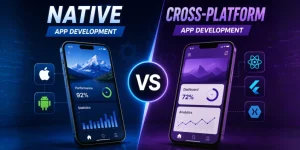
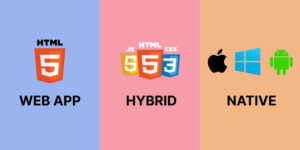
Cross-platform mobile app development has become essential for businesses reaching users on iOS and Android simultaneously. The real challenge isn’t whether to build cross-platform—it’s identifying which framework (Flutter, React Native, or native development) delivers the best return on investment, shortest time-to-market, and lowest long-term maintenance burden for your specific constraints.
This guide cuts through marketing hype and provides a data-driven decision matrix, cost-benefit analysis, and implementation roadmap you can apply immediately. We’ve synthesized 13+ years of cross-platform development experience—from AI-powered hardware platforms like Liftech to scalable consumer apps like Happy Wedding App—into actionable frameworks that help decision-makers and development teams eliminate uncertainty and choose the optimal approach for mobile app development.
How to Choose the Right Cross-Platform Framework: Five Selection Criteria
Framework selection requires evaluating measurable business and technical criteria rather than following industry trends. Five dimensions directly impact your mobile app development success and ROI: time-to-market (how quickly you ship production code), development cost (total investment for build and year-one maintenance), team expertise requirements (skills your team possesses or must acquire), performance benchmarks (whether the framework meets your app’s speed and responsiveness demands), and long-term maintenance costs (sustainability of the framework ecosystem and upgrade path). By evaluating your project against these five dimensions transparently, you’ll make decisions based on your actual constraints rather than marketing positioning.
The Five Essential Criteria for Framework Evaluation
Time-to-Market: Cross-platform frameworks accelerate development by sharing code across iOS and Android, typically reducing cycles by 25–40% versus separate native projects. If launching within 6 months is critical, this factor heavily favors Flutter or React Native.
Development Cost: Single-codebase approaches reduce labor expenses, but specialized tooling, team training, and dependency management can offset savings. Calculate total cost including year-one maintenance, not just initial development.
Team Expertise Requirements: Do your developers know Dart (Flutter), JavaScript (React Native), or Swift/Kotlin (native)? Learning curves vary—JavaScript developers onboard to React Native significantly faster than learning Dart.
Performance Benchmarks: Can your chosen framework meet demands for startup speed, frame rate consistency, memory efficiency, and battery drain? Performance-critical apps (games, AR, hardware integration, real-time trading) often require native development.
Long-Term Maintenance Costs: How stable is the framework’s API? How active is the community? What’s the realistic cost of managing updates, security patches, and dependency evolution over 3–5 years?
Assessing Your Project Constraints Before Comparing Frameworks
Before evaluating frameworks, audit your project’s specific constraints. Define your launch deadline—can your business wait 9–12 months for native development, or does the market window require shipping in 6 months? Establish your budget ceiling for development and first-year support—this number immediately excludes expensive options. Identify performance requirements—does your app need real-time animations, AR capabilities, or hardware communication, or can it tolerate slight cross-platform latency? Determine platform priority—iOS-first (enterprise clients, high-value demographics), equal weight (consumer apps), or Android-focused (emerging markets, cost-sensitive users).
These answers anchor your framework decision and prevent misdirected effort. A consumer app with a 6-month deadline and $120K budget will benefit from cross-platform development to maximize code reuse and minimize team overhead. A hardware-intensive application requiring sub-100ms response times may accept slower development timelines to ensure native performance guarantees. The key insight: framework decisions should reflect your unique business constraints, not generic industry recommendations or personal technology preferences.
Flutter vs. React Native vs. Native Development: A Data-Driven Comparison Matrix
This comparison matrix eliminates marketing bias and shows precisely where each cross-platform development approach excels and where significant trade-offs occur. Use it to evaluate frameworks against your project’s specific requirements.
Criterion
Flutter
React Native
Native Development
Time-to-Market
4–6 months for MVP to production (single codebase, minimal platform-specific code)
Medium–High: $15K–$25K annually (platform-specific updates, larger codebases, iOS and Android version management)
Cost-Benefit Analysis: When Each Framework Makes Business Sense
Select Flutter when you prioritize rapid cross-platform development: You need both iOS and Android releases simultaneously or within 2–3 months of each other; your business timeline demands launching in under 7 months; your team can invest in Dart training or hire Dart specialists; you want a stable, well-maintained framework with predictable upgrade paths backed by Google’s investment; you’re building consumer apps, SaaS platforms, productivity tools, or MVP products where time-to-market is more valuable than extracting every ounce of performance. Flutter’s growing ecosystem and strong native performance make it excellent for reducing long-term maintenance costs while maintaining rapid iteration speed.
Select React Native when you leverage existing JavaScript expertise: Your team already includes JavaScript developers or web engineers; you’re building web and mobile applications simultaneously and want to share logic and UI patterns across platforms; you need access to thousands of third-party libraries and community solutions; you value rapid problem-solving through a massive developer ecosystem. React Native’s JavaScript foundation enables faster initial development for web-skilled teams—but prepare for longer-term maintenance as libraries evolve independently and dependency management becomes complex. Best suited for startups with existing JavaScript teams and projects where web-mobile feature parity matters.
Select Native Development when performance or platform specificity is non-negotiable: Your app demands maximum performance (games, AR/VR experiences, real-time financial trading, intensive graphics); you require deep hardware integration unavailable in cross-platform frameworks (camera processing, specialized sensors, Bluetooth, NFC, industrial hardware communication); your product depends on latest iOS or Android APIs and platform-specific capabilities; you’re targeting a single dominant platform where native optimization justifies development investment; your business model depends on premium user experience or sub-100ms response times. Native development eliminates performance uncertainty and provides direct access to platform capabilities—justified for enterprise applications, performance-critical systems, and hardware-dependent solutions where framework limitations create unacceptable compromises.
Performance Trade-Offs and Real-World User Experience Impact
Performance concerns frequently drive framework decisions—and often with less scientific basis than they deserve. Flutter delivers near-native performance through its own rendering engine, achieving smooth 60–120 FPS consistently across animations, scrolling, and transitions on devices from three generations back. React Native introduces JavaScript-to-native bridge overhead where UI updates require communication between JavaScript code and native components, typically resulting in 50–60 FPS on older devices—a difference most users experience as indistinguishable from native smoothness during typical interactions.
For the vast majority of mobile apps—social networks, messaging platforms, productivity tools, e-commerce applications, content consumption, booking platforms—this performance difference is imperceptible in production use. Users experience equally fluid navigation and responsive interactions across all three approaches. Performance differences become user-facing only in specific scenarios: applications with intensive graphics (real-time particle effects, complex animations, dynamic data visualization), sub-100ms response time requirements (financial trading, gaming with competitive multiplayer), or hardware-driven demands (AR applications processing sensor data in real-time). These specialized categories justify native development or, increasingly, Flutter’s native rendering. For everything else, framework selection should prioritize cost, time-to-market, and team expertise over fractional performance improvements.
Step-by-Step Implementation Roadmap for Cross-Platform Mobile App Development
Framework selection is the strategic decision; implementation execution determines whether projects ship on time, within budget, and with sustainable code quality. This three-phase roadmap applies across Flutter, React Native, and native development—specific tools differ, but architectural principles that prevent technical debt and ensure long-term maintainability remain constant.
Phase 1: Architecture Planning and Cross-Platform Codebase Setup
Begin by designing your codebase structure around clean separation between business logic (which should be 100% platform-independent) and UI implementation (which should leverage each platform’s native design language). For Flutter projects, organize as /lib/models (data structures), /lib/screens (page-level UI), /lib/services (API calls and business logic), /lib/widgets (reusable components), and /lib/utils (platform-agnostic helpers). For React Native, follow /src/components, /src/screens, /src/services, /src/navigation, and /src/store (state management). This standardized structure prevents architectural chaos as your codebase grows and enables new developers to navigate code confidently.
Simultaneously, configure your build pipeline and dependency management. Establish version control workflows (branching strategy, code review requirements), create a process for evaluating and approving third-party packages before integration, and define separate build configurations for development (with verbose logging), staging (production-like environment), and production (optimized for distribution). This foundational infrastructure investment—often underestimated—prevents cascading deployment issues and debugging nightmares months later. Invest the extra week now; save months of troubleshooting later.
Phase 2: Development Workflow and Code Reuse Strategy Across Platforms
Maximize code reuse by implementing a layered architecture: place all platform-agnostic business logic (data models, API communication, authentication, state management, validation, calculations) in a shared core that compiles identically across iOS and Android. Create thin, platform-specific UI layers that leverage each platform’s native design language, animation capabilities, and platform conventions. This approach enables 70–85% code reuse (typical range varies with app complexity) while ensuring each platform delivers an optimized, native-feeling user experience.
Structure your team around this architecture: assign developers to shared business logic implementation and core features, with specialized developers optimizing platform-specific UI and performance characteristics. Use feature branches for parallel work across team members, enforce mandatory code review before merging to main development branches, and run automated tests on every commit to catch regressions immediately. This workflow prevents bugs from multiplying and ensures consistent behavior across iOS and Android releases. When you can’t run the same code on both platforms, that code should be minimal, isolated, and thoroughly tested—not scattered throughout your codebase.
Phase 3: Testing Strategy, CI/CD Pipeline, and Quality Assurance
Implement a layered testing approach: unit tests cover all business logic and data models (should be 100% platform-independent and exercise edge cases), integration tests validate API interactions and state management (test platform-specific integrations separately), and end-to-end tests verify critical user workflows function correctly on real devices (not just emulators). Automate all testing within your CI/CD pipeline—tests execute automatically when code is committed, providing developers immediate feedback and preventing broken builds from reaching team members or production.
Test exclusively on real devices for final validation, not just emulators, to catch performance issues, display rendering variations, and device-specific bugs that simulators miss. Implement crash reporting (Firebase Crashlytics, Sentry) and performance monitoring tools (Datadog, New Relic, Firebase) to track production behavior and identify issues users experience in real conditions. Establish quality gates that prevent code shipping without passing all tests, meeting performance benchmarks, and clearing security scans. This discipline prevents technical debt accumulation and maintains user trust in your app’s reliability and stability.
Real-World Cross-Platform Development Success: WeeTech Case Studies
Framework selection decisions aren’t theoretical for us—we’ve implemented cross-platform development strategies across consumer apps, SaaS platforms, and specialized systems. Here’s how two WeeTech portfolio projects applied framework selection principles to achieve specific business outcomes.
Case Study: Liftech – AI-Powered Construction Platform with Hardware Integration
Liftech is a command-and-control platform for construction hoist elevators, combining hardware communication with AI-driven software. The client faced non-negotiable constraints: the app required real-time communication with specialized hardware, safety-critical command execution with 99.9% reliability, compatibility with older Android devices prevalent at construction sites, and guaranteed sub-100ms response times for safety-critical operations. These requirements eliminated pure cross-platform frameworks and pushed toward native Android development for maximum hardware control and performance certainty.
We implemented a strategic hybrid approach: native Android development for the primary construction platform (ensuring direct hardware integration, zero-latency safety responses, and complete sensor access) paired with a focused iOS companion app for supervisors and safety oversight. This balanced approach launched Android on schedule with verified 99.9% reliability and seamless hardware integration that cross-platform frameworks couldn’t guarantee. iOS shipped four months later, allowing us to mature Android production performance before expanding platforms. The business result: Liftech achieved critical industry certifications and won enterprise adoption precisely because we prioritized native performance over cross-platform convenience.
Case Study: Happy Wedding App – Scalable Consumer Platform with Rapid Iteration
Happy Wedding App prioritizes rapid feature iteration and reaching both iOS and Android wedding planners simultaneously. The app manages planning coordination, guest communication, vendor integration, and task tracking—performance-sensitive but not hardware-dependent. The client’s business model required launching quickly, iterating features based on user feedback monthly, and scaling to thousands of simultaneous users without multiplying development costs.
We selected a cross-platform framework to maximize code reuse and enable rapid simultaneous releases across both platforms. The team builds features once, tests across iOS and Android, and ships updates to both App Store and Google Play simultaneously—eliminating the coordination overhead of managing separate native codebases and the cost multiplication of parallel teams. This approach reduced development time by 30% compared to maintaining separate iOS and Android specialists and made it straightforward to scale the product team as user base and feature complexity grew. Happy Wedding App now releases new features monthly to both platforms from a single codebase, proving that cross-platform frameworks can support mature, high-growth applications.
Outcome Metric
Liftech
Happy Wedding App
Framework Strategy Chosen
Native Android + iOS companion app
Cross-platform shared codebase
Development Timeline to Launch
8 months to Android (hardware integration requires extended testing), 12 months to both platforms
Cross-platform team + iOS/Android optimization specialists (4–5 developers)
Time Between Platform Releases
4 months (mature Android codebase tested extensively before iOS launch)
Same-day simultaneous iOS and Android releases
Year 1 Production Results
5,000+ construction professionals, verified 99.9% uptime, critical safety certifications achieved
10,000+ users across both platforms, weekly feature releases, 4.7-star app store rating
Best Practices for Cross-Platform Architecture and Long-Term Maintenance
Selecting the right framework is the beginning of mobile app development, not its conclusion. Long-term success depends on architectural decisions and maintenance discipline that protect your investment, prevent technical debt accumulation, and keep operations sustainable as your application scales and the framework ecosystem evolves.
Code Reuse and Platform-Specific Optimization Strategies
Design a three-layer architecture: (1) Business Logic Layer – completely platform-independent code handling data models, API communication, authentication, validation, and state management. This layer should compile and run identically whether deployed to iOS or Android. (2) Abstraction Layer – interfaces and protocols defining how UI components communicate with business logic, allowing platform-specific implementations without exposing business logic to platform details. (3) UI Layer – platform-specific code leveraging iOS native components, SwiftUI animations, and iOS design conventions for iOS, and Android Material Design, Jetpack Compose, and Android conventions for Android.
This architecture enables 70–85% code reuse in typical applications while optimizing for each platform’s strengths. An iOS app can implement motion effects and haptic feedback using native capabilities, while Android uses Material 3 animations and vibration patterns—both call identical shared business logic. Performance-critical sections (rendering pipelines, animations, sensor processing) can be optimized independently per platform, while data handling, validation rules, and API logic remain unified, tested once, and deployed identically across platforms.
Managing Technical Debt and Dependency Updates Over Time
Technical debt compounds exponentially over time. Establish non-negotiable discipline: dedicate 10–15% of every development sprint to refactoring, updating dependencies, and reducing code complexity. When a framework releases major updates, evaluate compatibility and migration effort within 2–3 months, test thoroughly, and plan migration if benefits exceed switching costs. Never ignore deprecation warnings or security advisories—addressing them when they appear prevents breaking builds and security vulnerabilities that become expensive and urgent months later.
Document architectural decisions systematically. When you choose specific libraries, implement platform-specific workarounds, or make design trade-offs, write down the decision, reasoning, alternative approaches considered, and implementation details. This knowledge transfer prevents new team members from re-solving identical problems independently and ensures consistent architectural patterns as your application evolves. Strong documentation isn’t optional overhead—it’s insurance for long-term project health, team productivity, and knowledge preservation when team members transition.
Building Scalable Teams and Knowledge Transfer for Cross-Platform Projects
Cross-platform development success depends on team expertise and organizational knowledge. Invest in developing expertise: ensure at least 2–3 developers deeply understand your framework’s architecture, platform-specific behavior, performance optimization techniques, and production debugging approaches. When onboarding new developers, pair them with experienced team members for 2–3 weeks, then gradually increase code ownership. This prevents knowledge silos from forming and ensures your team handles production emergencies independently without consulting external consultants.
Establish documentation standards: create architecture diagrams, developer setup guides, testing procedures, deployment checklists, and post-mortems after production incidents. Treat documentation as a requirement before code ships—tie documentation completion to code review approval. This discipline compounds over time, creating an organizational knowledge repository that accelerates developer onboarding, reduces onboarding time, and prevents repeated mistakes. When developers transition to other projects or leave the company, strong documentation ensures continuity and prevents critical knowledge from walking out the door.
Make Your Cross-Platform Development Decision Today
Choosing between Flutter, React Native, and native development no longer requires speculation or bias. Evaluate your project against the five criteria outlined in this guide, use the decision matrix to compare frameworks, and ground your decision in your specific constraints. Contact WeeTech Solution for a free technical consultation where our team will evaluate your project’s unique requirements—timeline, budget, performance demands, team composition—and recommend the optimal cross-platform development approach. We’ll show you how our 13+ years of implementation experience across Flutter, React Native, and native development can accelerate your mobile app development and deliver measurable business results.