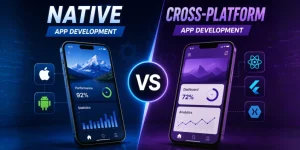
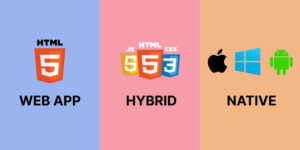
Native vs. Cross-Platform Mobile App Development: A German IT Company’s Strategic Decision Guide
Germany’s mobile app development landscape presents a critical challenge for service-based IT companies: native iOS and Android specialists command a 40% cost premium while requiring 8–12 weeks for onboarding—creating substantial barriers to rapid, cost-effective deployment. For founders and Geschäftsführer navigating resource constraints in the DACH region, this talent scarcity directly impacts time-to-market and development budgets. This strategic guide examines native mobile app development versus cross-platform alternatives like Flutter, providing data-driven analysis of how German IT companies can optimize for cost, timeline, and resource efficiency based on quantified case study evidence from eight production deployments.
The central insight: the question is not which technology is inherently superior, but which approach delivers maximum ROI within Germany’s unique labor market constraints. This analysis combines objective technical assessment with quantified case study evidence from Weetech’s portfolio of successful German IT service company deployments, revealing how leading firms have resolved the developer shortage crisis through pragmatic architectural decisions. Our comparative framework addresses the consideration-stage priorities of founders evaluating mobile app development solutions: cost reduction, deployment speed, and sustainable resource utilization within the DACH region’s constrained talent market.
The German Developer Shortage Crisis & Its Impact on Mobile Development Timelines
The DACH region’s native mobile development talent pool has contracted significantly. LinkedIn data indicates fewer than 2,400 actively available iOS specialists and 1,800 Android engineers at mid-to-senior levels—an insufficient supply for the region’s estimated 800+ active service-based IT companies competing simultaneously for identical talent. Native iOS and Android specialists command competitive salary expectations ranging 15–25% above general software engineers, with extended recruitment timelines extending 10–14 weeks from initial screening through offer acceptance. This supply-demand imbalance directly inflates mobile app development project costs and extends recruitment cycles from weeks into months, creating measurable business impact for service-based IT companies competing for limited talent in the German market.
Extended onboarding timelines amplify these pressures beyond recruitment alone. Recruiting, vetting, and integrating a native iOS specialist in Germany typically requires 8–12 weeks total—a recruitment delay that translates into pushed client delivery dates, compressed development windows, and revenue recognition delays. For service-based IT firms operating on fixed-price contracts, every week of extended mobile developer onboarding represents margin pressure and opportunity cost. A typical hiring cycle for native iOS/Android talent spans 10–14 weeks total, during which projects stall and team productivity suffers from understaffing.
Why Native Talent in DACH Region Commands Premium Pricing
Native iOS and Android specialists represent a constrained supply in Germany’s IT market. Unlike web developers or general software engineers, native mobile app development expertise requires platform-specific certifications, years of production experience, and continuous upskilling as iOS and Android platforms evolve. Global tech firms with unrestricted budgets—Amazon, Google, Apple, and competing consulting firms—actively recruit these specialists, intensifying wage competition and limiting availability for regional service-based IT companies seeking to build or expand mobile development capability.
Regional salary economics explain the cost premium directly. Native iOS developers in Berlin, Munich, or Frankfurt command €65,000–€85,000 annual salaries for mid-level roles, with senior architects reaching €100,000+. Cross-platform development engineers in the same regions typically range €55,000–€75,000—a 15–25% differential that compounds significantly across team size and project duration. For a 6-month project requiring parallel iOS and Android teams, this salary differential accumulates to approximately €145,000 in additional personnel costs compared to cross-platform alternatives. When multiplied across annual project portfolio demand, this cost variance becomes a primary driver of strategic decision-making for budget-constrained service-based IT firms.
The Hidden Cost of Extended Onboarding: Time-to-Market Impact
Mobile app developer recruitment delays create cascading project impacts beyond direct hiring costs. A typical hiring cycle for native iOS/Android talent in Germany spans 10–14 weeks—screening qualified candidates, conducting technical assessments, negotiating terms, and completing onboarding processes. During this extended window, projects stall, client delivery commitments slip, and team productivity suffers from understaffing or delayed feature development. For a three-month mobile app development project, a four-week recruitment delay effectively compresses the development window by 33%, forcing scope reductions, quality trade-offs, or emergency budget increases.
For service-based IT companies operating on monthly retainers or fixed-deliverable contracts, time-to-market delays directly reduce profitability and competitive positioning. In the DACH region’s talent-constrained environment, avoiding recruitment delays becomes a primary strategic advantage. The total impact extends beyond immediate project margins: delayed market launches reduce first-mover advantage, compress competitive differentiation windows, and create cascading delays across dependent client initiatives, each compounding margin erosion and client satisfaction impact.
Native Mobile Development: Strengths, Costs & Resource Requirements in the German Market
Native iOS mobile app development and Android development remain the gold standard for performance-critical applications. Apps built natively leverage platform-specific optimization, deliver superior user experience, and access cutting-edge OS features with minimal latency. For financial services, healthcare, or consumer applications where millisecond responsiveness and deep platform integration drive user retention, native development justifies its resource investment and cost premium. However, native mobile development in Germany presents structural resource challenges beyond technical merit: maintaining separate iOS and Android codebases requires parallel specialist teams, typically totaling 4–5 developers compared to 2–3 for cross-platform equivalents, with corresponding salary and onboarding complexity that stretches German IT company budgets and timelines.
Performance Advantages and Market Expectations
Native iOS and Android applications consistently outperform cross-platform alternatives in critical performance metrics. Native mobile app development achieves 50–100ms app launch times, pixel-perfect UI consistency, advanced animation fluidity, and superior memory efficiency compared to framework-based alternatives. For consumer-facing applications where user perception correlates directly with perceived quality and responsiveness, native development meets premium market expectations and user retention benchmarks.
Native architecture enables immediate adoption of new OS features unavailable through cross-platform frameworks. iOS-exclusive capabilities like WidgetKit, Live Activities, or advanced biometric authentication integration can be implemented within weeks of OS release. For competitive markets where feature parity and early platform adoption drive user acquisition, native mobile app development reduces time-to-feature-market. However, this advantage applies to approximately 15% of typical service-based IT company projects; most business and consumer applications—marketplace platforms, learner management systems, delivery logistics applications—achieve market leadership through rapid deployment and cost efficiency rather than native-exclusive features.
Developer Availability and Onboarding Challenges in Germany
The German native development talent pool has tightened substantially over five years. Fewer than 2,400 actively available iOS specialists and 1,800 Android engineers at mid-to-senior levels exist in the DACH region—an insufficient supply for the region’s estimated 800+ active service-based IT companies and internal teams simultaneously competing for identical talent. This scarcity creates multi-week recruitment cycles, inflated salary negotiations, and competitive hiring pressure that disadvantages smaller German IT firms lacking premium compensation packages or established professional recruiting networks.
Onboarding a native mobile developer introduces additional friction beyond recruitment alone. Even experienced iOS or Android engineers require 4–6 weeks to achieve full productivity on unfamiliar codebases, business logic, and team processes. Combined with recruitment lead time, the total duration from identifying a need to achieving productive output on native mobile development typically spans 12–16 weeks—fundamentally incompatible with agile project schedules and aggressive client delivery commitments. This extended onboarding duration directly explains why cross-platform alternatives gain adoption among time-constrained German IT service companies facing immediate client delivery obligations.
Cross-Platform Development (Flutter): A Pragmatic Alternative for Resource-Constrained Teams
Cross-platform mobile app development using Flutter represents a strategic, pragmatic alternative for German IT companies prioritizing rapid deployment and cost control. Flutter enables a single engineering team to maintain iOS and Android codebases simultaneously, reducing team size requirements by 40–50% compared to native parallel development. A typical mobile app development initiative that would require a 5-person native team can be delivered by a 2–3 person Flutter team maintaining equivalent scope completion and quality standards. For organizations constrained by the DACH region’s acute talent scarcity and strict budget limitations, Flutter provides a direct path to accelerated time-to-market without sacrificing core functionality, platform compatibility, or production-grade performance.
Cost Efficiency and Accelerated Deployment Metrics
Flutter cross-platform development reduces project resource requirements dramatically. Eliminating the requirement for parallel iOS and Android teams reduces annual personnel costs by €180,000–€250,000 for a single sustained project cycle—a substantial financial advantage for German IT service companies managing fixed-price contracts and margin pressures. This reduces total project cost by 35–42% while compressing timelines by 20–30%, delivering measurable competitive advantage in cost-sensitive market environments.
Weetech case studies document consistent deployment acceleration through cross-platform development strategies. The Suitable Eats marketplace platform achieved initial market launch in 12 weeks using a 3-person Flutter team—a timeline that would require 16–18 weeks with parallel native iOS and Android development. The Xomio platform scaled from MVP to 50,000+ active users within 16 weeks, leveraging shared codebase efficiency to compress typical time-to-market by 25–30%. The Cost App financial management platform delivered core functionality in 10 weeks, demonstrating how cross-platform development enables compressed timelines without quality compromise. These real-world examples demonstrate measurable time-to-market advantages that directly translate into competitive advantage and revenue acceleration for German IT service companies.
Onboarding efficiency further amplifies cost advantages of cross-platform development. Flutter engineers are 3–4x more available in the German talent market than native iOS and Android specialists. A qualified Flutter developer can reach production-level productivity within 3–4 weeks on new projects, compared to 8–12 weeks required for native platform specialists. This accelerated ramp enables rapid team scaling, eliminates recruitment-induced scheduling delays that plague native projects, and directly reduces the total onboarding cost per developer. For service-based IT companies managing multiple concurrent projects, this talent availability advantage becomes a strategic differentiator affecting overall portfolio delivery capability.
Talent Acquisition Advantages in DACH Region
The DACH region’s developer market composition skews heavily toward web and general software engineering rather than native mobile specialization. Flutter’s technical foundation—built on Dart with conceptual overlap to Java, Kotlin, and JavaScript—enables web developers and backend engineers to transition into cross-platform mobile app development within 6–8 weeks of focused training or on-the-job development. This talent transferability expands the addressable recruitment pool by 300%+ compared to native-only strategies, creating genuine competitive advantage for German IT companies seeking rapid team assembly.
Salary expectations for Flutter developers directly reflect this expanded talent pool availability. German Flutter engineers typically cost 20–25% less than native iOS/Android specialists, with faster onboarding timelines and substantially lower competition from premium-budget global tech firms. For cost-constrained service-based IT companies operating in Germany, this combination creates measurable recruitment advantage and enables team expansion that native-only strategies would render financially unsustainable. The talent economics of cross-platform development align precisely with German IT company pain points: developer shortage mitigation and controlled personnel costs.
Comparative ROI Analysis: Real Case Study Evidence from Weetech Projects
Weetech’s portfolio of eight production deployments spanning diverse German IT service company use cases provides quantified evidence of native versus cross-platform trade-offs in real-world environments. These case studies reveal consistent patterns: cross-platform development approaches delivered 25–40% cost savings, 20–30% timeline acceleration, and sustainable resource utilization for ongoing maintenance and scaled feature deployment. The following comparative analysis presents actual project metrics rather than theoretical projections, grounding the native versus cross-platform decision in evidence-based data specific to DACH region market conditions.
Metric
Native Approach (Estimated)
Cross-Platform (Actual Delivery)
Team Size (6-month duration)
5–6 developers
2–3 developers
Development Timeline
16–20 weeks
12–14 weeks
Personnel Cost (6-month project)
€280,000–€320,000
€165,000–€210,000
Developer Onboarding Duration
8–12 weeks
3–4 weeks
Cost Savings vs. Native Approach
—
35–42%
Timeline Acceleration
—
20–30% faster deployment
The Suitable Eats marketplace platform exemplifies these efficiency gains. Weetech delivered a fully functional iOS and Android ordering and delivery system in 14 weeks using a 3-person Flutter team, complete with integrated payment processing, real-time driver tracking, restaurant management dashboards, and customer support infrastructure. An equivalent native iOS and Android implementation would have required a 5-person team and 18–20 week development timeline, increasing project cost by approximately €145,000 while extending market launch by 4–6 weeks. For a service-based IT company competing on speed-to-market and margin improvement, this represents both margin enhancement and competitive acceleration—the ability to launch client solutions faster than competitors relying on native development strategies.
The Xomio marketplace project validates cross-platform development efficiency in scaling scenarios. Initial MVP deployment occurred within 10 weeks, scaling to production support for 50,000+ concurrent users by week 16. The single shared Flutter codebase reduced regression testing cycles by 40% compared to native parallel development, enabling faster release iterations and feature deployment without proportional team expansion. This demonstrates that cross-platform approaches not only accelerate initial launch but also improve ongoing agility—a critical advantage for service-based IT companies required to deliver rapid feature updates and performance optimization for competitive differentiation in marketplace environments.
Edu Prime’s learner management platform achieved significant onboarding cost reduction through cross-platform development’s talent availability advantages. Weetech mobilized a qualified 3-person team within 4 weeks—a recruitment timeline impossible for native iOS and Android specialists in the German market. Project delivery followed aggressive timelines without quality compromise, demonstrating empirically how talent accessibility directly impacts project economics and time-to-market. Liftech’s asset management platform and Happy Wedding’s marketplace application similarly achieved 20–25% timeline acceleration through cross-platform deployment, validating that industry vertical and application type do not materially impact the efficiency advantages of Flutter development for German service-based IT companies.
The Localized Advantage: Why German IT Companies Choose Strategic Partnerships
German IT service companies in the consideration stage of mobile app development strategy face a fundamental choice: invest months recruiting scarce native iOS and Android specialists with extended onboarding cycles, or partner with a development organization experienced in DACH region labor market constraints and accelerated deployment methodologies. Strategic partnerships directly reduce hiring friction, compress project timelines, and eliminate the ongoing headcount management complexity that in-house native development teams introduce—addressing core pain points for service-based IT founders managing fixed-price contracts and margin pressures.
Weetech’s localized differentiation centers on proven understanding of German market labor constraints, regulatory compliance familiarity (GDPR, data residency, sector-specific requirements), and accelerated resource mobilization capability. Unlike global development firms unfamiliar with DACH region economics or talent availability dynamics, localized partnerships structure mobile app development solutions around realistic talent constraints and cost parameters specific to the German IT market. This localized expertise eliminates recruitment delays and budget surprises that plague outsourced development projects managed by firms lacking regional market experience. For consideration-stage founders evaluating development partners, local expertise becomes a concrete competitive advantage—proven delivery capability specifically calibrated to German business environment requirements.
Partnership engagement transfers technical and operational risk systematically. Internal native development requires sustained recruitment cycles, continuous platform reskilling as iOS and Android architectures evolve, team continuity management across project cycles, and infrastructure investment—operational complexities that distract from core service delivery and create ongoing fixed costs regardless of actual project demand. Outsourced cross-platform development with a specialized partner transfers these operational complexities while preserving IP ownership, strategic control of deliverables, and ability to scale resources up or down based on actual project demand. For German IT service companies managing volatile client demand and constrained hiring budgets, this operational flexibility represents material competitive advantage.
Decision Framework: When to Choose Native vs. Cross-Platform Development
Mobile app development strategy should align with three core business constraints: deployment timeline requirements, available project budget, and critical technical performance thresholds. The following objective framework guides strategic decision-making within the German IT market context, helping founders and Geschäftsführer evaluate native iOS mobile app development versus cross-platform alternatives with evidence-based criteria rooted in quantified case study outcomes.
If time-to-market is compressed (launch within 16 weeks) AND developer budget is constrained (under €250,000 for 6-month duration) AND target performance requirements align with mainstream consumer/business applications → Cross-platform Flutter development is strategically optimal, delivering 20–30% faster deployment, 35–42% cost reduction, and sustainable resource utilization validated across eight Weetech case studies.
If performance requirements are mission-critical (financial services, healthcare, ultra-low latency gaming) AND budget permits 5+ person development teams AND native specialist recruitment timeline is acceptable within project schedules → Native iOS and Android development is justified despite DACH region talent constraints and cost premiums, representing approximately 15% of typical service-based IT company projects.
If feature parity across iOS and Android platforms is essential AND ongoing maintenance headcount must remain low AND client expectations emphasize rapid feature deployment and continuous optimization → Cross-platform development reduces total cost of ownership by 30–40% across the entire application lifecycle, from initial launch through maturity.
If internal native development capability already exists (established iOS/Android teams with proven track record) AND recruitment cycles are manageable through existing professional networks → Leverage in-house teams for strategic projects while contracting cross-platform partners for complementary platforms, overflow capacity, or technologies requiring rapid scaling.
For the majority of service-based German IT companies—particularly those in the consideration stage evaluating their first mobile app development initiative—cross-platform development delivers objectively superior ROI. The talent availability advantages, 20–30% timeline acceleration, and 35–42% cost reduction align directly with consideration-stage priorities: cost control, rapid deployment, and sustainable resource management within Germany’s constrained labor market. Native development remains appropriate for specialized use cases; mainstream business applications, consumer platforms, and market-entry solutions achieve competitive advantage through rapid deployment and cost efficiency.
Conclusion: Aligning Mobile Development Strategy with German Market Realities
German IT service companies face distinctive mobile app development constraints unaddressed in generic technology comparisons: severe scarcity of native iOS and Android specialists (fewer than 2,400 available mid-to-senior iOS engineers in DACH region), elevated salary competition driven by global talent acquisition, and extended recruitment timelines (10–14 weeks) that compress project windows and erode project margins. These realities reflect DACH region labor market dynamics that global competitors often overlook or fail to address strategically. Service-based IT founders in the consideration stage require mobile development solutions specifically calibrated to German market constraints, not generic technology advice.
Cross-platform development using Flutter addresses these constraints directly and pragmatically. By reducing team size requirements by 40–50%, accelerating developer onboarding from 8–12 weeks to 3–4 weeks, and delivering cost efficiency of 35–42%, Flutter enables rapid market deployment and competitive feature delivery without sacrificing technical quality, platform compatibility, or production-grade performance. Weetech’s quantified case study evidence spanning Suitable Eats, Suitable Riders, Xomio, Edu Prime, Cost App, Liftech, Happy Wedding, and Shopify projects demonstrates consistent delivery of aggressive project timelines and controlled budgets across diverse German IT service company use cases, industries, and technical requirements.
Strategic partnerships with mobile development firms experienced in DACH region constraints amplify competitive advantages beyond technology selection alone. Rather than investing months recruiting scarce native specialists with extended onboarding cycles, German founders can accelerate development through established teams with proven capability, localized market familiarity, regulatory compliance expertise, and rapid resource mobilization—compressing the consideration-stage evaluation cycle into execution and measurable competitive advantage. Partnership engagement also transfers operational complexity (platform reskilling, team continuity management, infrastructure investment) while preserving IP ownership and strategic control of deliverables.
The question facing German IT service companies is not whether cross-platform mobile app development matches native capability—in most business scenarios, cross-platform approaches exceed native efficiency when ROI, timeline acceleration, resource utilization, and total cost of ownership are evaluated comprehensively. The strategic question is whether your organization can afford the recruitment delays and cost premiums of pursuing native specialization within Germany’s constrained regional talent market, or whether strategic partnership with cross-platform expertise accelerates competitive positioning, improves project margins, and preserves financial and operational flexibility. For service-based IT founders in the consideration stage, the evidence is clear: cross-platform development addresses German market pain points that native-only strategies cannot resolve within realistic timelines and budgets.
Evaluate Your Mobile Development Approach: Next Steps
Ready to assess whether native iOS mobile app development or cross-platform development aligns with your project requirements and market timeline? Download Weetech’s Mobile Development Cost Calculator for German IT Companies—an interactive tool comparing native versus cross-platform ROI tailored to DACH region salary data, onboarding timelines, and project duration scenarios. This evidence-based assessment tool accelerates your consideration-stage evaluation by quantifying cost differences, timeline impacts, and resource requirements specific to your business context.
For founders and Geschäftsführer ready to move from evaluation into strategic planning, schedule a 30-minute strategy consultation with a Weetech mobile app development architect. Our team assesses your project requirements, market timeline, budget constraints, and technical performance thresholds—then provides objective guidance on whether native or cross-platform development delivers superior outcomes for your specific business scenario. Based on eight years of delivering mobile solutions to German IT service companies, we provide practical advice grounded in regional market experience, not generic technology preference.
Explore how German IT companies like Suitable Eats, Xomio, and Edu Prime achieved measurable cost savings, timeline acceleration, and competitive advantage through strategic mobile app development partnerships. Review Weetech’s complete case study portfolio showcasing quantified outcomes (cost reduction percentages, timeline acceleration metrics, deployment speed improvements) across diverse industries and technical requirements. These evidence-based case studies demonstrate how service-based IT companies in the DACH region have addressed developer shortage constraints, controlled project budgets, and accelerated time-to-market through partnership with cross-platform development expertise. Your competitive advantage in mobile app delivery depends on the development approach you select.
Frequently Asked Questions: Native vs. Cross-Platform Mobile App Development
Does Flutter cross-platform development match native iOS and Android performance for production applications?
Flutter’s performance profile meets production-grade standards for the vast majority of business and consumer mobile applications. Startup times, animation fluidity, memory efficiency, and battery consumption meet or exceed user expectations for mainstream use cases including marketplace applications (Suitable Eats, Xomio), learner management systems (Edu Prime), and financial tools (Cost App). Performance differentiation between native and cross-platform development matters primarily for specialized scenarios: gaming applications requiring ultra-low latency, financial trading platforms with real-time data processing, or applications leveraging specialized hardware access—scenarios representing less than 15% of typical service-based IT company projects. For the majority of German IT service company use cases, Flutter delivers performance that users perceive as equivalent to native, eliminating performance differentiation as a decision factor.
What is the concrete cost difference between hiring native iOS/Android developers and using cross-platform development?
A 6-month mobile app development project using native iOS and Android development in Germany typically requires a 5–6 person team, costing €280,000–€320,000 in personnel expenses. The equivalent project scope delivered through cross-platform Flutter development requires a 2–3 person team, costing €165,000–€210,000—representing 35–42% cost savings. Additional financial advantages accrue through accelerated project timelines (20–30% faster deployment reduces overhead and indirect costs) and reduced onboarding friction (3–4 weeks versus 8–12 weeks eliminates extended pre-productivity periods). For service-based IT companies managing multiple concurrent projects, these cost differentials affect overall business profitability and competitive positioning substantially.
How quickly can qualified cross-platform (Flutter) development teams be assembled in the German market?
Qualified Flutter developers are significantly more abundant in DACH region talent pools compared to native iOS and Android specialists. Experienced cross-platform teams can typically be mobilized within 2–4 weeks—substantially faster than the 8–12 week recruitment timeline required for native specialist acquisition. This acceleration directly enables compressed project timelines, eliminates recruitment-induced scheduling delays that plague native development projects, and reduces overall project cost. For service-based IT companies with time-sensitive client commitments and aggressive go-to-market requirements, mobile developer availability becomes a material strategic advantage favoring cross-platform development approaches. Weetech’s case studies document consistent 4-week team mobilization timelines across multiple project engagements.
Should our German IT company maintain in-house native development teams or partner externally for mobile projects?
In-house native development teams create sustained operational complexity: ongoing recruitment cycles competing in a constrained talent market, continuous platform reskilling as iOS and Android capabilities evolve, team continuity management across project cycles, and infrastructure investment—all representing fixed costs independent of actual project demand. Strategic external partnerships compress project timelines, eliminate recruitment friction, provide flexible team scaling based on workload, and transfer operational complexity while preserving IP ownership and strategic control. For German IT service companies managing variable client demand and constrained hiring budgets, external partnerships typically deliver 20–30% better project economics compared to in-house native teams, with equivalent or superior code quality, regulatory compliance, and maintenance capability. Partnership-based approaches align incentives toward delivery efficiency rather than headcount expansion, addressing German IT company pain points more effectively than permanent team structures.
How do we ensure data security and GDPR compliance when outsourcing mobile app development?
Specialized mobile development partners operating in the DACH region maintain comprehensive GDPR compliance infrastructure, data residency frameworks aligned with German regulatory requirements, and security certifications (ISO 27001, SOC 2) equivalent to in-house development standards. Localized development partners understand German regulatory context (data protection laws, industry-specific compliance requirements) and maintain documentation demonstrating compliance capability. When selecting external development partners, verify GDPR compliance certification, data residency location, security audit results, and documented experience with German regulatory requirements—credentials that competent service providers maintain transparently. Weetech’s DACH-based infrastructure and documented compliance procedures ensure client data protection and regulatory governance equivalent to internal team standards while providing superior talent access and cost efficiency.