Automation has been the bedrock of efficiency for many decades now, whether in the form of factory assembly lines, back office IT scripts, or any other form of software-based execution of repetitive high-volume tasks. The conventional automation paradigm liberated employees from mundane activities like data entry, performing routine calculations and working with strict processes and procedures.
But technology is approaching its turning point. We are moving away from rule-based software and towards Agentic AI.
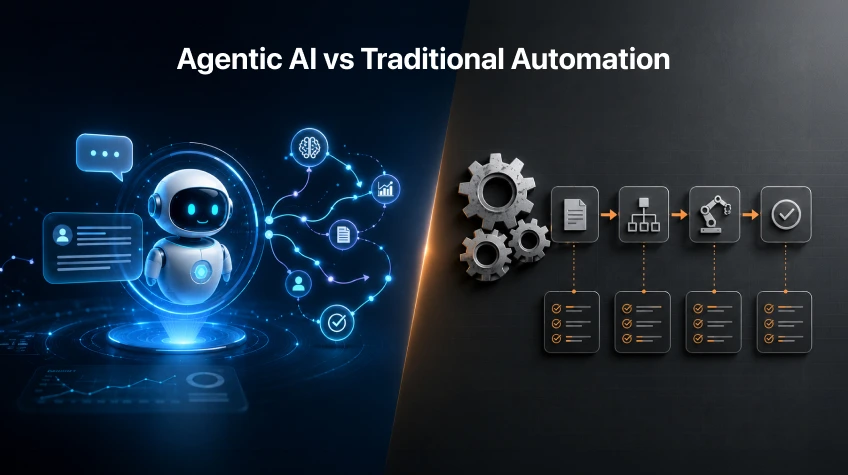
Whereas the conventional automation system performs according to predetermined rules, agentic AI does things with a purpose. It reasons, adapts, makes decisions and solves problems on its own.
For all the business people who find themselves today in the middle of the digital transformation era, having a good understanding of the difference between the two approaches becomes essential.
Here, we are going to examine the distinguishing features of Agentic AI and how it differs from the conventional automation model.
Understanding the Foundations: Traditional Automation
To better understand the progress made by the emergence of Agentic AI, one needs to first comprehend the functioning of conventional automation.
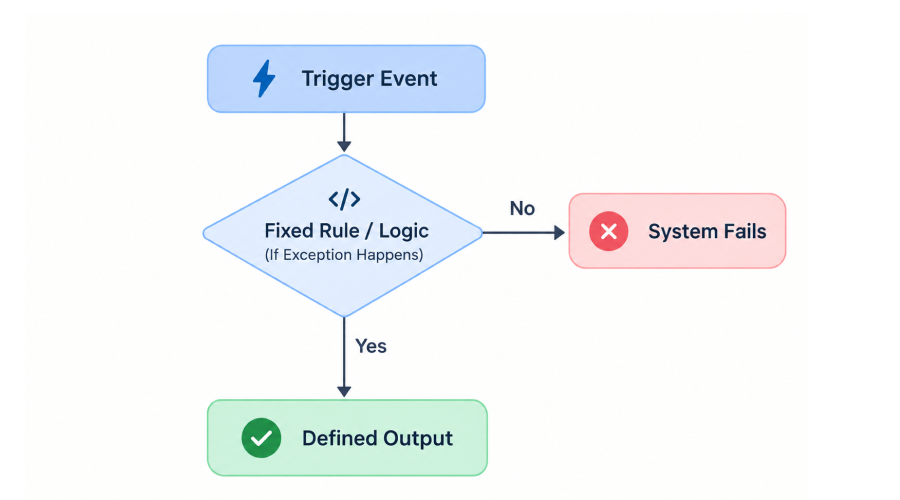
The conventional form of automation conducted through Rule-Based Systems, Workflow Automation, or Robotic Process Automation (RPA) is completely dependent on determinism. It functions exclusively on an “If This, Then That” (IFTTT) basis.
⇒ Core Features of Conventional Automation
Deterministic Processing: It strictly adheres to the path programmed for it and gives the same result based on the identical input.
Precise, Not Adaptable: It works perfectly for those scenarios that involve no margin of error, like transferring data from an Excel sheet to a database.
Vulnerability to Unusual Variables: In case an unusual input variable crops up, like a wrongly placed form or change in file format, the process crashes and requires human intervention to make it functional again.
Lack of Learning Capabilities: These automation programs have no capacity to learn from past experiences and work as per the instructions coded into them.
It can be safely concluded that conventional automation is a train moving on pre-fixed physical railroads with all speed and efficiency. However, it fails to bypass any hurdle in its way.
What Is Agentic AI? The Shift to Autonomous Reasoning
If conventional automation is the digital train on rails, Agentic AI is the autonomous vehicle endowed with smart navigation, sensors, and situational awareness. It does not merely follow pre-defined actions but works on the accomplishment of high-level goals.
Agentic AI technologies use sophisticated Large Language Models (LLMs) and multi-agent architectures with reasoning, planning, memory, and tool utilization abilities. Unlike receiving an instruction by instruction input, the agentic agent gets a goal objective, divides it into smaller actions, completes them through various software tools, evaluates its performance, and changes the course of action if it detects errors.
⇒ Characteristics of Agentic AI
Goal-Oriented Autonomy: You formulate the target result (for example, “solve the customer issue #4092 and keep them subscribed”), and the agent comes up with the sequence of actions.
Problem Solving and Adaptability: In case the initial strategy fails, the agent finds another solution or asks for help from external data sources.
Understanding Context: It comprehends unstructured data like emails, voice logs, PDF documents, and customer inquiries in a way similar to humans.
Tools Utilization: Agents can access APIs, execute code, query knowledge bases, and operate third-party applications.
Side-by-Side Comparison: Agentic AI vs Traditional Automation
To clarify the practical distinctions between these technologies, let’s examine how they compare across key operational metrics:
Operational Dimension
Traditional Automation (RPA / Rule-Based)
Agentic AI (Autonomous Agents)
Logic Framework
Rigid, rule-based instructions (IFTTT)
Reasoning, goal-oriented planning, & inference
Data Handling
Highly structured data (CSV, SQL, standardized forms)
Unstructured & semi-structured data (Emails, PDFs, Chat)
Complex, multi-step problem solving & decision workflows
Real-World Business Scenarios: Comparing the Two Approaches
It is only when the technology is applied in the day-to-day functioning of the business that one can understand the difference between traditional automation and Agentic AI.
➣ Scenario A: Customer Support Operations
Traditional Automation: The customer files an automated helpdesk ticket in relation to a refund request. The automated system verifies whether the user has filled in all the required information, sends out an automated email indicating that the helpdesk ticket has been received, and forwards the same helpdesk ticket to the human agent queue using keyword matching. If the automated email contains any spelling errors or the order ID is missing, the entire process stops there.
Agentic AI Approach: The customer files an unstructured angry email regarding his or her request for a refund. The AI agent reads the email, determines the tone, searches the transaction history through the order database using the API, understands the company’s refund policy, figures out that the refund is valid, and initiates the refund through the payment gateway while sending out an empathetic email to the customer.
➣ Scenario B: Supply Chain & Inventory Management
Traditional Automation:: Once the stock level drops below 50 units in the ERP system, a program automatically generates a purchase order of 100 units from Supplier A. However, if Supplier A is out of stocks, then the process fails, and an alert message is sent to the purchasing manager.
Agentic AI Approach: The AI agent continuously monitors the inventory levels together with the forecast weather conditions, possible delays in shipment, and the sales trend according to the season. Realizing that there will be bad weather causing delay in shipment from Supplier A, the agent automatically contacts other suppliers and generates a purchase order from Supplier B.
Key Benefits of Implementing Agentic AI in Enterprise Workflows
Why are the company’s managers spending money on the new agentic architecture, but not on the classic technologies? There are advantages that are much more valuable than the pure cost saving on them.
1. Processing of Unstructured Data in Vast Quantities
More than 80% of a company’s data are kept in an unstructured form – in emails, presentations, call center communication, meeting transcripts, PDF documents, etc. Classic software is not able to handle such data. The agentic AI performs well in working with unstructured data since it converts raw data to business decisions without any need for transforming the data.
2. Drastically Lowering System Maintenance Cost
Each and every change in interface or database schemas of the key enterprise applications makes the classic bots programmed through hardcoded scripts obsolete. Agentic AI operates via visual and semantic recognition, therefore it adjusts itself to updates without developers’ participation.
3. Instant Reaction
As the AI does not require any human confirmation to make routine decisions, the processes that used to take several days because of human interaction can be completed in seconds. Pre-approval of loans, onboarding of the vendors and fraud investigation are performed immediately.
4. Scalability of High-Value Decision Making
While traditional tools automate muscle memory, Agentic AI automates cognitive work. This allows organizations to scale complex analytical capabilities without linearly expanding headcount.
Challenges and Considerations for Adoption
Despite its transformative potential, deploying Agentic AI comes with unique operational challenges that business leaders must address carefully.
➢ Handling Non-Deterministic Behavior
Whereas the conventional software would generate identical results on each execution, LLM-based agents would exhibit non-deterministic behavior. Sometimes they can hallucinate or follow a suboptimal path to achieve their objective. Firms will have to employ effective system prompts, output filters, and structural safeguards.
➢ Maintaining Security and Access Management
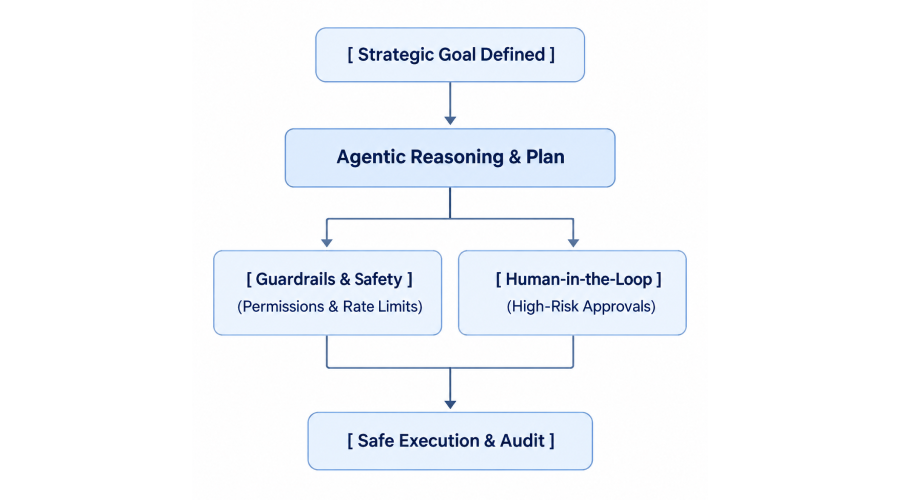
As AI agents undertake actions independently across your software environment, it is important to put in place the right access controls. Providing the agent unfettered permission to write into the firm’s database or financial gateway poses significant security dangers. Enterprises will need to enforce principle-of-least privilege access for autonomous bots.
Completely autonomous functioning may not always be ideal. In some cases, such as a wire transfer, a diagnosis or even a termination, it may not be appropriate to leave the decision-making process in the hands of autonomous agents. It is necessary to blend the agent’s autonomy with human control.
The Future Ecosystem: Coexistence, Not Replacement
Does the emergence of Agentic AI signal the death of traditional automation? Not at all.
The future of modern enterprise infrastructure will have to be in a combination of both technologies, which are complementary:
Traditional Automation will continue to be responsible for rigid, repetitive, high-throughput operations in which absolute deterministic precision and zero latency are needed (payroll processing, database syncing, structured data logging).
Agentic AI will be the layer on top of the deterministic pipeline, responsible for exception handling, chaotic input interpretation, decision making, and the guidance of traditional bots to perform certain downstream tasks.
Conclusion
The evolution from traditional automation into Agentic AI implies a paradigm change in business. We are transitioning from the time when people had to program computers to perform specific actions to the time when all they need to do is instruct computers with their goals.
Organizations that depend solely on rigid rule-based processes will sooner or later fall behind companies who utilize autonomous agents to adapt, make decisions, and take action.
In order to prepare your organization for this paradigm shift:
Find the Bottlenecks: Find those processes that are currently halted by any exceptional or unstructured data that comes through.
Auditing Your Data: Make sure that your enterprise documentation and data streams are available via APIs.
Create Guardrails: Create a clear security framework and human-in-the-loop workflows prior to deploying autonomous agents.
It’s possible to combine the structural efficiency of legacy automation with the dynamic capability of Agentic AI in order to create a more nimble, future-focused organization.