
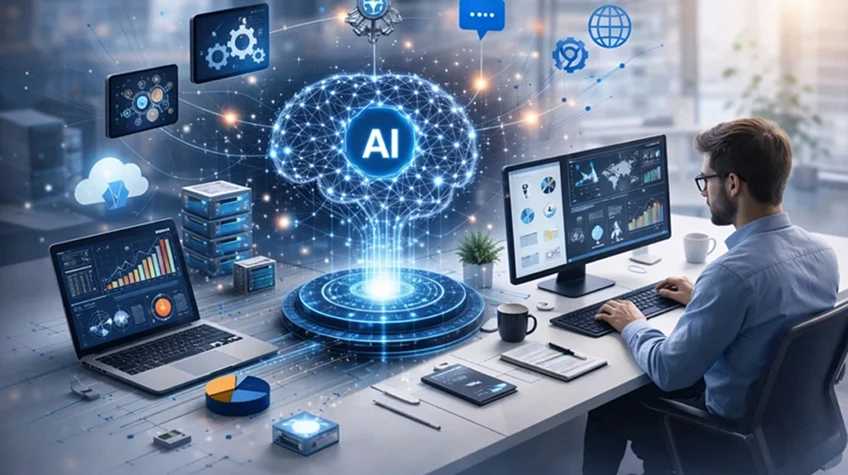
The offshore software development industry has evolved significantly, with businesses increasingly relying on offshore teams to reduce costs and access skilled talent. However, successful offshore development requires faster delivery, effective communication, strong security, and high-quality software areas where Artificial Intelligence (AI) plays a crucial role.
AI helps automate repetitive tasks, improve project management, accelerate coding, and enhance overall team efficiency. As a result, offshore development teams can deliver projects more effectively than ever before.
While AI offers numerous benefits, integrating it into offshore development also presents challenges. Understanding both the advantages and limitations of AI is essential for businesses to minimize risks, improve productivity, and make informed decisions. In this article, we explore the key benefits, challenges, and practical tips for successfully leveraging AI in offshore development.
Understanding AI in Offshore Development
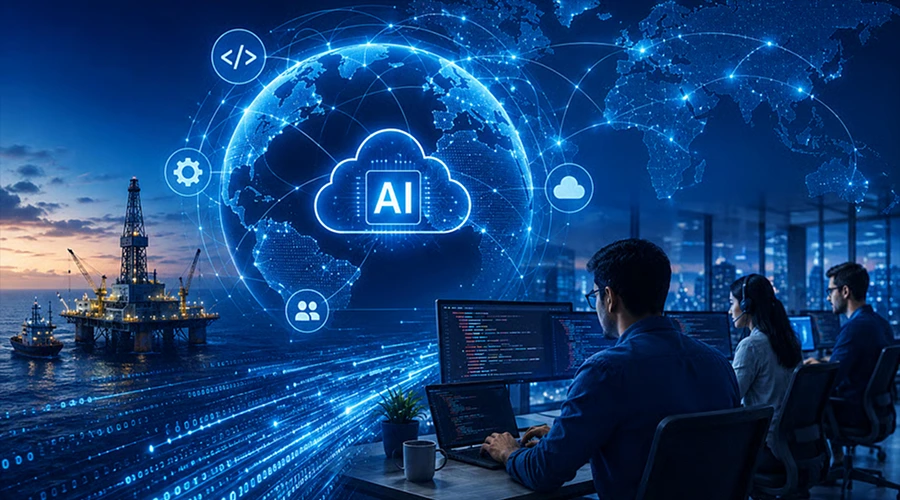
AI in offshore development implies to the use of artificial intelligence tools and systems. These systems help offshore teams with coding, testing, debugging, communication, project tracking, customer support, data analysis and many other activities involved in software development. More and more offshore developers today rely on AI-powered coding assistants, automated testing systems, chatbots, predictive analytics tools and smart project management platforms. All these together help developers finish the project in a timely manner and reduce manual workload. This is because AI-powered tools allow developers to write codes instantly and identify bugs within a few seconds, helping them to focus on other important aspects of application development.
AI-powered tools also help developers improve code, generate documentation and automate parts of the software testing process so that developers can focus more on solving complex problems. That’s why more offshore development companies are adopting AI tools to deliver more accurate results while meeting clients’ expectations for faster turnaround times. Businesses that are still using the traditional development methods struggle to compete in the modern software market. Read the next section for the benefits of implementing AI in offshore development…
Benefits of AI in Offshore Development
Here are some of the best benefits of integrating Artificial Intelligence in offshore development. Take a look…
1. Faster Software Development
Speedy development is one of the best benefits of integrating AI in offshore development. AI-powered tools are designed to automate repetitive tasks and allow developers save a lot of their time which they otherwise lose in manual methods.
For instance, using AI coding assistant developers can instantly generate code suggestions, detect syntax errors instantly and make improvements in the code. When all these tasks are handled by AI tools, rest everything becomes a breeze and quality improves significantly.
Besides that, they use automated testing tools that are capable of running multiple test cases at once. In this case, AI systems can quickly identify issues and provide reports in real time. This prevents offshore teams from manually checking every feature and allows them to release the product on time. In this competitive business environment, focusing on faster development is a MUST for offshore development teams to stay competitive in the industry and AI ensures it pretty well.
2. Improved Productivity
Productivity is one of the most important aspects of offshore software development because teams work across different times zones in this kind of format. Implementing AI ensures enhanced productivity. With AI, developers can handle larger workloads more efficiently, automate repetitive tasks and focus more on creative problem-solving and innovation. In addition, AI-powered tools help project managers to track deadlines, monitor workloads and predict possible delays before they happen. This improves overall project planning and resource management.
Also, AI help reduce communication delays and speed up decision-making processes. AI-powered collaboration tools help teams to organize workflows, schedule meetings, summarize discussions and provide project updates automatically. This allows offshore teams to stay organized and productive throughout the development process irrespective of their physical location.
3. Higher Software Quality
AI not only helps improve speed and productivity; it can also improve software quality. The quality of software largely depends on how effectively errors and bugs are removed during development. AI comes in handy when it comes to identifying errors early in the development process. Traditional debugging methods may miss hidden issues that later become expensive problems but that’s not the case with AI-powered tools. AI-powered tools deeply analyze code patterns and detect vulnerabilities that are often overlooked by human developers.
This is an important aspect for offshore developers because they are often hired for complex and large projects that involve large teams working on different parts of the software simultaneously. With AI teams can easily maintain consistency across the entire project. In addition, automated quality assurance tools allow teams to continuously monitor software performance in order to ensure there are no issues even during releasing updates. All in all, higher software quality improves customer satisfaction and strengthens business reputation.
4. Cost Savings

Offshore development is already popular because of its lower development costs, and AI makes it even more affordable by improving efficiency, reducing manual workload, and helping teams complete projects faster with fewer errors. Tasks that were previously handled by multiple developers can now be completed using fewer resources with AI assistance. Besides that, automated testing, documentation generation and project monitoring again help reduce operational expenses.
Moreover, AI-powered tools help developers save both time and money by identifying bugs early, strengthening security and reducing the chances of project delays. However, businesses should understand that AI cannot replace developers completely, instead, it can only be used as a supportive technology to help teams improve productivity, accuracy and overall performance.
5. Enhanced Communication
Having clear communication is essential for smooth offshore software development. Smooth conversation helps prevent misunderstandings, improves teamwork and ensures that projects stay on track. But different languages and time zones often lead to communication challenges in offshore development. However, implementing AI tools eradicate those challenges and help teams improve communication throughout the development process.
AI-powered translation systems help multilingual teams collaborate more smoothly. In addition, smart meeting assistants help teams generate summaries, track action items and organize conversations automatically. Besides that, chatbots and virtual assistants are also used for quick answers to common questions to reduce communication delays.
6. Better Decision-Making

Last but not least benefit of implementing AI in offshore development is better decision-making. AI systems are capable of analyzing large amounts of data in an instant. AI systems help project managers with useful insights based on project data. Businesses can utilize this data to make better decisions regarding timelines, budgeting, staffing and risk management.
Modern offshore teams rely on predictive analytics tools to identify patterns regarding project delays or budget overruns. Based on these patterns managers can take preventive action before problems become serious. Besides that, AI also help businesses understand customer behavior and market trends. Based on these understandings, offshore teams can improvise the software to ensure it perfectly matches user needs.
Let’s now take a look at the limitations of implementing AI in offshore development. Here we go…
Challenges of AI in Offshore Development with Their Solutions
Undoubtedly, implementing AI in offshore development is advantageous for teams, but it does include certain limitations as well. Knowing these limitations can help businesses make smarter decisions and ensure faster development. Take a look at the challenges here…
➢ CHALLENGE NO. 1: Data Security Concerns
AI in offshore development brings data security concern and this is one of the biggest challenges in this era. Most AI tools require access to sensitive company information, source code, customer data or business processes. This increases the risk of data leaks.
Furthermore, the issue becomes even bigger if offshore teams operate across multiple countries. This is because different countries follow different privacy laws and security regulations. This significantly increases the risk of data leaks or compliance issues.
SOLUTION: Businesses must ensure that AI tools that are used in the process follow proper security standards. Also, it is crucial for an organization to ensure that their offshore partner uses secure systems for handling sensitive information. This kind of attentiveness helps businesses protect data from security breaches, unauthorized access, and potential cyber threats.
➢ CHALLENGE NO. 2: Too Much Reliance on AI Tools
There is no doubt that AI helps in software development. It improves efficiency, productivity and allow teams to release products faster. However, too much reliance on automation can sometimes create problems. If the offshore development team rely heavily on AI-generated codes than there are chances that they may not be paying attention to important details. It is crucial to understand that AI can only be used as a support system. It cannot be used for creating the whole product. A machine cannot fully understand the logic behind the software like a human can do. Moreover, AI-generated suggestions are not always correct. Sometimes they also introduce security flaws, inefficient code or inaccurate outputs. And that’s when it becomes crucial for developers to take proper steps or decisions to ensure accuracy and authenticity.
SOLUTION: Companies should avoid using AI as the replacement for skilled developers and treat AI as a support system only. AI can only be used for automating repetitive tasks and not to create entire product. The project should only be handled by highly professional and experienced team of developers.
➢ CHALLENGE NO. 3: Integration Difficulties
Integrating AI into existing offshore development processes can be complicated. This is because some companies still use traditional software development systems. Traditional systems often struggle to integrate smoothly with modern AI tools and technologies. Besides that, training teams to use AI platforms also takes time and effort. Developers, testers and managers may take plenty of time and trainings to understand how AI systems work and how they can use these systems efficiently for their benefits.
SOLUTION: In such a situation, businesses should add AI slowly instead of transforming everything at once. They can begin with small AI tools for testing, automation or project management to make the process easier. Aside from that, they must make arrangements for training teams so that they can learn how to use AI tools effectively.
➢ CHALLENGE NO. 4: Communication Gaps
You may be surprised to know that even with AI systems teams can experience communication gaps. Understand that AI improves communication, but it cannot fully eliminate human misunderstandings. Cultural differences, unclear expectations and lack of personal interaction can still create problems in offshore development projects.
SOLUTION: Businesses should encourage regular meetings, transparent discussions and clear documentation even when using advanced AI systems. Doing so will ensure strong human collaboration, successful teamwork and faster software development.
➢ CHALLENGE NO. 5: Ethical and Legal Concerns
AI can also create ethical and legal concerns in software development. One major concern is determining who owns AI-generated code and whether AI systems may have been trained using copyrighted material without proper permission. Besides that, there are also concerns about bias in AI systems. If AI tools are trained on biased data, they may produce unfair or inaccurate results. Moreover, different countries may also have different laws regarding AI usage, data privacy, and automation, which can create compliance issues.
SOLUTION: Businesses planning to hire offshore teams should first understand the laws and regulations of the nation they are hiring their offshore partners from for smooth and seamless software development.
Top 8 Tips for Effective AI Integration in Offshore Development
Here are some of the best tips to ensure effective AI integration in offshore development. Take a look…
1. Have Clear Business Goals from the Start
Before introducing AI into any offshore project, ask yourself why you need it in the first place. You don’t need to use AI just because it is trending. You need to have a clear purpose before you actually implement it. Ask yourself: What problem are we trying to solve? Which tasks need to be automated? How can AI improve customer experience or productivity? How will automation reduce repetitive manual work? And so on. Knowing your goals clearly can help make better decision.
2. Choose the Right Offshore Development Partner
Choose the offshore development partner with strong experience of AI technologies. The offshore team you choose must have practical AI knowledge. You are advised to put in time and effort to evaluate potential partners carefully. Look for teams that have experience with Machine learning projects. AI-powered applications, Data handling and security, Cloud-based AI tools and Automation systems. Additionally, consider reviewing their previous work, client feedback and technical expertise to ensure wise selection.
3. Keep Communication Simple and Consistent
Communication issues are pretty common with offshore projects and AI can increase them further. In such a situation, it is wise to have regular communication to avoid confusion. Weekly video meetings, clear task documentation, shared project management tools, daily progress updates and having defined points of contact can help keep communication simple and consistent and avoid confusion throughout the process.
4. Begin With Small AI Features First
Building a large AI system all at once can create unnecessary pressure for both the company and the offshore team. Hence, it is wise to begin with small AI features first. Instead of transforming the entire business immediately, consider implementing one or two simple AI features such as, automated customer replies, AI-powered search suggestions, smart reporting tools, automated testing support or predictive analytics. Small steps often create the foundation for bigger success. You can always expand the system if the initial features perform well.
5. Encourage Collaboration Between Internal and Offshore Teams
AI integration works best when company employees and offshore developers collaborate closely instead of working separately. Internal teams understand the business goals, customer behavior and industry challenges. Whereas, offshore development teams offer technical skills and development expertise. Collaboration between internal and offshore teams can ensure smooth development. Hence, consider having joint brainstorming sessions, shared feedback systems, collaborative testing and open communication channels.
6. Pay Attention to Security and Privacy
Data security and privacy are crucial aspects of AI projects. These projects often deal with customer data, business information and internal systems. Therefore, businesses must establish strong security practices from the start, which often includes secure access controls, signing confidentiality agreements, data encryption, limited system permissions and regular security audits. Also, it is crucial to check whether or not the offshore partner follows international security standards and compliance requirements.
7. Continuously Monitor and Improve AI Performance
AI integration is a continuous process. AI-powered systems need regular updates, monitoring and adjustments to stay effective. Moreover, customer behavior changes over time, business goals evolve and data patterns shift. It makes it crucial for businesses to continuously monitor and improve AI performance by tracking accuracy levels, user satisfaction, error rates, response times and overall productivity of the tool. Offshore teams can help analyze performance reports and make necessary improvements when needed. This allows AI projects to stay reliable and useful for a long time.
8. Combine AI With Human Oversight
AI is a powerful tool, but of course, you cannot completely rely on it. Human judgement plays a crucial role even in AI projects. Human oversight is still necessary for reviewing AI-generated results, handling sensitive decisions, correcting mistakes, improving system accuracy and monitoring customer interactions. Therefore, you are advised to us AI as support system that assists human developers rather than treating it as a complete replacement for human involvement.
The Bottom Line
So, this is all about AI in offshore development. Undeniably, AI has transformed the way offshore development is done. It undoubtedly helps businesses improve productivity, reduce costs, increase development speed, enhance software quality and streamline communication across remote teams. However, you cannot simply ignore the challenges that it brings along, which are related to security, integration, ethics and communication. Ignoring them can prevent you from achieving the full benefits of AI integration. You are advised to use AI responsibly in software development to make the most out of it. When used properly, AI can help offshore development teams build better software faster and help businesses stay competitive in the digital world.