Get a complete breakdown of GitOps best practices for Infrastructure as Code (IaC) as we focus on declarative control, pull-based reconciliation, and a whole lot more. Learn how experienced teams use Git as a control plane to operate infrastructure reliability even at scale.
GitOps is growing ever more essential. It emerged not to make infrastructure fashionable, but because manual control often used to collapse under scale. Infrastructure as Code has already addressed that part of the problem by turning environments into versioned artefacts. GitOps does this by enforcing how those artefacts move, change, and recover in real systems.
At its very core, GitOps treats Git as a control plane. The repo defines the intent and everything else exists to reconcile reality against that intent. This model makes things simple but it breaks quick when teams treat GitOps as a deployment trick instead of an operating discipline.
Here are the best practices that focus on running GitOps for Infrastructure as Code in environments that grow, fail, and evolve.
GitOps Best practices for IaC
Start with declarative truth
GitOps will only work when repositories describe what must exist, not how to create it. Imperative scripts leak execution order, side effects, and assumptions about the current state which you definitely would not want. So declarative assumptions are a must in order to eliminate that ambiguity.
Kubernetes manifests, Terraform configurations, and OpenTofu plans work great here because these express desired state without procedural flow. The system determines the steps required to reach that state. This is a very important separation. This is what enables reconciliation, drift detection, and safe rollback. Without declarative intent, GitOps devolves into scripted automation with a Git wrapper. Remember, if a change requires reasoning about command order, the design has already failed.
Treat Git as the only source of truth
GitOps offers no parallel control paths. If engineers modify infrastructure directly, reconciliation tools will overwrite those changes or drift silently until something breaks. So both outcomes waste time.
Every infrastructure mutation has to originate from a commit. This also includes any emergency fixes and even experiments. Git is not here to block your speed, this just enforces traceability.
Your pull requests do more than gate changes. They capture intent, context, and accountability. When something fails sometime in the future, Git gives you the only reliable audit trail you will ever need.
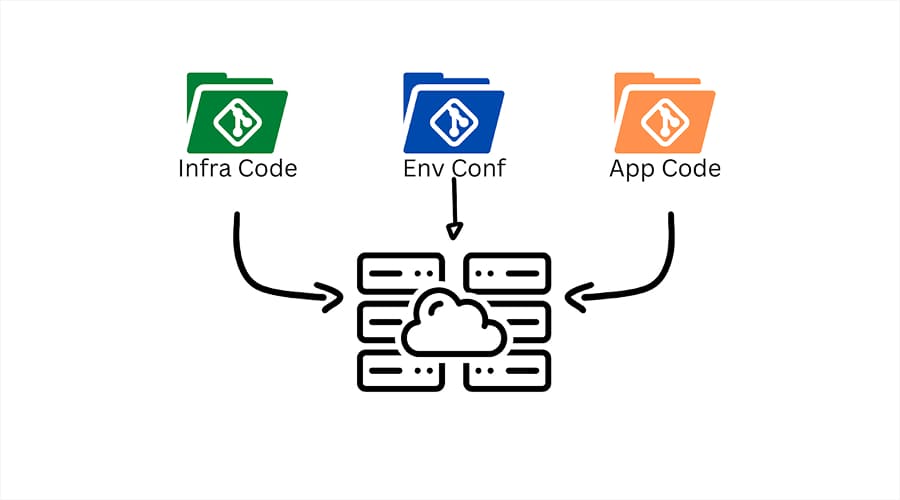
Separate infrastructure from application code
Application repos optimise for speed and infrastructure repos optimise for stability. Mix these and it forces conflicting workflows into one space.
Infrastructure code needs to change often to adjust scale, access, networking, or policy. These changes do not need complete application rebuilds. Trunk based workflows suit this model best because they reduce long lived divergence while also preserving review rigour.
Use pull based reconciliation, not push based deployment
Push based VI pipelines need credentials, timing coordination, and trust in the pipeline executor. Pull based GitOps agents tend to invert that relationship.
An agent runs inside the target environment. It polls the repo and applies changes locally. All the credentials stay inside the environment. The agent reconciles continuously, not just during releases. This model helps reduce the blast radius and enables automatic recovery. If someone modifies the live infrastructure manually, reconciliation restores the declared state without needing any human intervention.
GitOps without reconciliation only automates delivery. GitOps with reconciliation enforces correctness.
Design repos minimise duplication
Infrastructure repositories grow super fast and without structure they become unreadable YAML (YAML Ain’t Markup Language) archives.
Use composition instead of repetition. Kustomize overlays all work well when environments share structure but diverge in value. Helm works when parameters vary dynamically or remain unknown until deployment. Neither tool is going to replace the other. Both help solve different constraints.
Base definitions should describe the common behaviour. Overlays should describe differences, not copies. When engineers duplicate files or move faster, they create long term debt that GitOps exposes brutally. If changing a single value requires editing multiple files, the structure already failed.
Avoid environment branches
Branches model time and the environments model state. Confusing the two creates fragile promotion workflows. Environment branches require merges that combine unrelated differences like secrets, scaling rules, access policies, and much more. Promotions become the real conflict resolution exercise instead of controlled rollouts. Rollouts, then, become guesswork, and no one wants that.
Directories are able to handle environments much better. One branch. One history. Multiple environment overlays. Promotion then becomes value changes, not merge events. GitOps promotes manifests, not commits.
Enforce immutability in your releases
Mutable tags are what create ambiguity. Ambiguity kills rollback. Each release should be able to map to a unique, immutable identifier. Commit SHAs work well. Once deployed, that identifier must never change meaning. Redeploying an old identifier must be able to recreate the same state.
Immutability simplifies fatigue analysis and also satisfies audit requirements without additional tooling. When releases mutate, Git history loses authority. GitOps, thus, depends on trust in the historical state.
Detect and correct drift continuously
Drift happens even in disciplined teams. Cloud consoles exist. Credentials leak. Humans experiment.
Drift detection is able to compare the live state against the declared state. Reconciliation fixes the differences automatically. Alternatively, it can also raise alerts when the correction fails. Both of these outcomes matter.
Drift that persists long enough becomes normalised and engineers start to code around it. At that point, Git is no longer reflecting reality.
Make sure to run drift checks continuously and treat unresolved ones as a real defect.
Modularise aggressively, but with boundaries
Modules help reduce duplication and also hide complexity. But over-modularisation creates black boxes that teams fear changing. Each module should solve one concern: networking, identity, compute, storage. Cross-cutting behaviour should not belong in modules. Version modules explicitly. Breaking changes must remain obvious. A module that requires reading its source to use correctly has already failed its real intent.
Apply policy as code before deployment
Review alone will not help you scale. Humans will miss edge cases so policies are needed to catch them early. Policy as code enforces constraints on infrastructure definitions like allowed regions, instance types, encryption requirements, network exposure rules, and more. These policies must run automatically before any deployment. Store policies in Git. Version and test them. A policy that cannot evolve safely will eventually get bypassed. Governance works best when it blocks bad changes silently and predictably.
Keep credentials out of repos
Secrets in Git represent operational negligence. Even encrypted secrets expand the blast radius. Use external secret managers and inject secrets at runtime. You also need to rotate them regularly and limit access aggressively. GitOps reduces access needs as engineers can simply commit intent and the agents apply the changes. No credential ever leaves the environment. Repos should never leak secrets as Git history will preserve that failure forever.
Design for portability early
Cloud-specific abstractions accelerate early delivery that locks teams into migration pain later. Portability does not mean avoiding provider features. It means isolating them. Shared behaviour belongs in reusable modules. Provider-specific behaviour belongs behind interfaces. Tools that abstract infrastructure behind declarative APIs help here, but discipline matters more than tooling. Probability emerges from structure and not promises.
Treat GitOps as a cultural system
GitOps fails when teams view it as an ops-only pattern. It will only succeed when everyone trusts the workflow. Devs must understand how infrastructure changes flow. Operators must trust pull requests. Security teams must encode rules instead of issuing exceptions. When teams bypass GitOps to move faster, they create future incidents. GitOps helps expose the friction that already exists with teams.
Measure and refine continuously
Infrastructure code evolves like application code. Review it. Refactor it. Retire patterns that no longer scale.
Track all change failure rates along with rollback frequency. Also track drift incidents. These metrics reveal whether GitOps improves stability or only adds ceremony. With GitOps you get a system where excellence becomes measurable.
Closing thoughts
GitOps for Infrastructure as Code is only going to succeed if teams are willing to stop treating infrastructure as a side effect of deployment. It turns infrastructure into a governed, observable system that changes purposefully. The best practices are not only to optimise for novelty. They optimise for resilience. GitOps promise faster recovery, clearer intent and much fewer unknowns.