Infrastructure as Code helps accelerate cloud delivery but magnifies security mistakes at scale. Get a complete breakdown of IaC security and best practices across deployments and runtime. Also learns all about preventing misconfigurations, secrets exposure drift, and unauthorised access through disciplined, code-first controls.
Infrastructure as Code or Iac has really changed how teams build and operate cloud environments. IaC has made it possible for engineers to provision servers, networks, clusters, and services using only scripts, not consoles. This has helped tremendously. You now get speed, consistency, and reliability and also turn every infrastructure decision into executable logic.
But remember that logic can fail. A single misconfigured permission, an exposed secret, or even an outdated module can prove really disastrous. The same mistake will propagate across regions and accounts in just a matter of seconds. IaC security is critical to deal with such a mess.
IaC security focuses on protecting the codebase that defines the infrastructure and the runtime environments created from it. It addresses misconfigurations, access abuse, secrets leakage drift, and dependency risk. Strong and effective IaC security treats infrastructure code with the same rigour as production software.
The IaC security threat surface
IaC expands the blast radius
IaC scripts control identity policies, network boundaries, storage permissions, and service exposure. So errors in these scripts can cause problems. A faulty rule can open databases to the internet. An overly permissive role can grant attackers administrative reach. Manual infrastructure mistakes will affect one resource, but IaC mistakes affect everything created using that template.
Declarative vs Imperative security implications
Declarative configurations define a desired end state and the tools calculate how to reach it. The declarative model is great at reducing procedural complexity plus, it also improves consistency. But there is a downside to it too. It hides execution details so security teams must trust the tooling to reconcile the state safely.
Imperative configurations are the ones that define every step explicitly. This approach offers more of a granular control over the process, but increases complexity. Longer scripts create more room for insecure logic and missed edge cases.
Note that both these models need strong guardrails because neither of them guarantees security by design.
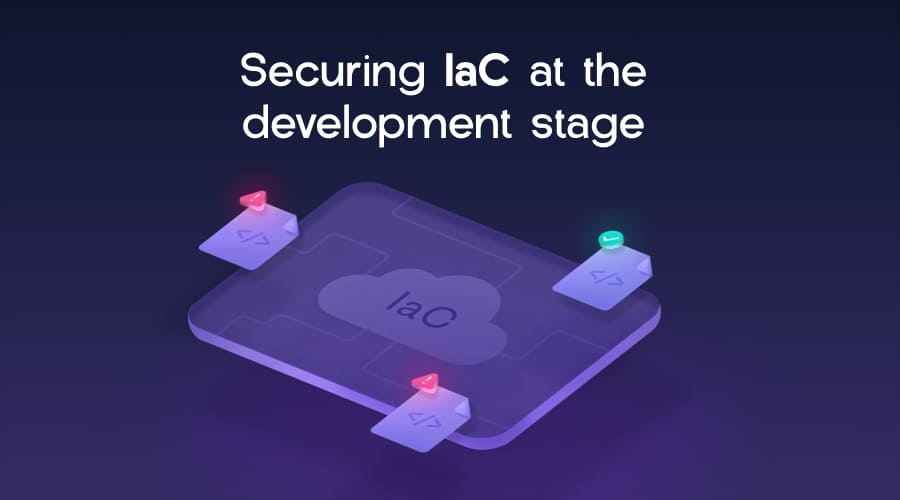
Securing IaC at the development stage
Shift security left with IDE enforcement
IaC security must start inside the editor itself. Devs have to write infrastructure code daily and catching insecure patterns at this stage does help prevent costly fixes later.
You have plenty of security focused IDE extensions that help scan templates as engineers type out their code in the IDE. These tools are great at flagging insecure details, exposed ports, risky permissions, and policy violations immediately. This makes it super easy for the developers to fix issues before committing their code. The approach shortens feedback loops and reduces friction between teams.
Threat modelling infrastructure code early
Threat modelling is not exclusive to applications. Infrastructure code defines the attack paths, trust boundaries, and data flows. Early threat modelling helps to highlight the high risk resources such as public endpoints, identity roles, storage systems, and inter-service permissions. Teams gain visibility into how attackers might exploit infrastructure logic before deployment. This practice will ensure that security controls evolve alongside infrastructure.
Secrets must never live in code
Secrets do not fail. It’s the storage decisions that cause it to fail. Hardcoded credentials, API keys, and SSH material frequently end up in repos. This might be due to convenience or oversight. No matter which, once committed, secrets persist through forks, logs, and backups.
Secure IaC pipelines inject secrets at runtime using dedicated secret managers. Automated scanners monitor repositories for accidental exposure. Rotation policies limit the damage when leaks occur. Secret management protects infrastructure identity and enforces operational discipline.
Version control as a security control
Version control tracks changes and enforces accountability. Every infrastructure change must tie directly to a feature, fix, or operational requirement. Teams commit infrastructure updates alongside application changes, not as isolated actions. This alignment is what preserves context and simplifies audits. Strong branching strategies and protected merges prevent unauthorised changes from reaching production environments.
Leak privilege must extend to IaC authors
IaC scripts create access. The authors wield huge power. Organisations should be able to strictly define who can create, modify, execute, or destroy infrastructure code. Permissions must reflect job responsibilities, not conveniences. Overprivileged IaC access creates silent systemic risk.
Scripts must be able to enforce least privilege on the resources they provision. Infrastructure should grant only the permissions required for runtime behaviour, nothing more.
Automated analysis: Finding risks before deployment
Static analysis for infrastructure code
Static code analysis tools inspect IaC templates without executing them. This is super helpful in identifying misconfigurations, insecure defaults, exposed services, and compliance gaps directly inside the code.
Static analysis focuses more on the infrastructure intent. It answers questions like who can access what, from where, and under which conditions. This analysis stops flawed designs before they are able to reach cloud environments.
Dependency and module risk management
IaC has a heavy reliance on external modules, images, and libraries. All of these components age very quickly so vulnerabilities tend to accumulate silently. Automated dependency analysis detects outdated or vulnerable components early. Continuous scanning ensures teams do not deploy known risk assets into production environments. Ignoring dependency hygiene turns isolated automation into a major liability.
Container image security in IaC pipelines
Many IaC workflows provision container platforms so image security becomes infrastructure security. Image scanning inspects build layers, packages, and configurations to uncover vulnerable libraries, misconfigured entry points, and insecure runtime settings before deployment. Secure images reduce the runtime attack surface created by infrastructure automation.
CI/CD integration and centralised visibility
IaC should always be running security checks automatically as manual only review cannot scale with modern deployment frequency. Integrating security analysis into CI/CD pipelines ensures every change gets the same level of scrutiny. Centralised reporting consolidates these findings across tools, environments, and teams.
Artefact integrity through signing
Infrastructure artefacts move across systems before execution. Attackers prefer to target this transition. Artefact signing verifies integrity and provenance. Build systems sign templates, images, and packages. Runtime systems validate signatures before use. This control prevents tampering between creation and deployment to protect the supply chain trust.
Securing the deployment phase
Inventory as a security foundation
It is not possible to secure something that you cannot see. Every deployed resource must register in an inventory system. Provisioning workflows label, log, and track assets automatically. Decommissioning workflows remove resources completely, including data and configurations. Incomplete cleanup creates ghost infrastructure that drains budgets and hides risk.
Tagging prevents operational blind spots
Tags are a great way to illustrate ownership, purpose, and lifecycle context. Untagged resources disappear from accountability. Consistent tagging helps with easy monitoring, cost tracking, compliance checks, and drift detection. Tags are a great way to prevent orphaned assets from accumulating silently. Tag enforcement belongs inside IaC logic. This should not be an afterthought.
Dynamic analysis reveals runtime interactions
Static analysis alone cannot predict how systems will behave together. Dynamic analysis evaluates live environments and service interactions. These tests uncover permission escalation, network exposure, and interoperability flaws that static checks tend to miss. Dynamic insights help close the gap between design intent and the operational reality.
Mutable systems drift and the drift hides compromise. Immutable infrastructure replaces systems instead of modifying them. Changes trigger new deployments and old instances retire automatically. This model eliminates undocumented changes, simplifies rollback, and limits attacker persistence within compromised resources.
Logging creates forensic readiness
Logs record reality. Infrastructure provisioning must enable security and audit logs by default. These logs capture access patterns, configuration changes, and system behaviour. Contralised log analysis enables incident investigation and threat detection. Missing logs erase evidence.
Continuous monitoring enforces security posture
Monitoring is quite essential if you want to track deviations from expected behaviour. Effective monitoring will help you detect policy violations, unauthorised access, performance anomalies, and compliance failures. Alerting mechanisms notify teams before small issues start escalating into something big. Employ regular monitoring to transform your static infrastructure into observable systems.
Runtime threat detection adds a final defence layer
Even the most well designed infrastructure is not safe from active threats. Runtime detection tools analyse system calls, network activity, and process behaviour. These tools flag anomalies and malicious actions as they occur. This capability closes the final gap between prevention and response in IaC managed environments.
Preventing drift and unauthorised changes
Drift is the main culprit in breaking trust in automation. Manual changes bypass code, reviews, and pipelines. These changes introduce inconsistency and security gaps. Drift detection compares live environments against declared states. Alerts trigger remediation before divergence grows. Strict immutability and access controls reduce drift at the source.
IaC security needs discipline, not tools alone
Tools are there to enforce rules but it is the discipline that enforces outcomes.IaC security succeeds when teams treat infrastructure code as a high risk asset. Secure defaults, automated checks, controlled access, and continuous visibility create a system and not a checklist.
Security must evolve alongside architecture. Static rules fail in dynamic environments. Continuous improvement sustains protection.
Secure code builds secure infrastructure
Infrastructure as Code multiples both efficiency and risk at the same time and security mistakes scale as fast as deployments. Strong IaC security embeds protection into every phase, from editor to runtime. Teams that secure infrastructure code protect everything built on top of it.
Speed without control is definitely going to invite failure. Discipline turns automation into strength.