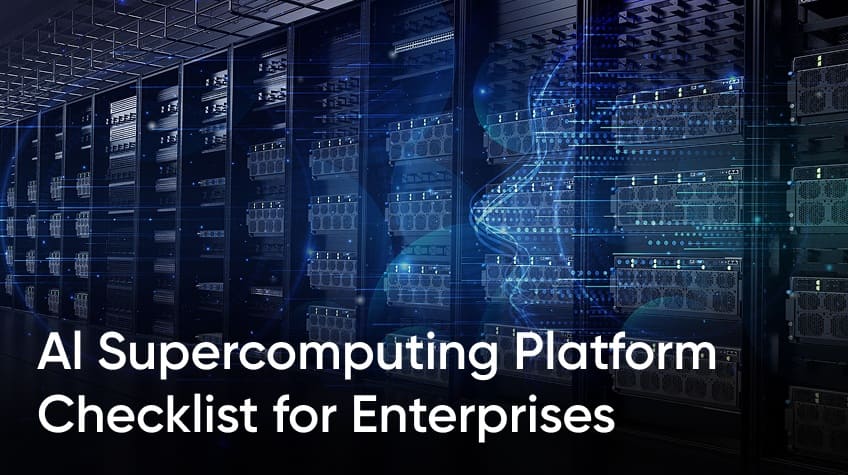
A complete checklist that outlines the non-negotiable technical, operational, and compliance criteria enterprises must evaluate when choosing a partner AI supercomputing platform to train their model.
There are predictable reasons why enterprise AI platforms fail. Power density might hit the ceiling. Cooling designs may not be able to keep up under sustained GPU loads. Networks introduce latency that destroys model training efficiency. Compliance gaps delay production rollout. These issues can be brutal for enterprises. What they need is a checklist to prevent these failures before capital gets locked into the wrong infrastructure.
We bring this checklist that focuses on what actually determines AI platform viability at scale. It applies to enterprises building private AI clusters,cloud providers deploying GPU fleets, and organisations expanding AI capacity beyond borders.
Infrastructure built for GPU saturation
Image Source Bloombergcom
AI supercomputing starts with physical limits. GPUs are going to consume enormous power and will generate constant thermal load. If platforms treat AI workloads as traditional enterprise compute, they are destined to fail under sustained utilisation
A capable environment should be able to support extreme rack densities without throttling. It delivers power at scale. The facility must handle hundreds of kilowatts per rack while maintaining predictable thermal behaviour across adjacent rows. So liquor cooling becomes mandatory at this scale. So ensure rear door exchangers, direct to chip loop, or immersion system are in place and operational.
Scalability is important too. Check for modular power delivery systems that allow incremental expansion without reworking the entire data hall. Thermal zoning helps to keep these high density GPU zones isolated from lower density infrastructure. Custom hall designs aligned to specific GPU architectures eliminate compromises introduced by genetic layouts.
Remember, future expansion will define long term value. Multi-megawatt deployments should be able to scale without the need for power or cooling expansion across places.
Network architecture that preserves model efficiency
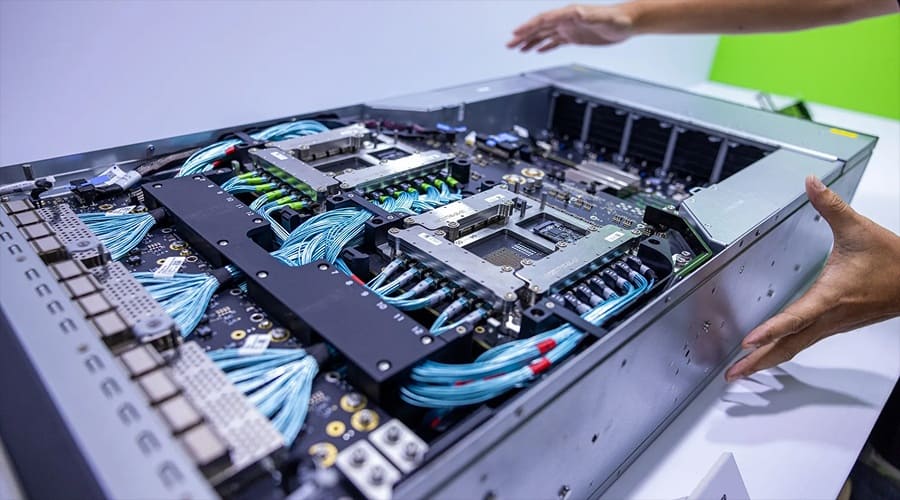
Image Source NVIDIA Blog
AI workloads can be really unforgiving when it comes to a weak network. Training jobs will stall when latency is high and distributed inference collapses when bandwidth fluctuates.
It is the network design that will determine how efficiently GPUs are able to communicate, not just how fast packets move. Therefore, you need a platform that is able to support most high throughput interconnects capable of sustaining ultra low latency traffic between GPU nodes.
Direct access to major cloud platforms enables hybrid workflows and burst capacity. Check for proximity to international subsea routes as this will reduce round trip latency for regional data movement and cross border collaboration. You need these physical advantages as these will compound over time and directly affect training throughput.
Support for distributed GPU clusters enables federated models and multi-site execution. Without this capability, enterprises lock themselves into single-location constraints that limit resilience and growth.
Security, compliance, and data control
Image Source Hyper Secure
AI supercomputing platforms need to process regulated data at scale. So, the security architecture must assume constant access attempts, not occasional threats. Compliance must hold under audit pressure, not marketing claims.
Check for high availability certification. It shows resilience at the infrastructure level. Continuous uptime commitments are very important when you have training jobs running for weeks without interruption. Any outage will destroy time and compute investment.
The platform needs to have internationally recognised compliance standards across information security, operational controls, and regulated payment or defence workloads. Layered physical security prevents unauthorised access before digital controls activate. Zero-trust architecture ensures every request goes through verification regardless of location or identity.
This is important because data sovereignty carries legal consequences. Privacy obligations and breach notification requirements demand operational maturity, not basic policy statements.
Supply chain trust also matters here. Platforms that operate within approved international frameworks are less likely to reduce exposure to hardware access without restrictions and geopolitical risk.
Location strategy and sustainable expansion
Image Source Interesting Engineering
Next comes geography. Geography influences performance. Distance will increase latency. Strategic placement across major cities enables national coverage and workload distribution. A local presence is critical to reduce latency for enterprise users and government systems. Access to international routes positions the platform as a regional hub.
Connectivity in your region supports regional expansion and cross-market AI deployment. Being physically close to cable routes improves reliability and routing control drastically. You need these advantages as AI workloads start growing more distributed. Edge AI deploymentsbeyond centralised hubs. Regional facilities support real-time interface, smart infrastructure, and latency sensitive applications. This decentralisation reduces backhaul costs and improves service reliability.
Sustainability will also dictate long term viability. AI consumes huge power and AI supercomputing platforms should be able to keep up. Check for sustainability programs, measurable efficiency improvements, and alignment with climate frameworks protect both operational continuity and regulatory standing.
Ecosystem integration and operational support
AI supercomputing platforms do not operate in isolation. They exist inside ecosystems of enterprises and service providers.
Check for direct interconnection with adjacent organisations to secure data exchange without public network exposure. Co-located ecosystems will help reduce latency, simplify compliance for you, and also strengthen collaboration across sectors such as finance, healthcare, government, and industrial operations.
Carrier-neutral and cloud-neutral design preserves flexibility. Enterprises avoid lock-in while maintaining control over performance and cost. This neutrality supports evolving requirements without architectural rewrites.
Operational support must also be considered when choosing as this determines your day to day success. Local teams are able to respond faster than offshore ticket queries. On-site expertise helps provision and resolve failures before they even have a chance to cascade. You need access to specialists who understand GPU tuning, workload optimisation, and performance profiling to turn raw infrastructure into usable compute.
Final perspective on your evaluation
An AI supercomputing platform will only succeed when every layer aligns with sustained GPU utilisation. Power, cooling, networking, compliance, geography, and operations should be able to work together under constant load. If gaps are left hidden during pilots, they will most definitely surface after scale introduces stress.
We brought this handy checklist to help you surface those gaps early. Enterprises that apply it during partner selection, site evaluation, or procurement reduce risk before deployment begins. AI infrastructure rewards preparation and punishes assumptions. So pick wisely.