AI supercomputing powers modern artificial intelligence by offering massive parallel hardware, blazing fast networking, and precision cooling. We learn how these systems work and how bigger organisations use them responsibly and efficiently.
In 2026, AI will not stall because of weak algorithms behind it. It slows down when it hits a computational wall. Training trillion-parameter models, running real time interfaces for millions of users, and simulating complex physical systems needs machines that can keep up. Traditional servers are not meant to handle such enormous workloads. AI supercomputers are coming in to solve this huge constraint.
There are not “bigger computers.” They reflect a complete redesign of how computation, networking, power, and software work together at extreme scale. With relatively less knowledge floating around, it is imperative for teams to know how to approach them without burning money or energy.
How is an AI supercomputer different?
Image Source CDOTrends
An AI supercomputer brings together hundreds of thousands of processing units into a single coordinated system where each processor is tasked with handling a fragment of a much larger task. This allows the entire system to split workloads more aggressively and execute them in parallel. The result is that you get results at a much higher frequency.
And it is this coordination that defines the entire power of the system. Instead of having to handle one massive calculator with one processor, the supercomputer will run millions of smaller calculations at the same time. Every part stays aware of what the others produce. Unlike the supercomputers built for physics or weather models, AI supercomputers have a higher priority for neural network workloads.
Here are the complete basics that teach you the fundamentals of how an AI supercomputer operates.
➢Massive parallel processing at the core
As mentioned, AI supercomputers will divide workloads across their thousands of nodes. Each node contains multiple CPUs or accelerators, and each processor includes many cores. Even a modest configuration can have tens of thousands of cores. Larger installations will operate in the trillions of cycles per second.
Each processor executes a narrow slice of work and the system recombines the results continuously. It is thanks to this parallel structure that training runs that would take years on conventional infrastructure can be finished in days or hours.
➢High frequency processor communication
Processors in an AI supercomputer are able to exchange data constantly. During model training, gradients move across the system after every iteration. It is important to remember that communication does not happen in one direction. Data flows across a multidimensional grid that supports simultaneous exchange across many paths. This design prevents bottlenecks. When processors syncs fasters, the system is able to scale more efficiently instead of slowing down as more and more hardware join the cluster.
➢ Standard software, extreme scale
Despite all the exotic hardware on offer, AI supercomputers surprisingly rely on familiar foundations. Linux manages scheduling, networking, and system operations. Applications are often run in C++, C, or even Fortran. Message Passing Interface (MPI) libraries coordinate communication across the different nodes.
This software stability is very much important as engineers do not need to relearn OSs and can focus more on optimising workloads, memory usage, and data movement.
➢Dense circuits and thermal reality
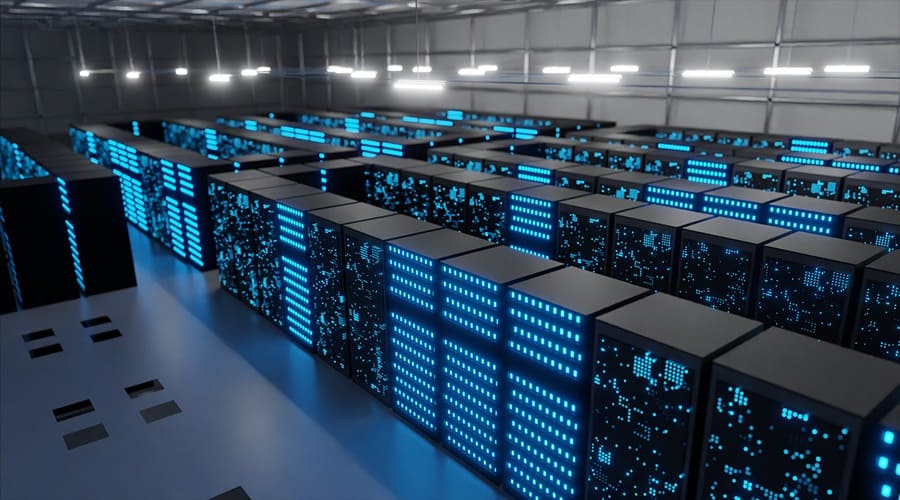
Packing in more and more transistors in smaller spaces will boost performance but will also generate extreme heat. Power delivery struggles to keep pace with density and without intervention, chips will surely fail. AI supercomputers address this problem through advanced cooling strategies. Copper wiring handles the high power density. Forced air removes surface heat. Liquid or refrigerant cooling circulates across racks to pull heat directly from the processors.
How are AI supercomputers able to handle analytics so well?
Image Source freepik
➢Node architecture at scale
Each node in an AI supercomputer contains multiple CPUs or accelerators, often with ten or more cores per processor. When clusters scale into thousands of nodes, the core count multiples rapidly. This structure is what allows trillions of operations per second without relying on higher clock speeds. More cores mean more parallel math. This is an environment where AI absolutely thrives.
➢Circuit density and execution speed
Shorter wire paths reduce the delay in the signal. Dense circuit boards allow much faster arithmetic and logical execution. These physical characters translate directly into lower latency during training and inference. The system now spends way less time waiting and more time computing.
➢True parallel workloads
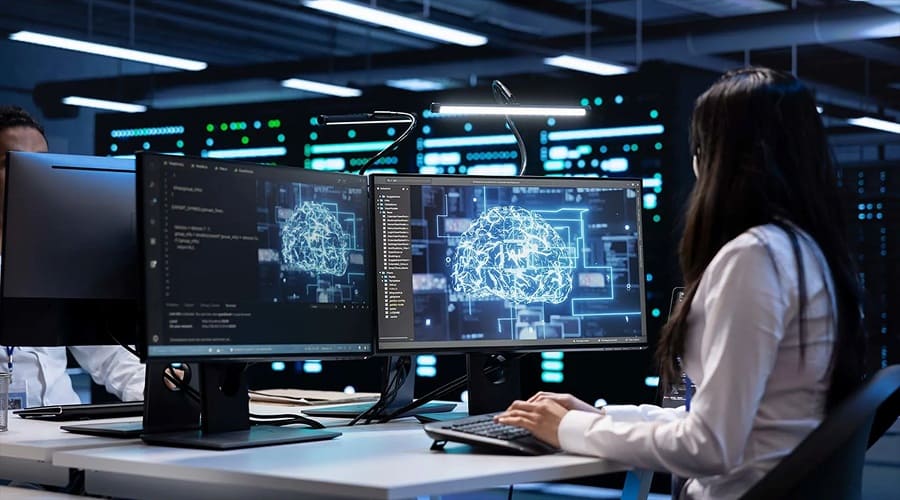
AI supercomputers are able to process thousands of tasks simultaneously. Parallel execution shortens the overall feedback loops during model training. Teams experiment faster, test more scenarios, and iterate with precision. This speed transforms research cycles. Insights arrive in hours instead of weeks. Model accuracy improves because experimentation expands.
Real world examples of AI supercomputers
➢NVIDIA DGX SuperPOD
NVIDIA designed DGX SuperPod as a modular AI supercomputing platform that connects multiple DGX systems into a unified architecture. This architecture is optimised for deep learning that research teams can use to train their large language models, simulate complex environments, and industrial AI pipelines.
DGX SuperPod prioritises GPU density and fast interconnects. Well shouted for large scale neural networks.
➢Summit at Oak Ridge National Laboratory
Summit brings on a combination of traditional high performance computing with AI acceleration. Built by IBM and HPE, Summit integrates POWER9 CPUs with NVIDIA GPUs. Scientists use it for deep learning,data analytics, and scientific discovery. Summit perfectly demonstrates how AI supercomputing supports fields ranging from materials science to climate research.
➢Fugaku in Japan
Fugaku, developed by RIKEN and Fujitsu, ranks among the fastest supercomputers ever built. The architecture supports a wide spectrum of workloads, including AI-driven simulations, image recognition, and natural language processing.
2026 will see AI supercomputing platforms like these become the backbone of modern AI development. These platforms integrate CPUs, GPUs, specialised AI chips, networking, power systems, and software into a single environment that is engineered for scale.
Traditional cloud servers fragment workloads across loosely connected machines. AI supercomputing platforms eliminate that fragmentation and act as one cohesive engine.
GPU mega clusters form the computational heart. Thousands of GPUs operate as a single logical unit. AI specific chips supplement GPUs to reduce cost and power consumption for the targeted workloads. Processors too can share data with minimal delay thanks to ultra fast interconnects. And advanced cooling systems prevent thermal collapse at megawatt power levels. Every component in the system is there to serve one purpose and that is to sustain AI computation without degradation.
Why AI supercomputing matters now
Image Source freepik
➢Model scale keeps expanding
Modern AI is continuously pushing into trillions of parameters like text, images, audio, and video. And all simultaneously. Continuous retraining has now become a standard practice. It is only AI supercomputers that can support this scale reliably and economically.
➢ Interface will drive the next bottleneck
Training takes up all the headlines, but it is the interface that will dominate real world costs. Millions of concurrent users expect instant responses, so latency will matter more than just peak throughput. AI supercomputers help deliver predictable performance under constant demand. That stability enables commercial deployment at a global scale.
➢The economic and strategic impact of AI supercomputers
AI supercomputing influences national security, scientific leadership, and business competitiveness. Companies and nations without access to this infrastructure will fall massively behind in research and product capability. It is computing capacity that now defines the strategic advantage.
Best practices for using AI supercomputing effectively
Designing models for parallelism: Models must be able to scale thousands of processors. Poorly designed architectures will waste compute through idling cores and communication delays. Engineers should profile workloads early and optimize data flow accordingly.
Control data movement aggressively: Communication overhead is a massive performance-killer. Teams should minimise unnecessary synchronisation and reduce data transfer frequency for more efficient batching and gradient compression. This will improve throughput. Compute speed means little if data moves slowly.
Treating cooling and power as first class constraints: Thermal limits should also be considered. Organisations should be able to plan their workloads around cooling capacity and power availability. Ignoring physical constraints shortens hardware lifespan and inflates downtime.
Monitor and optimise continuously: AI supercomputers need constant observation. Performance counters, energy metrics, and failure rates reveal inefficiencies early on. Continuous optimization prevents silent cost creep.
You have hyperscalers like Microsoft, Google, and Amazon that integrate AI supercomputing into their cloud platforms. AI-native organisations design models alongside custom hardware. National laboratories operate supercomputers for public research.
Startups and universities increasingly tap into these platforms through partnerships and cloud access.
What this means for builders and researchers
Few teams will actually get to own an AI supercomputer. But most will depend on them. Understanding how these systems work shapes better decisions. Efficient models cost less, smart infrastructure choices scale further. Teams that think in systems outperform teams that think in servers. AI progress now tracks compute literacy.
A look at the road ahead
AI supercomputers will surely grow smarter, denser, and more energy aware. Hybrid architectures will blend GPUs and specialised chips. Scheduling systems will adapt workloads dynamically to power conditions. And slowly these machines will fade into the background, shaping everything around us. AI supercomputing is now defining the future.