Robotics is moving faster than factories can redesign themselves. From AI-driven autonomy to humanoids, these trends will reshape how machines work, decide, collaborate, and coexist with humans and industries after 2026.
2026 will see robotics enter a very decisive phase. The question is no longer if machines will take on complex physical work, but how intelligently, safely, and economically they will do it. By 2025, robotics is starting to look less like isolated machines and more like adaptive systems embedded into everyday operations.
These ten trends show where robotics is headed next. And also why this shift matters so much for us.
Robots Get their Brains with AI
Image Source Freepik
Gone are the days when robots used to run purely on rigid scripts. Predetermined lines of code that had a specific outcome. AI is now becoming the brains behind it. It drives perception and decision making. This shift turns robots into adaptive workers rather than simple programmable tools doing one specific task over and over again.
Natural language interfaces now allow operators to instruct robots using plain speech instead of code. Vision models interpret cluttered environments. Predictive systems anticipate failures before breakdowns occur. Fleet intelligence is now able to coordinate thousands of machines as a single organism.
Simulation has also gotten more realistic over time as robots are now able to train inside digital worlds where they encounter endless scenarios with zero physical risk. When they deploy, they arrive experienced rather than experimental.
As AI models mature so do robots. Getting much closer to intent-based operation. Humans define goals and the machine figures out how to do it.
Sustainable Robotics Moves from Ethics to Economics
Energy costs and carbon pressure are forcing robotics to evolve as efficiency now determines competitiveness. Manufacturers redesign robots to recover braking energy, reduce idle consumption, and optimise motion paths. These changes cut electricity use up to a third in real deployments. Longer lifecycles and recyclable materials further help reduce the environmental impact.
Robots also enforce sustainability through action. They enable precision agriculture that limits chemical use. They sort waste with the accuracy humans can only dream of and inspect renewable infrastructure without downtime. Green robotics no longer signals goodwill. It protects margins
Collaborative Robots Grow Stronger and Smarter
Cobots have outgrown their early limitations. Modern and newer models are now able to lift heavier loads, reach farther, and operate at industrial speeds while being safe around people. Thanks to advanced vision that allows real time obstacle detection, cobots are now able to work without cages. This has allowed them to adapt quite instantly when a human steps close or a task changes. This flexibility suits factories with short production runs and frequent reconfiguration.
Tasks like welding, packing, palletising, or food processing are now handled quite effortlessly by cobots. Earlier these sorts of tasks were only reserved for industrial robots. This ease has made automation viable even for small or mid-sized businesses that previously would have preferred to stay manual. Human-machine teamwork now becomes the default production model.
Humanoid Robots Cross the Cost Barrier
Image Source Freepik
Humanoid robotics has shifted from spectacle to strategy as the hardware costs have dropped quite significantly, while capability has climbed. Modern humanoids walk uneven terrain, use tools, and understand instructions through multimodal AI. And improved batteries and power consumption have extended their runtime.
Electric actuators have replaced those complex hydraulics and onboard computing now rivals small servers. All thanks to this, factories have started to use humanoids for internal logistics and material transport. Warehouses deploy them where infrastructure cannot justify fixed automation. Their human-like form lets them operate in spaces built for people rather than machines.
As far as costs go, it generally approaches annual wage levels. So, humanoids can really change the labour economics. Not through replacement, but through relentless availability.
Robotics as a Service
Subscription models are creeping into basically everything. So why should robotics be left behind? Plus, the subscription model removes the friction of capital expenditure. Robotics as a service shifts robots from assets to utilities. Companies pay monthly to get hardware, software updates, maintenance, and analytics. Providers manage the uptime and you, as a customer, will buy the outcomes.
This model is great for environments with fluctuating demands, labor shortages, or limited capital. Logistics, security, cleaning, and inspection already rely heavily on RaaS deployments.
With advances in 5G connectivity and cloud robotics, providers manage fleets remotely at scale. Robots receive updates overnight. Predictive maintenance happens without site visits.
Regulation and Ethics Catch up with Autonomy
As robots gain agency, oversight tightens. Governments now treat advanced robotics as safety-critical systems. Regulations will have to be transparent and auditable. More so in cases of high-risk applications. Autonomous machines must prove safe behaviour not just in expected conditions, but under failure and uncertainty.
It is important to remember that ethical design moves upstream. Developers embed safeguards directly into control systems. Independent governors constrain behaviour mathematically. So compliance becomes a part of engineering.
But it is public trust that will decide how far robots will reach into our daily lives. Regulation aims to earn that trust before adoption outpaces control.
Autonomous Mobile Robots Redefine Movement
Image Source Freepik
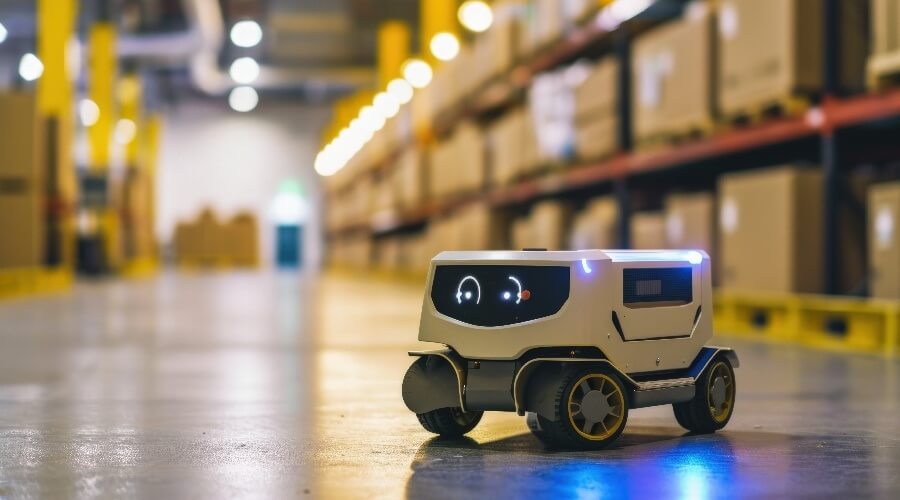
Autonomous mobile robots or AMRs have slowly started to become the silent workforce of logistics and healthcare.
In contrast to fixed automation, AMRs adapt to changing layouts without infrastructure changes. They are able to map environments dynamically and also coordinate with other machines in real time. This allows warehouses to deploy fleets that scale during peak demand and hospitals to move supplies while staff focus on care. Heavy duty models now transport loads once handled by forklifts.
Battery advances extend uptime, while opportunity charging eliminates downtime.
Edge Computing Gives Robots Instant Awareness
Latency is perhaps the biggest autonomy killer, and edge computing is here to solve it. Robots increasingly process data locally and not on cloud servers. This shift enables split-second reactions in safety-critical tasks such as driving, surgery, or manipulation. Power-efficient AI chips now fit inside robots of all sizes and this sensor fusion allows vision, touch, sound, and motion. Multimodal models interpret context instead of raw signals.
5G and local edge servers have amplified this capability so naturally robots are able to communicate with nearby systems or each other with practically zero latency.
Soft Robotics Enables Safe Physical Interaction
Rigid programmable robots of the past were great at precision but often struggled with fragility. This limitation has driven the rise of soft robotics.
Built from compliant materials, soft robots absorb impact and adapt shape. They handle irregular, delicate objects without damage. Plus, the risk of injury is also reduced during human interaction.
Food processing benefits from gentle gripping. Healthcare adopts soft exoskeletons for rehabilitation and mobility support. Inspection robots squeeze through spaces rigid machines cannot enter.
Advances in material science have helped improve durability and control as soft robotics now turns physical interaction into an advantage.
Swarm Robotics Scales Intelligence through Numbers
Swarm robotics relies on decentralised coordination. This is inspired by nature. Each robot makes local decisions while sharing information with neighbours. The system adapts even when individual units fail. And defence investment has definitely helped accelerate swarm robotics development, but commercial use is not far away. Warehouses can deploy coordinated fleets for sorting and transport while environmental monitoring can use drone swarms to cover vast areas cheaply.
Edge AI and mesh networking have enabled real-time sync without needing a central command. Operators manage swarms as unified systems as scale quickly becomes a feature.
What Comes Next
Robotics cannot advance in isolation; it needs AI, material science, energy systems, and more to help shape its trajectory for the future. Expect robots of the future to repair themselves, coordinate across domains, and learn continuously from experience. Expect machines that feel far less mechanical and more intentional. Expect workplaces to be designed around this collaboration.
The next era will not be utopian, but much closer to normal. And that will be the real disruption.