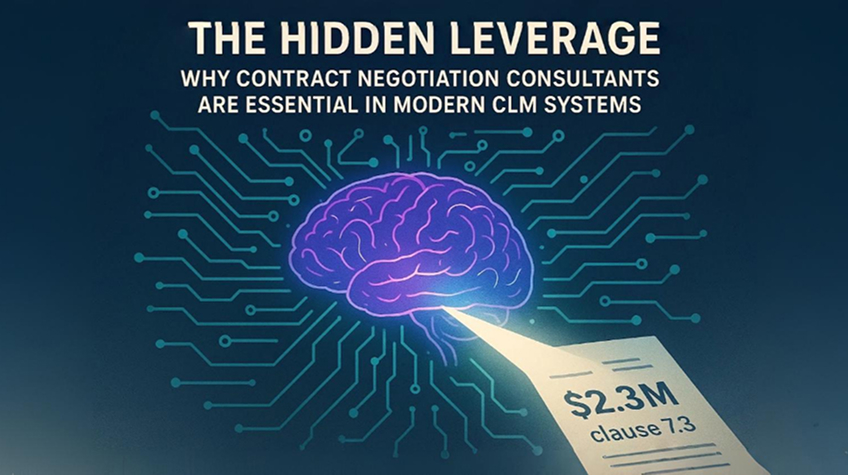
A Fortune 500 procurement director recently discovered that her team had left $2.3 million on the negotiating table—not because they lacked authority, but because they lacked visibility. A single unfavorable payment term buried in clause 7.3 cascaded through 47 vendor contracts, compounding annually. This isn’t incompetence. It’s a structural problem: most organizations treat contract negotiation as a one-time event rather than a strategic discipline anchored in technology and expertise.
Contract negotiation consultants solve this blind spot. But here’s what most people get wrong: their value isn’t just haggling better rates. It’s architecting negotiations within Contract Lifecycle Management (CLM) systems that transform contracts from static documents into dynamic profit engines.
A contract negotiation consultant isn’t a salesperson’s adversary or a legal generalist. They’re strategic architects who specialize in extracting maximum value from agreements while managing risk exposure. They operate at the intersection of commercial acumen, legal precision, and relationship management.
Their core responsibilities include:
Pre-negotiation positioning: Analyzing counterparty leverage, identifying your BATNA (Best Alternative to Negotiated Agreement), and defining your Zone of Possible Agreement (ZOPA)—the range where both parties can reach consensus without walking away.
Clause-level strategy: Understanding which contract clauses directly impact cash flow, risk allocation, and operational flexibility. A payment term consultant might restructure milestone-based payments to improve cash conversion cycles. A risk allocation specialist might redefine liability caps to match your actual exposure.
Multi-party coordination: Managing negotiations across procurement, legal, finance, and business units—ensuring alignment so concessions in one area don’t undermine goals elsewhere.
Post-signature optimization: Monitoring contract performance to identify renegotiation opportunities before renewal, ensuring obligations are actually fulfilled.
The career path typically requires 5-7 years of progressive experience in procurement, legal, or vendor management—often formalized through certifications like the Certified Professional Contracts Manager (CPCM) or Procurement Certified Professional (PCP).
The Problem: Negotiation Without System Architecture
Traditional negotiation consulting works like this: consultants negotiate a deal, hand off the signed contract to legal for filing, and disconnect. The contract becomes institutional knowledge locked in email threads and spreadsheets.
The result? Organizations lose 5-9% of contract value annually to what industry analysts call “contract leakage”—missed renewals, unenforced service levels, overlooked improvement clauses, and renegotiation opportunities that expire silently.
This happens because negotiation and contract lifecycle management operate in silos. A consultant might negotiate perfect payment terms, but if your CLM system doesn’t flag payment obligations or trigger alerts 60 days before renewal, that negotiation loses 40% of its value.
Where Contract Negotiation Meets CLM Systems
Modern CLM platforms fundamentally change how consultants operate. Here’s why this integration matters:
Negotiation transparency: Contract analysis tools embedded in CLM systems allow consultants to extract and compare clause language across hundreds of contracts. You can instantly identify patterns—”Do we have consistent payment terms across vendors?”—and benchmark your negotiating position against your own historical agreements.
Real-time obligation tracking: Post-signature, CLM systems automatically extract and monitor contract obligations. A negotiated SLA isn’t just language on page 4—it becomes a trackable metric that surfaces deviations before they become compliance issues. This transforms negotiation from a moment in time into continuous value capture.
AI-assisted clause analysis: Modern CLM systems flag high-risk clauses using machine learning trained on millions of contracts. A consultant negotiating a supplier agreement might get real-time alerts: “This liability limitation is below median for your industry” or “This auto-renewal clause creates $400K exposure if not addressed.”
Version control and redlining: Rather than emailing contract versions back and forth, CLM collaboration portals create a negotiation audit trail. Consultants track who proposed what, when counterparties modified terms, and what trade-offs were made. This prevents costly misunderstandings and creates institutional learning.
Financial cascading: Contract value assessment isn’t guesswork. CLM systems calculate gross contract value, net contract value (accounting for discounts), and contract price—enabling consultants to model negotiating scenarios with precision. “If we improve this payment term by 10 days, what’s our cash benefit?” becomes a quantified decision, not a debate.
The synergy is critical: negotiation consultants working inside CLM systems don’t just close better deals—they ensure those deals compound value throughout the contract lifecycle.
Strategic Negotiation in CLM Context
ZOPA mapping with analytics: CLM systems aggregate contract data across your organization. A consultant renegotiating a telecom services agreement can instantly see: “We’ve negotiated 12 similar contracts in the past 18 months. Average unit cost is $X. Counterparty is asking for $Y.” This transforms negotiation from one-off dialogue into informed positioning.
Risk-based prioritization: Not all clauses deserve equal negotiating energy. CLM risk assessment tools highlight clauses with outsized financial or operational impact. A consultant might concede on service level definitions but fight fiercely on limitation of liability—because the analytics show liability exposure is material while SLA variations rarely trigger.
Vendor relationship intelligence: CLM systems track vendor performance across all active agreements. A consultant might discover: “Vendor A consistently misses delivery milestones. Their contract includes weak penalty clauses.” This intelligence completely reframes the negotiation—you’re not just protecting against hypothetical risk; you’re fixing documented patterns.
Renewal optimization: Rather than waiting for auto-renewal notices, CLM systems surface renewal opportunities 6-12 months in advance. Consultants have time to renegotiate from strength, armed with performance data that shows either strong relationship grounds for improved terms or documented underperformance justifying harder stances.
The consultant’s role evolves from reactive deal-closer to proactive value architect.
Why Organizations Are Investing Now
Three forces are converging to elevate the contract negotiation consultant role:
Regulatory pressure: Compliance regimes increasingly require documented risk management and contract compliance tracking. Consultants who can prove they negotiated defensible risk allocations provide legal defensibility.
Economic sensitivity: In recessionary environments, procurement departments hunt for margin recovery. Contract automation and artificial intelligence assisted analysis reduce operational friction, freeing consultant time to focus on high-value negotiations—deals where 1% improvement on a $10M contract yields $100K in recovered value.
Technology enablement: CLM platforms have moved from theoretical “nice-to-have” to operational necessity. Organizations with mature CLM systems can now measure negotiation effectiveness—tracking win/loss data on specific clauses, correlating negotiation positions to actual contract performance, and building cumulative intelligence that makes consultants more effective each cycle.
Next Steps: Building Your Negotiation Capability
If you’re evaluating whether contract negotiation consulting creates ROI for your organization:
Conduct a contract health audit: Analyze 20-30 of your largest contracts. What do they cost to manage? How many obligations do you actually track? What renewal opportunities have you missed? This baseline reveals negotiation and CLM value simultaneously.
Map high-leverage clauses: Identify the 3-5 contract clauses that drive the most financial or operational impact in your industry. These are where consultant expertise delivers outsized returns.
Integrate consulting with technology: Negotiation consultants paired with CLM systems are 3-4x more effective than either resource alone. Evaluate both simultaneously—they’re complementary investments, not alternatives.
FAQ
Q: What’s the difference between a contract negotiation consultant and a procurement professional?
A: Procurement professionals manage the vendor selection and sourcing process. Negotiation consultants specialize in maximizing value extraction and risk allocation within contracts. Often, procurement professionals become negotiation specialists after developing deep clause expertise and strategic positioning skills.
Q: How much does a contract negotiation consultant cost versus CLM software?
A: Consultant costs vary ($150-300/hour for external specialists, or $120K-180K annually for internal hires), while CLM software ranges $30K-500K+ annually depending on contract volume. The key insight: they’re not competing investments. CLM software makes consultants more productive—your consultant’s time becomes higher-impact analysis rather than manual clause comparison.
Q: Can CLM systems replace negotiation consultants?
A: No. CLM systems provide intelligence and automation; consultants provide judgment, relationship management, and strategic positioning. AI can flag risky clauses; only humans can decide which risks to accept based on business strategy. The best outcomes combine both.