
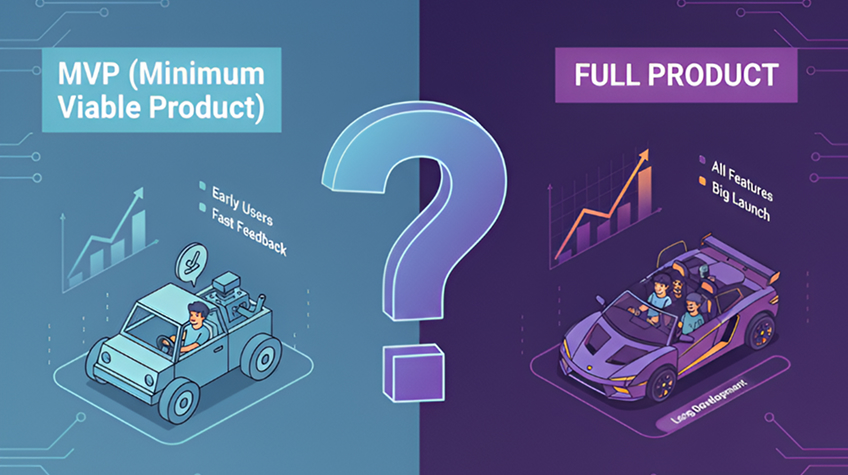
Launching a new software product whether it is a web app, mobile app or SaaS often comes with a difficult question: Should you start lean and build a Minimum Viable Product (MVP) or go all-in and build a full-featured product from the get-go? At WeeTech Solutions, we believe this decision is foundational: the right strategy depends heavily on your business goals, your risk tolerance, your resources, market dynamics and what you know about your users.
In this article, we will break down what MVP is, what a full product means and how to evaluate which path to choose for your context.
Table of Contents
What is an MVP and Why It Matters
The concept of a Minimum Viable Product (MVP) refers to a product built with just enough core features to satisfy early users and validate key assumptions.
➢ Key characteristics of an MVP
- It focuses on the minimum set of features required to solve the core problem your product addresses andnothing extra.
- It is viable which means it is usable, stable and capable of delivering real value to early adopters. It is not a prototype or concept; it is a working product.
- It is launched early by enabling you to get to market quickly and start learning from real users and iterate based on real feedback.
➢ Why build an MVP first?
- Lower cost and faster time-to-market: Since you are only building essential features, an MVP typically costs less and takes less time to develop than a full product.
- Validate your idea early: Instead of betting on assumptions you can test your core idea with real users to check product–market fit before committing major resources.
- User-driven roadmap: Feedback from early users helps you prioritize what features matter most, avoid building unnecessary ones and iterate intelligently.
- Reduced risk: Because the initial investment is smaller, the downside is limited if the idea fail and losses are contained.
- Flexibility and agility: An MVP supports incremental agile development you can adapt, pivot or evolve based on real-world feedback.
That said an MVP is not a half-baked product. It still needs to be functional, stable and deliver real value. Launching a poorly built MVP one that is buggy or lacks core utility can damage brand reputation or lead to false feedback.
What is a Full Product and When It Makes Sense
A full product (also described as a fully-featured product or full-scale product) is a more mature, comprehensive version that includes not just core features but many of the additional capabilities, integrations, polish, scalability, UX optimizations, basically everything you envision as the “complete” version.
➢ What distinguishes a full product
- A broader feature set: beyond the “must-haves,” it may include advanced features, integrations, automation, UI/UX polish and scalability considerations.
- More time and resources invested: building a full product usually takes longer, costs more and involves more development cycles, testing and quality assurance.
- Ideal for when requirements are clear, market expectations are high or when the product must meet a broad set of user needs. For example, enterprise apps, regulated domains or markets where users expect completeness from day one.
➢ When full-product development is worthwhile
- When the product is in a mature market with proven user needs and clear requirements.
- When the application demands complex functionality from the start , e.g. enterprise software, critical workflows, compliance-heavy solutions or integrated ecosystems.
- When the business has sufficient funding, time and resources and is willing to invest upfront for a polished, market-ready solution rather than risk a prolonged iteration cycle. When early impressions matter , e.g. in competitive markets, against established products where users expect high polish and feature-completeness from day one.
How to Decide: Key Questions to Ask Before You Choose
There is no one-size-fits-all answer. The decision depends on many variables. Here are some guiding questions you can use (or that we at WeeTech often use with clients) when evaluating whether to build an MVP or go full product first:
| Question | What to reflect on |
| How clear and validated is your idea? | If your concept is new or untested, an MVP helps validate assumptions before heavy investment. |
| How confident are you about user needs and priorities? | If you are uncertain what users want, MVP + feedback loop is safer. |
| What is your budget and time-to-market requirement? | Tight budget or need for fast launch → MVP. If you have resources and time, a full product may be viable. |
| What is the complexity and required feature-set of the product? | Simple, core functionality → MVP. Complex, integrated, enterprise-level → consider full product. |
| How competitive is your market / how high are user expectations? | High-competition and polished-expectation markets may demand full products. |
| What is your risk tolerance? | Low risk tolerance: MVP. High risk tolerance (with potential high reward): full product. |
| Is early feedback valuable for your product direction? | If yes MVP. If no (e.g. due to strict regulation or fixed requirements) full product. |
When you analyze honestly, you will often find one approach clearly aligns more with your business context than the other.
Common Pitfalls & What to Watch Out For
Both approaches come with risks. Here is what to watch out for depending on which route you take:
➢ Risks with MVP-first approach
- Underestimating what “minimum” really means : An MVP should not feel like a prototype with poor UX or bugs. It still needs to deliver real value and be usable.
- Misinterpreting early feedback: Feedback from early adopters might not reflect the broader market. Relying too heavily on limited or biased feedback can mislead development.
- Delayed feature creep / scope expansion: Continuous iterations can stretch timelines and budgets if scope is not managed. MVPs are meant to validate core value, not to become a chaotic checklist of features.
➢ Risks with building full product up front
- High upfront cost and resource commitment: you may invest heavily in features users do not need or build complexity before confirming demand. This increases risk.
- Longer time before market entry: in fast-moving markets, delayed launch can mean losing first-mover advantage or letting competitors claim territory.
- Difficulty pivoting or changing direction: once significant resources are committed, shifting strategy or architecture becomes harder.
Also Read: How Much Does It Cost to Build an MVP in Software?
How WeeTech Approaches the Decision: A Balanced, Context-Driven Strategy
At WeeTech Solutions, we do not believe in one-size-fits-all product strategies. Instead, we evaluate each project based on its unique context: business goals, market, user needs, funding, timeline and risk appetite. Here is our recommended approach for clients:
- Start with discovery & hypothesis validation before writing any significant code, we help you define the core problem you are solving, key assumptions about users and what minimal features are essential.
- If the idea is untested / high uncertainty, build an MVP first, get to market quickly, test assumptions, gather real user feedback and use data to drive next steps.
- If requirements are clear, the market is mature and product demands complexity, consider full product development especially for enterprise-grade solutions or when users expect completeness.
- Plan for scalability early even if you build an MVP, design architecture and codebase in a way that allows easy iteration, scaling and addition of features later without major refactoring.
- Adopt incremental, agile development whether MVP-first or full product, incremental delivery, constant testing and user feedback should guide product evolution.
- Ensure clear communication and realistic expectations align stakeholders early on regarding what the first version will be (MVP or full), what will come later and what metrics or feedback will guide further investment.
For many startups or early-stage products, the MVP-first route balances risk, cost, learning and speed. For others especially in regulated or mature markets full product build may be justified.
Conclusion: There is No “One Right Way” Only the Right Way for You
MVPs and full products are not rival philosophies; they are tools in a toolbox. The right choice depends on where you are in your product journey, what you know about your audience, your resources and what you aim to achieve with your first release.
- Choose an MVP when you need to validate assumptions, minimize risk, save costs and iterate based on real user feedback.
- Choose a full product when you have clear requirements, user expectations demand completeness and you have the resources to invest upfront.
At WeeTech Solutions, we guide you through this decision helping you evaluate your circumstances, weigh trade-offs and select the approach that aligns with your business goals. Whether you begin with a lean MVP or a fully-featured launch the key is to stay user-focused, data-driven, flexible and always ready to learn.