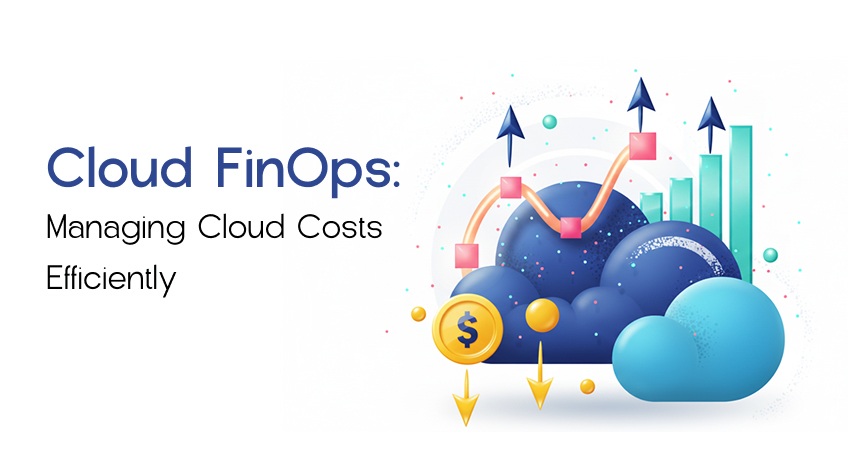
Come 2026, Cloud FinOps is moving beyond cost tracking into real time decision making. We learn how mature organisations align finance and automation to control cloud spend, manage AI-era workloads, and turn variable costs into a strategic advantage.
Cloud cost overruns are no longer a surprise for anyone in the tech world. By 2026, most enterprises have come to accept the fact that cloud waste is a real thing and it does not come from reckless spending but from structural blind spots baked into how teams build, deploy, and scale software. The cloud is there to still deliver the speed and reach, but it punishes indiscipline quietly and continuously.
FinOps has come a long way in all these years. Growing beyond traditional dashboards and budget alerts, it now works as an operating system for cloud decision making. It now connects engineering intent with financial consequence in near real time. Organisations that still treat it as a side function will struggle and those that embed it into their daily workflow will regain control.
Why Cloud Costs Still Spiral in Mature Organisations
Cloud platforms never stop billing and this very simple truth is what collides with our basic human habits. Teams provision resources for peak demand and forget to unwind them. Storage tiers accumulate data no one queries. Data transfer charges sneak in through architectural shortcuts. Note that this is not a reflection of incompetence. It is just velocity without feedback.
Variable pricing models of your cloud provider amplify this problem. Every architectural decision carries a financial implication, but that will often show up weeks later in an invoice that everyone forgets about. By the time finance teams see this, the damage is too great. FinOps corrects this by making the cost a first-class signal.
FinOps in 2026: More Than Just Cloud Accounting
Image Source freepik
Modern FinOps works more like a cross functional discipline by aligning finance, engineering, and business leaders around a shared language of value. And going forward in the next few years, that language extends well beyond virtual machines and storage buckets.
Organisations now apply FinOps principles acrossSaaS platforms, AI workloads, data infrastructure and even their internal platforms. Beside traditional metrics, GPU consumption, model inference frequency, anddata pipeline efficiency are now all considered into cost optimisation.
FinOps teams also evaluate maturity by capability. Some organisations excel at cost visibility but struggle with automation. Others enforce governance well but lack developer trust. Thanks to this granular view with Cloud FinOps, teams can now aim for targeted improvement instead of performative maturity models.
The Three Motions That Define Effective FinOps
In order for FinOps to be really successful, teams need to treat it as a continuous loop and not a series of to-do lists. Here are the key aspects of FinOps to keep in mind.
Visibility: Visibility comes first because it is impossible to manage something that you cannot see. Mature organisations track cost at the same resolution as usage. They connect spend to customers, features, and transactions. They surface this data while decisions still remain reversible.
Action: Action follows insight. Optimisation now focuses less on one-time cleanups and more on systematic waste prevention. Rightsizing remains important, but automation now handles most of the repetitive work. Engineers focus on architectural choices that shape long-term cost curves rather than chasing small savings.
Accountability: Accountability sustains progress. Teams that understand their cost footprint are able to make sharper tradeoffs. Scaling strategies are chosen deliberately and cloud spend is treated as a design constraint.
Cost Optimisation Without Performance Compromise
There is a myth that cost control slows down teams. However, evidence continues to erode it. Most waste hides in idle capacity and misaligned sizing. Not in performance-critical paths. With continuous rightsizing you get consistent compounding returns allowing your team to review utilisation patterns regularly. Commitment-based discounts reward predictable workloads without locking teams into brittle assumptions. Autoscaling reduces the tax of peak provisioning while preserving responsiveness.
Non-production environments represent another silent drain. Automated schedules that align resource availability with working hours cut significant spend without touching production reliability. These controls are going to work best when teams agree on default behaviour rather than negotiate exceptions case by case.
Containerised environments deserve special attention. Kubernetes clusters often come masked with inefficiencies behind its abstraction layers. Accurate resource requests, intelligent autoscaling, and disciplined node management reclaim capacity that teams already pay for but rarely use.
Governance that Engineers Actually Accept
Governance will naturally fail if it feels external. In 2026, effective FinOps governance embeds directly into your delivery workflows. Engineers encounter cost feedback during design and deployment, not after incidents. Policy-as-code plays a central role here. Automated rules enforce tagging, lifecycle policies, and retention standards without human policing. These controls prevent expensive mistakes quietly, allowing teams to move fast within safe boundaries.
Alerting has also evolved. Instead of noisy budget warnings, anomaly detection highlights meaningful deviations early so teams can respond to signals rather than alarms. This massive shift builds trust.
Automation as the Backbone of Modern FinOps
Image Source freepik
Manual FinOps is not built for scale. Cloud environments change too quickly, and audits age before completion. Third party platforms bridge gaps but introduce complexity of their own. Successful organisations define their FinOps data model first. They standardise cost and usage formats before selecting tooling. This is a great approach as it prevents lock-in and simplifies integration. Tools that serve strategy.
Developers increasingly expect cost visibility alongside performance metrics. Platforms that unify these views reduce friction and improve decision quality. Cost becomes just another dimension of system health.
Cultural Resistance and How Teams Overcome it
FinOps challenges often come from culture rather than tooling. Engineers resist when cost discussions feel punitive or detached from technical reality. Finance teams struggle when data lacks operational context.
Leaders and managers address this by reframing FinOps as enablement. When teams understand the economics of their systems, they gain leverage. They justify architectural investments and defend scalability decisions with data.
Education matters too. Few professionals start with fluency in both cloud architecture and financial modeling. So training programs help close this gap in knowledge over time. The strongest FinOps teams operate as translators rather than being enforcers.
FinOps Meets AI, Sustainability, and Platform Engineering
Image Source freepik
The rise of AI workloads helps reshape cloud economics dramatically. GPU use, the choice of model, and inference frequency introduce cost dynamics that traditional tooling never anticipated. FinOps teams now can guide decisions about training cadence, provider selection, anddeployment architecture.
Sustainability also enters the equation here. Carbon-aware organisations align environmental goals with their financial ones. Teams increasingly evaluate efficiency through both lenses, especially as reporting requirements become tighter.
Platform engineering absorbs many FinOps capabilities as well. Internal developer platforms surface cost signals natively which allows engineers to reason about impact that too without context switching. This convergence reduces friction and increases adoption.
Turning Cloud Spend Into a Strategic Signal
By 2026, organisations will have to make sure that they spend deliberately. Spending less is not going to bring you the wins that you wanted. FinOps provides the structure to do that exactly. Mature teams treat cloud costs as feedback and learn from it. And so they are able to adapt their systems accordingly. Note that Cloud FinOps does not eliminate complexity. It makes complexity legible. That difference separates organisations that merely survive cloud scale from those that control it.
The cloud remains one of the most powerful tools modern businesses have and FinOps ensures it works with intent and not inertia.