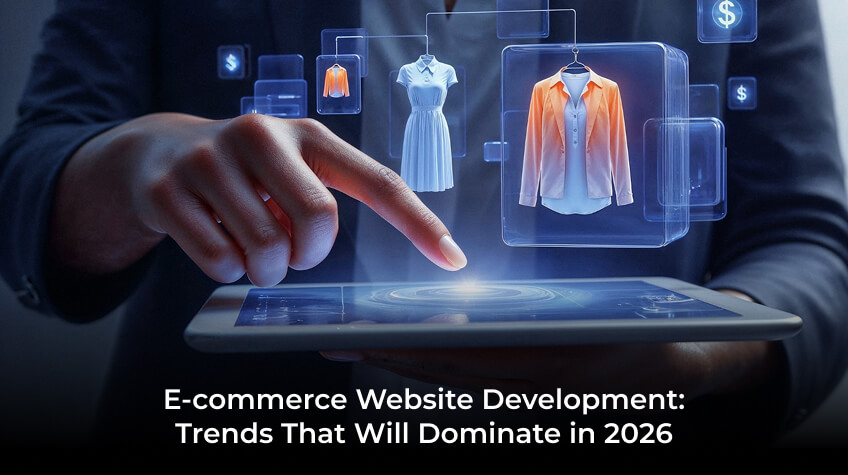
E-commerce sites have evolved dramatically from being just an online storefront to well-organized marketplaces. As of 2025, 33% of the world’s population (which is approximately 2.77 billion people) buy from e-commerce sites. And this figure is expected to grow in the future for sure.
AI-driven experience that blends immersive visuals, frictionless payments and predictive logistics all at once add to the customer experience. 2026 will mark a defining shift in e-commerce website development, where only brands that deliver truly productized, experience-driven journeys will stay ahead of the competition. If you are wondering which e-commerce website development trends will dominate the industry in 2026, then read this post. Here we have outlined the top 12 trends web teams and ecommerce business owners should be aware of to make a lasting impact. So, without further ado, let’s get started…
Before we delve into the trends, let’s first understand the fundamentals of e-commerce website development. Here we go…
What Exactly Is eCommerce Website Development?
eCommerce website development is the process of designing, building, optimizing and maintaining an online store. A well-orchestrated eCommerce site enables businesses to sell their products or services online easily to the users across the world. eCommerce website development includes creating user-friendly layouts where features like product catalogs, shopping carts, secure payment gateways, order tracking, inventory management and performance optimizations are integrated to ensure smooth operations.
Most brands today opt for customizedeCommerce website development as it ensures smooth buying and selling experience. Custom eCommerce website development gives businesses the flexibility to design every component, from user interface to payment systems to fit unique business goals. Also, customized sites are created to offer outstanding speed, mobile responsiveness, security and exceptional customer experience that drive conversions and long-term business growth.
Key Elements of eCommerce Website Development
Personalized User Experience: Modern businesses are more focused on delivering personalized user experience via their eCommerce sites. And this can only be possible when the design and functionalities are aligned with customer behaviour.
Custom Integrations: Custom integration is yet another key component for successful eCommerce website development. It ensures seamless integration with CRMs, ERPs, payment gateways, logistics systems and other platforms.
Scalable Architecture: The architecture today needs to be scalable so as to easily accommodate growth in future.
Data Protection & Security: Since customers useonline payment gateways to buy the product, ensuring their data protection is highly important.
Ownership and Control: Businesses now prefer having control over the overall infrastructure to have full authority over their brand, data, revenue and long-term growth strategy.
The Future of eCommerce Website Development
The future of eCommerce website development seems to be evolving faster than ever before. Intelligent automation, immersive AR/VR, data-driven AI and voice commerce are some of the major trends that will dominate 2026 and beyond. Brands that will adopt and implement these trends will scale faster, operate leaner and build strong connections with their customers. Read the next section for the topmost eCommerce website development trends going to dominate 2026 and beyond…
Top 12 E-Commerce Website Development Trends Dominating the Future
Here are the top most trends going to define the future of eCommerce website development in 2026. Take a look…
1. AI Shopping Agents
Agentic & Conversational Commerce is going to dominate the eCommerce landscape in the future. Shopping assistants or shopping agents, such asAI chatbots, voice agents will be researching products and comparing prices for customers so that they can make better, mindful decisions. In addition, these agents will also remember preferences for future reference. By enabling AI agents to seamlessly access inventory and complete transactions through structured APIs, retailers can tap into entirely new layers of customer demand in 2026.
2. AI-First Personalization & Search
In 2026, more and more brands will integrate modern AI for personalized search and suggestions. Instead of relying only on past shopping behavior, modern AI will show smarter product suggestions, create personalized landing pages and rank products based on what each user is actually looking for when shopping. This will entirely redefine generic merchandising and transform eCommerce sites into well-orchestrated platforms. In a way, in 2026, AI will do much more than suggest products. It will also help create website content, change images and build smart product bundles to increase sales and ROI.
3. Immersive Visual Commerce: AR / VR / Virtual Try-On
Image Source freepik
There was a time when people only hoped for a virtual try-on, but in 2026 it is going to become a reality. Now more and more eCommerce brands are focusing on immersive visual commerce. Integration of in-browser AR, virtual fitting rooms and 3D product models will allow customers “touch” products visually before they actually buy it. This is going to dominate eCommerce website development as integrating AR/VR/Visual Try-Ons will significantly reduce returns, particularly for fashion, cosmetics, clothing and eyewear brands. Top brands have already started integrating virtual try-on tools to help customers see how products will look or fit, leading to confident purchases and fewer returns.
4. Mobile-First & Progressive Web Apps (PWA)
Studies reveal that 30% of global customers shop via mobile. Another study shows that Mobile devices generate about 66% of all global e-commerce orders and account for approximately 80% of retail traffic. This implies that having a progressive web app or app-like web experiences are going to be the trend in 2026 to make search easier and handier than ever. More and more brands are now offering app-like websites that users can add to their home screens, work offline and that feel as fast and smooth as native apps. This eliminates the need to download anything from an app store.
5. Headless + Composable Architecture
Headless + Composable Architecture, also known as MACH, stands for Microservices, API-first, Cloud-native and Headless architecture. It involves building systems with independent, cloud-based components that communicate through APIs and provide much-needed flexibility and scalability. Separating the front end from the eCommerce back end lets teams create customized user experiences while enabling the best services for payments, inventory and search. This trend is going to dominate in 2026 as it will allow brands to deliver differentiated experiences across channels. More and more brands are now integrating composable storefront to enhance their operations and improve customer experience.
6. Zero-Click Commerce
Zero-Click Commerce is yet another eCommerce Website Development trend that is going to make waves in 2026. This approach is designed specifically to make online shopping as effortless and seamless as possible. This approach significantly minimizes the steps between product search and checkout. Instead of navigating through multiple pages or manually entering payment details, zero-click commerce completes transactions automatically, allowing customers to save a lot of time and effort.
This basically leverages tools like AI shopping assistants, voice commands, one-click payments and pre-saved customer preferences. The main objective is to reduce friction, save time and create a seamless shopping experience so that customers can instantly buy what they wish to purchase. Businesses can utilize this approach to increase conversion rates, boost customer satisfaction and strengthen rapport with customers.
7. Social & Live Commerce Integration
This includes buying directly through social platforms. In this approach, brands include shoppable posts on their social media handles where hosts demo products in real time. This is going to dominate the eCommerce landscape as it shortens the path from discovery to purchase. Experts even suggest that social commerce will make up a significant part of global online sales by 2026 and beyond. Brands that link their products and checkout directly to social media can make the most of this growing trend.
8. Payment Flexibility
Image Source freepik
Integrating frictionless and diverse payment systems is again going to be a main trend in 2026. Many brands have already started introducing multiple, localized payment methods, which include UPI, cryptocurrency, one-click wallets, tokenized cards, Buy Now Pay Later (BNPL) and so on. Experts suggest that integrating multiple payment methods will not only reduce cart abandonment, but will also help businesses increase their sales and build rapport with their customers.
9. Sustainability & Ethical UX
With more people choosing a sustainable lifestyle, eCommerce brands are becoming more eco-conscious and focused on implementing environmentally friendly business practices. Carbon labels, repairable products, low-impact shipping and clear sourcing information are some of the practices that businesses are sure to be opting for in 2026. Implementing this approach can help eCommerce platforms build trust, impact purchase intent and gain lifetime loyalty.
10. Privacy-First Data Design & Local Compliance
Designing sites that ensure privacy is again going to dominate eCommerce website development. Using first-party data, minimizing tracking, being transparent and personalizing without cookies is going to define the eCommerce landscape in the future. Sticking to local compliance and regulations like GDPR, CCPA and so on, brands can ensure customer trust. Being transparent about how data is used will not only help build confidence but will also help improve conversions and customer loyalty in the long run.
11. Agentic Payment Protocols
Agentic Payment Protocols is yet another trend that will dominate eCommerce website development in 2026 and beyond. This approach leverages AI-powered shopping agents or virtual assistants to make purchases on behalf of customers automatically and securely. With this on site, users will not be required to enter their payment details each time to make a purchase; instead, these protocols enable trusted agents to access pre-authorized payment methods, complete transactions and manage order fulfilment. This not only speeds up the buying process but also creates a seamless shopping experience for customers. Brands supporting agentic payment protocols can increase conversion rates, reduce cart abandonment and cater to the growing trend of AI-assisted commerce.
12. Logistics & Reverse-Logistics UX
Last but not least is logistics and reverse-logistics UX to make shipping transparent, returns easy and seamless and micro-fulfillments faster and easier. Integrating logistics and reverse-logistics UX can help brands have seamless business operations and deliver products in a speedy manner. Modern customers expect speed and convenience, whether it is about delivery of the product or returning a product. Customers want speedy deliveries and painless returns. Integrating logistics and reverse-logistics UX will make it all as seamless as possible for brands, resulting in higher sales and stronger loyalty.
The Bottom Line
So, these are the top 12 eCommerce Website Development trends that are going to dominate the eCommerce landscape in 2026 and beyond. Customizing your website with these capabilities will allow you to stand out amidst your rivals and build stronger rapport with your customers. Of course, all these trends are going to take your online business to a next new level altogether.
However, the success of your site boils down to selecting a reputable and highly experienced eCommerce website development company. Yes, only a team of experts, experienced in modern eCommerce protocols and trends would be able to help you build a site that stands out. WeeTech Solutions Pvt. Ltd., is a trustworthy eCommerce Website Development company with highly experienced professionals in customized online stores. We can help you with a customized and highly scalable online store that delivers long-term ROI and success! Feel free to contact us for more details!